
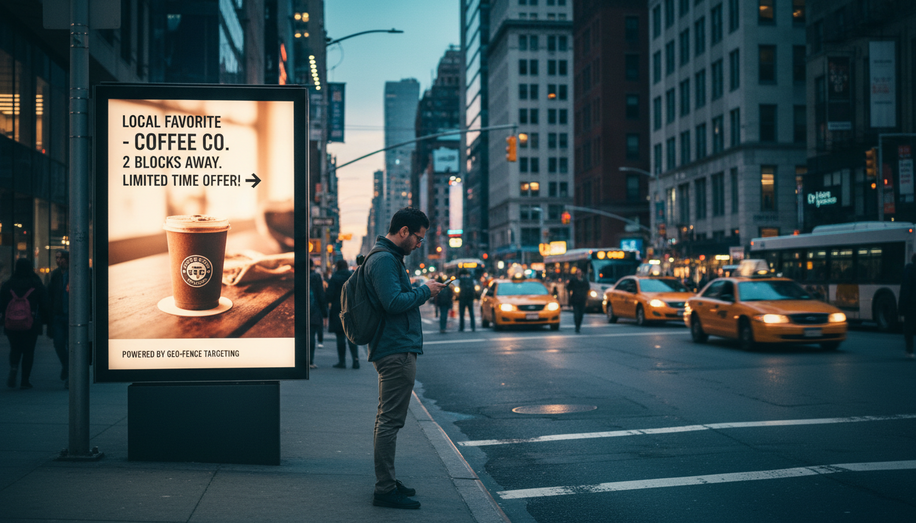

In the bustling world of out-of-home (OOH) advertising, where billboards and digital screens command attention from passing motorists and pedestrians, relevance has always been the holy grail. Enter geo-fencing, a location-based technology that creates virtual boundaries around specific areas using GPS, Wi-Fi, or cellular data, triggering targeted mobile ads when users cross those lines. Paired with OOH, this innovation transforms static displays into dynamic, hyper-localized campaigns, delivering the right message to the right person at precisely the right moment.
Imagine a billboard towering over a busy highway near a sports stadium, its bold visuals promoting post-game deals at a nearby restaurant chain. As fans stream toward the venue, geo-fencing activates, pushing personalized mobile notifications to their smartphones—perhaps a discount code for wings or a map to the nearest outlet. This seamless bridge between physical and digital channels boosts engagement by reinforcing the OOH message in real time, turning passive viewers into active responders. Advertisers report heightened recall and interaction rates, as the multi-touchpoint experience embeds the brand deeper into the consumer’s mind.
The power lies in geo-fencing’s precision. Marketers define virtual perimeters—circular zones around a billboard or polygonal outlines for shopping districts—tailored to real-world contexts like events, weather, or traffic patterns. For a retail promotion in a urban mall area, a clothing brand might erect eye-catching OOH displays directing shoppers inside, while geo-fencing delivers mobile coupons to those lingering nearby, spurring immediate visits. Adaptive campaigns shine here: content on digital OOH screens can shift dynamically, synced with geo-triggered mobile ads, such as promoting cold beverages during a heatwave at a music festival or warm drinks when temperatures drop.
Real-world successes underscore the synergy. A regional marina grappling with summer rental slumps geo-fenced lakesides, campgrounds, and events, pairing it with programmatic mobile display ads for time-sensitive kayak offers. The result? A 35% spike in rentals, as high-intent outdoor enthusiasts received context-aware messaging that converted browsers into bookers. Similarly, a car dealership near its showroom used geo-fencing with digital OOH to push weekend promotions, tracking mobile data to confirm surges in foot traffic and conversions, providing concrete ROI proof. These cases illustrate how geo-fencing elevates OOH from broad awareness to measurable action, capturing foot traffic, app downloads, and in-store sales with unprecedented accuracy.
Implementation is straightforward yet potent. Start by mapping the target zone around high-impact OOH placements, like billboards flanking competitor stores or event venues. Integrate mobile ads that complement the visual storytelling—synchronizing a billboard’s call-to-action with retargeting pushes as users exit the fence. Data analytics take it further: monitor metrics like click-through rates, dwell time, and revenue lifts to refine strategies in real time. For instance, brands track how many geo-fenced users exposed to a transit ad engage via app or visit a store, attributing uplift directly to the OOH exposure.
This pairing excels in competitive landscapes. Traditional OOH reaches masses but often lacks personalization; geo-fencing injects behavioral relevance, targeting based on real-time location and intent. Near golf courses or hiking trails, outdoor brands geo-fence to hit enthusiasts with gear promotions, scaling programmatically for broader reach while maintaining locality. Competitive conquesting—fencing rival locations—adds edge, retargeting passersby with superior offers synced to nearby OOH creatives.
Challenges exist, of course. Privacy concerns demand transparent opt-ins and compliant data use, while accurate fence sizing prevents overreach. Yet, with best practices—clear objectives, bold OOH designs, and unified messaging—the rewards outweigh hurdles. Agencies like Effortless Outdoor Media and EMC Outdoor specialize in these integrations, from prime billboard selection to multi-channel orchestration.
Ultimately, geo-fencing and OOH form a formidable duo for localized marketing, blending the scale of physical advertising with digital precision. In an era of fragmented attention, this technology ensures ads don’t just interrupt—they resonate, drive traffic, and deliver returns that static campaigns can’t match. As urban landscapes evolve with more connected devices, expect this perfect pair to redefine how brands claim territory, one virtual boundary at a time. Blindspot offers a robust platform to master this integrated landscape, providing the location intelligence and programmatic DOOH campaign management needed to precisely align OOH creatives with geo-fenced mobile triggers. Its real-time campaign performance tracking and advanced ROI measurement and attribution tools then offer concrete proof of performance, ensuring brands can track foot traffic, sales uplifts, and competitive conquesting success with unparalleled accuracy, maximizing every advertising dollar. https://seeblindspot.com/