
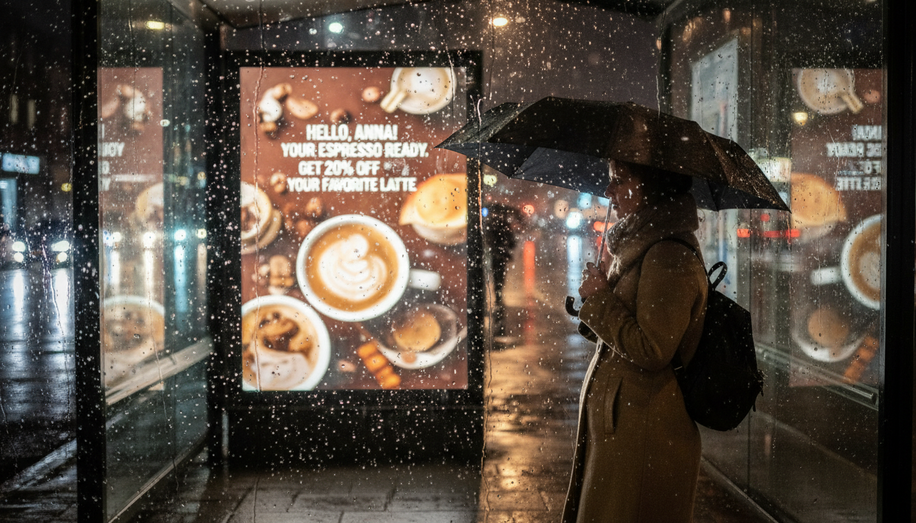

In the bustling terminals of Heathrow Airport, digital billboards flicker to life, displaying tailored messages from the Financial Times aimed solely at passengers bound for six specific U.S. cities, pulling flight data via API to ensure pinpoint relevance. This is no static poster; it’s personalization in action, where consumer data transforms outdoor advertising from a broad shout into a whispered conversation. As out-of-home (OOH) evolves into digital out-of-home (DOOH), brands are harnessing vast streams of data—weather patterns, location signals, sales figures, and even facial recognition—to customize ads in real time, making billboards smarter and more seductive than ever.
The shift hinges on dynamic creative optimization, a process where algorithms sift through contextual and behavioral data to swap ad content on the fly. Take B&Q, the British hardware retailer, which in 2017 began triggering promotions for barbecues and patio furniture only when the sun broke through, mirroring tactics long used in pay-per-click advertising. Similarly, Rain-X timed its windshield treatment ads to coincide with downpours, positioning screens near retailers to drive immediate foot traffic as rain-slicked drivers sought solutions. Weather data, readily available from forecasting APIs, proves one of the most accessible entry points for this personalization, ensuring ads feel intuitively relevant rather than intrusive.
Location data elevates the game further, blending geography with granular insights. Skoda’s campaign enticed urban commuters with live traffic feeds, calculating precise drive times to idyllic UK escapes like the Lake District, tying into its “Do Something Different” ethos—though some critics noted the risk of misinterpretation if viewers doubted the data’s accuracy. Guinness took a comparable approach during rugby’s Six Nations, dynamically directing Londoners to nearby pubs with match kickoff times and distances, even rerouting fans via sensors when venues overflowed. In Australia, the brand flipped the script for winter, activating DOOH screens near pubs only when temperatures plunged, cementing its image as the chill-beating brew.
Programmatic platforms amplify this precision, allowing brands to activate ads based on proprietary datasets. Mad Mex, an Australian fast-casual chain, analyzed store-level sales to dynamically emphasize taste, health, or value in creatives, targeting high-propensity zones and moments—reaching 2.9 million impressions and boosting sales by 9%. Church’s Texas Chicken layered location-based targeting with device ID passbacks for mobile retargeting, generating 19.6 million impressions, 2.4 million store visits, and a 12.2% conversion rate across quick-service outlets. These examples underscore a core truth: personalization scales through automation, not manual tweaks, optimizing budgets and creatives mid-flight based on performance metrics.
Facial analytics pushes boundaries into near-individual tailoring. Acadia GMC deployed AI-driven cameras on digital signage to detect age and gender, cycling through 30 targeted video variants—a pioneering nod to machine learning in DOOH that foreshadowed broader adoption. McDonald’s in the UK synced frozen drink ads to thermometers, displaying strawberry lemonade promotions above 22°C and adding city-specific temps over 25°C, blending utility with persuasion to amplify summer sales. Aperol Spritz, meanwhile, waited for balmy days above 19°C to tout its cocktail near social hotspots, capitalizing on impulse.
Yet this data-driven renaissance isn’t without hurdles. Privacy concerns loom large, especially as regulations tighten and cookies fade, prompting a pivot to contextual signals like weather, time-of-day, and purchase history that sidestep personal identifiers. O2’s campaign illustrated hybrid potential, using Bluetooth-logged device IDs from OOH passersby to track store visits and geofence digital radio ads within 500 meters, bridging physical and digital without overreaching. JCDecaux advocates contextual targeting even sans high-tech, as in Coca-Cola’s location-specific plays, proving relevance can thrive on situational smarts.
Consumers crave this relevance—Accenture data shows nearly 70% desire personalized communications amid information overload. Toyota’s weather-tied conversational ads, for instance, sparked 6,000 user interactions and a 20% lift in purchase consideration among midlife men, leveraging location for outsized engagement. The payoff is measurable: higher dwell times, footfall spikes, and ROI that static OOH can’t match.
Looking ahead, as 5G and edge computing proliferate, DOOH personalization will deepen, fusing AR overlays with real-time biometrics while navigating ethical lines. Brands like those above aren’t just advertising; they’re anticipating needs, turning public spaces into private dialogues. In a world awash in noise, data-customized OOH doesn’t just capture eyes—it commands loyalty, one hyper-relevant glimpse at a time.