
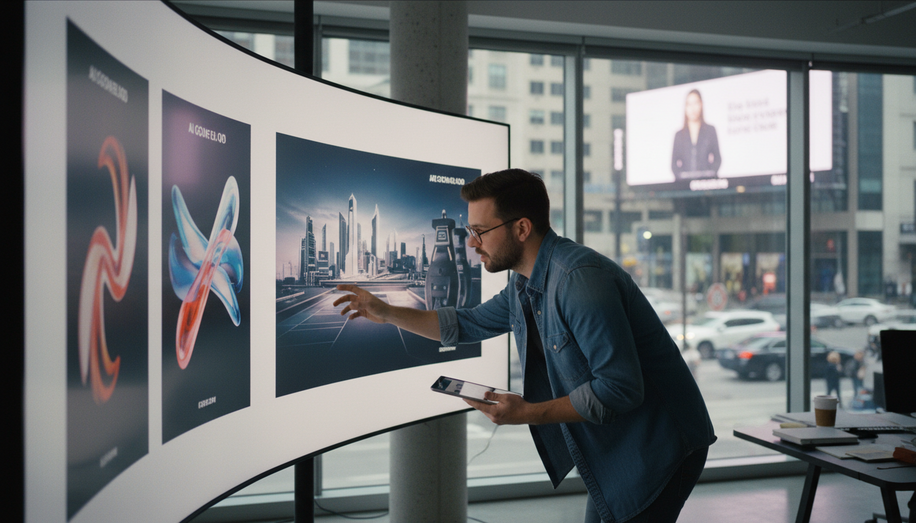

In the bustling streets of Mexico City and the crowded interchanges of Madrid, billboards are no longer static canvases but living, breathing mediums that respond to the world around them. Artificial intelligence is at the heart of this evolution, powering the design, layout, copy, and adaptation of out-of-home (OOH) advertising to create campaigns that feel eerily personal and precisely timed. What was once a labor-intensive process of sketching concepts, tweaking layouts for irregular screen sizes, and hoping for the best is now augmented by algorithms that generate visuals, suggest punchy headlines, and swap elements in real time based on weather, traffic, or local events.
Generative AI tools are leading the charge in creative production. Platforms like AdCreative.AI, deployed by providers such as Clece OOH in Spain, automatically produce ad variations tailored to the unique dimensions of large-format LED screens in high-traffic spots like Príncipe Pío or Plaza de Castilla. For a soda brand, this means AI can instantly conjure images of the product splashed across Madrid’s urban landmarks, preserving brand consistency while adapting to context—sunny plazas get chilled cans foregrounded against blue skies, while rainy avenues feature droplets on bottles. These tools don’t stop at visuals; they optimize copy and calls to action, generating concise, location-specific text that fits the fleeting glance of a commuter. In Mexico, BM Outdoor leverages similar technology to switch messaging dynamically along routes like Periférico during rush hour, morphing awareness ads into promotions when data predicts peak receptivity.
Dynamic creative optimization (DCO) takes this further, embedding AI directly into the ad’s behavior. Gone are the days of looping pre-rendered videos; now, machine learning mixes and matches headlines, images, colors, and CTAs on the fly. A fashion retailer might program rules where sunny weather triggers light blouses on digital screens, while rain summons raincoats—all without human intervention. Pondiot, a DOOH specialist, highlights how DCO analyzes performance metrics to refine content mid-campaign, ensuring only the highest-engagement elements rotate into view. This real-time adaptation boosts recall by up to 40%, according to the Out-of-Home Advertising Association of America’s 2025 DOOH Trends Report, turning billboards into proactive storytellers.
Programmatic DOOH amplifies these capabilities, automating not just buying and scheduling but the entire creative pipeline. AI sifts through mobility data, geolocation, weather feeds, and even satellite imagery to optimize placements and content. Billups, a U.S. firm with two decades of campaign data, layers this with advertiser inputs and street-view analysis to spot issues like obstructing tree branches, fixing them faster than manual checks. OneScreen draws from over 100 data sources for planning and execution, while Broadsign’s forthcoming AI assistant categorizes and approves vast creative volumes for programmatic supply-side platforms, keeping pace with demand. In Latin America, Mexico is emerging as a hub, with networks like BM Outdoor’s enabling nationwide campaigns that self-adjust via unified dashboards.
Real-world examples underscore AI’s creative prowess. PODS, a storage company, deployed a roving digital billboard on its trucks powered by Google’s Gemini AI. As the vehicle navigated neighborhoods, the ad tailored itself to local conditions—highlighting weather, traffic jams, or subway delays to drive a 60% spike in website visits. Pushing boundaries further, Finland’s Hau-Hau Champion dog food brand created an AI-driven billboard disguised as a cartoon doghouse. Video recognition software detects approaching dogs, dispensing kibble to engage their senses of hearing, smell, and taste, guaranteeing “100% attention” from the target audience. These innovations blend whimsy with precision, proving AI can handle everything from pet food prototypes to enterprise-scale personalization.
Yet AI’s role extends beyond generation to prediction and measurement. Machine learning forecasts audience patterns, like rush-hour swells in Monterrey or event-driven crowds in Guadalajara, allowing preemptive creative tweaks. It links exposures to outcomes, tracking foot traffic and conversions through advanced analytics. Imaginuity combines this with location strategy for campaigns that “don’t just get seen—they drive results.” Tools for billboard design, as explored by Whistler Billboards, separate hype from reality, validating AI’s utility in layout and suggestion while cautioning against overreliance.
Challenges remain, including data privacy and the need for human oversight to infuse genuine creativity. Still, AI democratizes OOH, letting smaller brands compete by slashing production times and costs. As programmatic ecosystems mature, expect more predictive trend analysis, where AI anticipates shifts in consumer behavior for proactive planning. In 2026, OOH is no longer about shouting into the void—it’s a dialogue orchestrated by intelligent machines, designing ads that meet audiences exactly where they are, visually and emotionally. The next generation of outdoor advertising isn’t just smarter; it’s alive.