
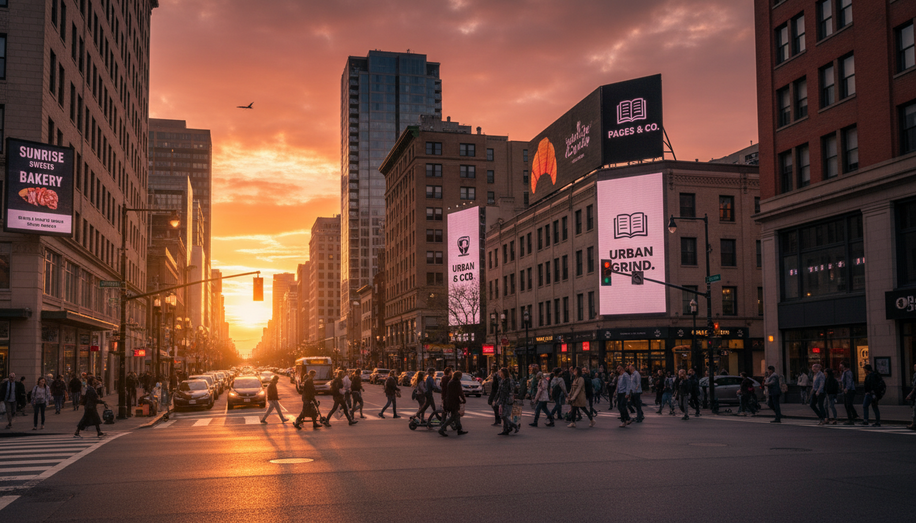

In the bustling heart of small-town America, where highways hum with local traffic and neighborhoods pulse with everyday life, out-of-home (OOH) advertising is quietly revolutionizing how small and medium-sized enterprises (SMEs) connect with their communities. Far from the multimillion-dollar spectacles of national brands, these local legends—seafood markets, breakfast cafes, heating companies—are harnessing billboards, directional signs, and creative displays to drive real results without breaking the bank. For SMEs, OOH offers an affordable path to visibility, turning passing drivers into loyal customers and building enduring brand presence.
Planning a cost-effective OOH campaign starts with clarity on your goals and audience. Identify the local pain points: a seafood market like Krab Kettle in Florence, Oregon, faced invisibility along a busy highway despite its prime spot near tourist dunes. The owner pinpointed two needs—differentiating from nearby restaurants and grabbing travelers’ eyes—and opted for a single bold billboard featuring a giant crab extension in high-contrast colors, paired with simple copy: “fresh seafood market.” No prior OOH experience was needed; the key was matching the medium to high-traffic locales where tourists and locals converge. Similarly, Egg River Cafe in Hood River targeted breakfast crowds with directional billboards at key entry points, one from Portland, guiding visitors uphill to its downtown overlook. These examples show SMEs succeeding by focusing on proximity: place ads where your customers already drive, like main roads or commuter routes, rather than broad-market TV that wastes reach on distant audiences.
Execution demands creativity on a budget. Mahalo Heating and Air Conditioning in Roseburg, Oregon—a town of just 30,000—switched from ineffective TV spots, which spilled over to the larger Eugene market an hour away, to a saturation of 15 annual billboards blanketing the area. Every few blocks, drivers saw their compelling offer: “0% financing for 72 months.” The result? Sales on that financing jumped from $469,000 in 2020 to $1.4 million in 2021, then 21% more to $1.7 million in 2022. Co-owner Erin Gogal noted seeing the ads seven times on a nine-minute drive, cementing the message. SMEs can replicate this without massive spends by negotiating shared or rotating billboard space, opting for static over digital when impressions matter more than motion, or partnering with local providers for custom extensions like Krab Kettle’s crab. For a roofing contractor, one billboard led to two closings that covered a full year’s cost, with the owner quipping, “The billboards are out there selling me so I don’t have to sell myself.” Directionality and repetition turn OOH into a local whisper that becomes a roar.
Measuring success elevates OOH from guesswork to proven strategy, especially for SMEs tracking every dollar. Tools like mobile attribution and impression data make it accessible: Krab Kettle reported a 75% spike in social media engagement right after launch, while a five-billboard campaign for Express captured 174,490 daily impressions at a CPM of just $1.12. Broader studies reinforce this—gas station visits rose post-billboard exposure via aggregated mobile data, and a denim brand saw 80% lift in store traffic from place-based kiosks. For Mahalo, raw sales growth spoke volumes, but SMEs can layer on free tactics: post billboard photos on social media, as Oregon’s Department of Fish and Wildlife did, netting 650 likes and 82,000 impressions in two days. Track foot traffic with geofencing apps or simple call-tracking codes on ads. Providers increasingly offer attribution studies linking exposure to visits, proving OOH’s role in everything from social buzz to direct sales.
What makes OOH empowering for SMEs is its scalability and community fit. Unlike digital ads drowned in noise, billboards command attention during commutes—74% of Mahalo’s budget now goes there, called their “wisest investment.” A flooring store in Ontario reversed customer bleed to Boise with local OOH, boosting foot traffic and pride in serving neighbors. Startups like Posh and Polished ditched flyers for OOH after early struggles, while salons relocating used it to reconnect patrons. Even non-profits, like museums drawing families with kid-art dinosaurs, show its versatility.
Challenges exist—weather, regulations, creative risks—but SMEs mitigate them by starting small: one billboard, tested for a month, scaled on proof. Consult local OOH firms for audience maps; they know where your HVAC customers drive or tourists detour. In 2026, with digital OOH adding real-time tweaks, affordability keeps dropping, CPMs rival radio, and measurability rivals online.
Local legends thrive when they claim the streets. For the small business owner plotting against invisibility, OOH isn’t just advertising—it’s a billboard-sized invitation to dominate your turf, one drive at a time. Sales soar, awareness sticks, and communities notice. The highway is yours; light it up.