
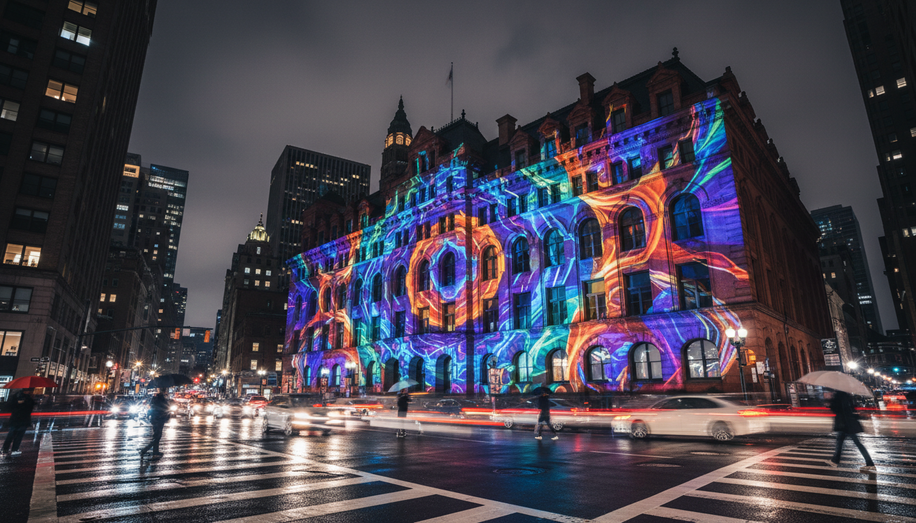

The out-of-home advertising industry is undergoing a quiet revolution. While digital screens dominate conversations about modern OOH, an equally compelling wave of innovation is reshaping how brands engage audiences through projection mapping, interactive installations, and advanced materials that push beyond traditional advertising formats.
Projection Mapping: The Art of Light and Architecture
Projection mapping has emerged as perhaps the most transformative non-digital OOH technology available today. Unlike static billboards or even video screens, projection mapping turns buildings, landmarks, and public spaces into dynamic canvases. The technology works by precisely calibrating multiple projectors to map digital content onto three-dimensional surfaces, transforming the architecture itself into part of the narrative.
The scale and impact of these installations cannot be overstated. When Target partnered with Chicago Projection Mapping for a Halloween activation at L.A. Live’s Nokia Plaza, 11 synchronized projectors brought “Skeletown Square” to life with character animation, choreographed lighting effects, and an original musical score. Similarly, the Van Gogh Immersive Experience demonstrated the potential for deeply engaging installations, with 53 Panasonic projectors transforming the Toronto Star building into a 11,000-square-foot gallery where visitors encountered Van Gogh paintings scaled to 26 feet high and up to 170 feet wide.
What makes projection mapping particularly compelling for advertisers is its flexibility and cost efficiency compared to traditional permanent installations. Projection advertising can be deployed at multiple sites in a single night, reaching different audiences while reducing campaign length and production costs. The technology thrives in high-traffic urban areas where movement and surprise—core elements of successful guerrilla marketing—capture audience attention in ways static advertisements cannot.
Interactive Physical Installations and Experiential Innovation
Beyond full-scale experiential events, brands are deploying interactive physical installations that engage audiences at street level. The Molson projection campaign exemplified this approach by inviting pedestrians to interact with projected dares, combining digital projection with physical participation and gamification. Similarly, ScotiaGallery connected Toronto’s citizens by projecting user-generated content, allowing Instagram posts with a specific hashtag to appear in live projections, blending digital engagement with physical display.
These installations succeed because they transcend the passive viewing experience. They create moments of genuine surprise and participation, qualities that traditional advertising struggles to achieve. The viral potential amplifies their reach, as participants become brand ambassadors sharing their experiences across social media platforms.
Materials and Structural Innovation
While the search results emphasize projection technologies, the broader landscape of non-digital OOH materials continues evolving. Smart paints and reactive surface materials represent the next frontier, though detailed commercial applications remain limited in current literature. The focus remains on how advanced projection capabilities—such as the 3D mapping and dual soft-edge projection techniques used in the Breuninger department store opening in Düsseldorf—are pushing what’s possible with existing architectural surfaces.
The sustainability angle is equally important. Many innovative installations repurpose existing structures rather than constructing new ones, reducing environmental impact. The transformation of industrial buildings into immersive experiences, as seen with the Van Gogh exhibition, demonstrates how non-digital innovations can give new purpose to aging infrastructure.
The Competitive Advantage
What distinguishes these technologies from traditional digital screens is their integration with environment and culture. Projection mapping on iconic structures like Prague’s Old Town Astronomical Clock or the Sydney Opera House sails doesn’t simply display an advertisement—it becomes a cultural moment, worthy of news coverage and social media discussion. This distinction matters tremendously in an increasingly crowded advertising landscape where attention is the scarcest resource.
As the experience economy continues reshaping consumer expectations, projection mapping and interactive installations represent a powerful middle ground: more dynamic than static materials, more culturally integrated than screens, and distinctly memorable. For OOH advertisers willing to embrace these technologies, the canvas for innovation extends far beyond anything digital displays alone can achieve.
For brands looking to fully capitalize on the competitive advantage offered by these immersive OOH innovations, quantifying their impact is essential. Platforms like Blindspot offer crucial **location intelligence and site selection** to strategically deploy campaigns in high-impact areas, alongside advanced **audience measurement and analytics** that track engagement and viral reach, providing the robust **ROI measurement and attribution** necessary to prove the value of these distinctly memorable experiences. https://seeblindspot.com/