
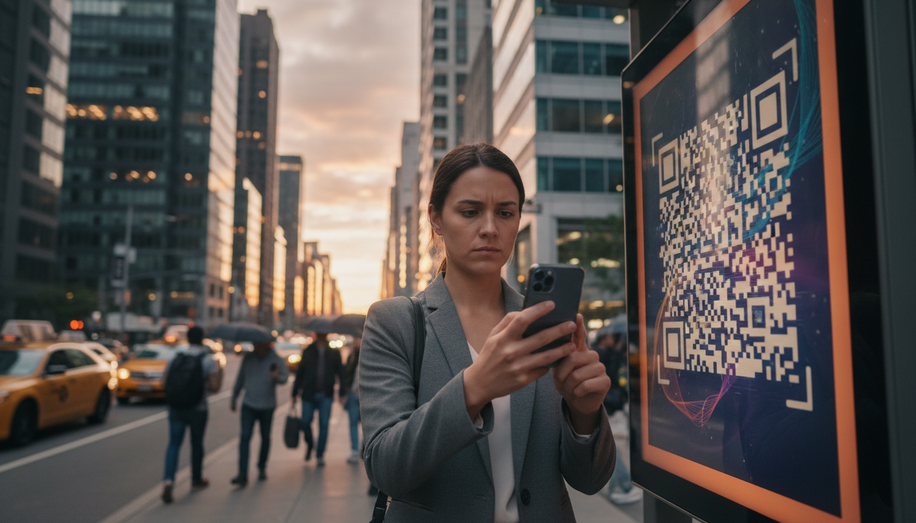

Out-of-home advertising has long been defined by static imagery and broad messaging reaching millions of passive viewers. Today, that model is fundamentally shifting toward interactive experiences that transform billboards from one-directional communication channels into two-way engagement platforms. The evolution reflects a critical industry realization: audiences increasingly crave relevant, engaging, and personalized experiences in public spaces rather than one-directional messaging. While augmented reality and virtual reality technologies capture headlines, practical interactive elements like QR codes, NFC tags, and gamification are emerging as the workhorses of modern OOH campaigns, delivering measurable engagement without requiring consumers to download specialized applications or possess cutting-edge smartphones.
QR codes have become ubiquitous in outdoor advertising, transforming billboards into bridges between physical and digital environments. A well-placed QR code invites passersby to scan and instantly access product information, promotional offers, or branded content, creating a direct pathway from outdoor exposure to online action. This approach addresses a fundamental challenge in traditional OOH: measuring campaign effectiveness and connecting offline impressions to online behavior. Interactive billboards incorporating QR codes and mobile engagement prompts help advertisers move beyond awareness into engagement, generating trackable data that demonstrates return on investment. The mechanics are simple, yet powerful. A commuter waiting for transit notices a billboard promoting a new product, scans the code with their smartphone, and instantly receives a discount or enters a contest. The billboard has now completed its purpose beyond brand exposure—it has captured a qualified lead and initiated a consumer relationship.
Near-field communication technology represents the next frontier in practical interactivity. NFC-enabled billboards allow consumers to tap their smartphones against the advertisement surface to trigger actions, from downloading content to unlocking location-specific rewards. Unlike QR codes, which require deliberate framing and focus, NFC creates a more intuitive and seamless interaction that feels natural to consumers accustomed to contactless payments and mobile interactions. The technology proves particularly effective in high-traffic retail environments and transit hubs where dwell times are elevated and consumer attention can be captured.
Gamification transforms passive viewing into active participation, creating memorable experiences that extend campaign reach through word-of-mouth amplification. Interactive billboards incorporating game elements—from simple prediction contests tied to real-time weather or traffic data to point-accumulation challenges across multiple locations—generate shareable moments and foster deeper brand relationships. Industry data demonstrates that interactive advertising formats can increase dwell time by twenty to forty percent, a metric that directly translates to enhanced brand recall and engagement. A billboard might ask passersby to predict the next weather change, with winners receiving digital rewards or exclusive access to upcoming product launches. The gamified element transforms the billboard from static information delivery into an event worthy of discussion and social sharing.
The convergence of these technologies enables hyper-local targeting that mirrors the sophistication of digital advertising while maintaining outdoor medium’s unique advantages. Real-time data integration allows billboards to adjust messaging based on traffic flow, nearby events, and audience demographics, ensuring maximum relevance. A coffee brand’s billboard can promote iced beverages on hot days and warm drinks during cold weather, while simultaneously inviting consumers to scan a code for location-specific ordering and pickup. This data-driven approach represents a fundamental shift from traditional outdoor advertising’s broad-brush methodology.
Strategic placement remains essential to success, with high-traffic locations such as city centers, transit hubs, and retail zones providing the visibility necessary for these interactive elements to achieve impact. Mobile billboards continue to offer flexibility by reaching audiences in specific neighborhoods and event locations at precisely the right moment. The physical presence of outdoor advertising allows brands to communicate meaning and emotion during moments that genuinely matter to audiences, creating resonance that digital channels struggle to achieve.
As advertisers increasingly question whether digital-heavy strategies continue to work, outdoor advertising’s integration of practical interactive technologies positions the medium as a sophisticated, measurable growth channel. QR codes, NFC tags, and gamification do not require consumers to embrace new technologies; they leverage smartphones already ubiquitous in urban environments. The result is an OOH medium that maintains its traditional strengths—scale, creative impact, and emotional resonance—while gaining the measurement capabilities and engagement depth that modern marketing demands.
For advertisers navigating this evolving landscape, platforms like Blindspot offer crucial tools to maximize and measure the impact of interactive OOH. By delivering real-time campaign performance tracking and robust ROI measurement and attribution, Blindspot empowers brands to quantify the effectiveness of their QR, NFC, and gamification strategies, connecting physical engagement to tangible business outcomes. This allows for data-driven optimization and proves the value of OOH as a sophisticated, measurable growth channel. Discover how at https://seeblindspot.com/