
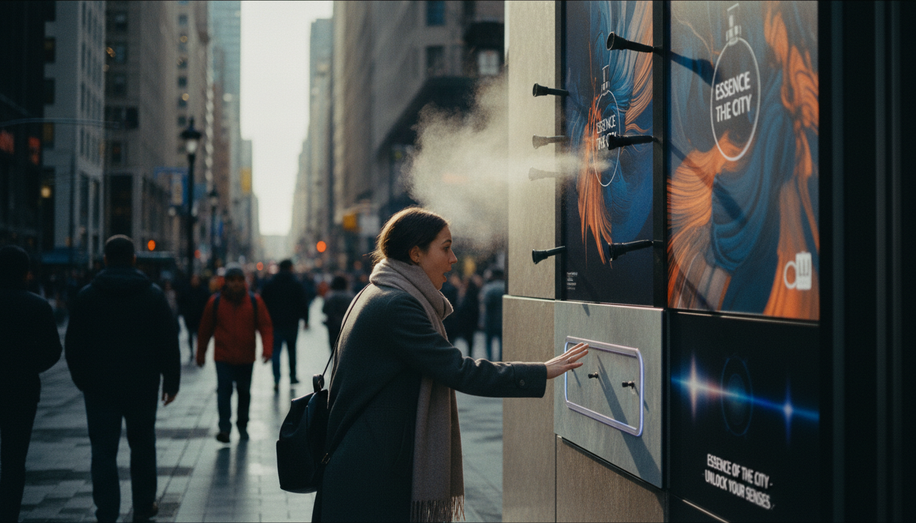

In the bustling streets of London, commuters hurrying to work one morning were suddenly enveloped by the rich, invigorating aroma of freshly brewed coffee wafting from bus shelters. This wasn’t a café nearby—it was Starbucks deploying scent machines during rush hour, a multisensory twist on out-of-home (OOH) advertising that boosted dwell time by 25% and lured foot traffic straight to stores. Such campaigns mark a pivotal shift in OOH, where brands transcend static visuals to engage smell, sound, touch, and even taste, forging deeper, more memorable connections with audiences.
Traditional billboards and posters have long relied on sight alone, but data from industry observers like Excite OOH reveals multisensory activations generate three to four times more interaction than standard displays. By layering in additional senses, advertisers create immersive experiences that linger in the mind long after a glance. “Brands that tap into all five senses can create experiences that stick,” notes Elliot Ward, an advertising expert at Excite OOH. “Scent, sound, and interactive elements elevate outdoor campaigns from being seen to being felt and remembered.” This evolution aligns with broader sensory marketing trends, where environments like Disney World’s theme parks masterfully blend sight, sound, touch, smell, and taste to captivate visitors.
Sound has emerged as a particularly potent tool, transforming passive displays into dynamic conversations. Nike’s talking billboards in New York synchronized voiceovers with digital visuals, delivering audio storytelling that captured pedestrians’ attention and amassed over 1.2 million social media impressions. In airports, ambient music or custom audio logos near boarding gates reinforce brand personality, turning transit moments into subtle auditory cues that enhance recall. JCDecaux highlights how sound accompaniment turns ads into immersive experiences, catching attention in noisy urban settings where visuals alone might fade. Even Baileys amplified its holiday campaign with digital formats paired with evocative scents, blending audio and aroma for heightened seasonal engagement.
Scent, often the most evocative sense tied to memory, offers brands a stealthy edge. Scratchable billboards for Billie deodorant released a tropical fragrance upon interaction, sparking viral TikTok and Instagram shares with millions of views. Tata Coffee Gold took this further in New Delhi for International Coffee Day, installing a 3D digital out-of-home (DOOH) setup that recreated the bean-to-cup journey through immersive scents and visuals across billboards and subway stations. Bus shelter takeovers push boundaries even more: Great Wolf Lodge added waterslide props with scent machines and fans mimicking mist, while Redd’s Hard Apple conjured an orchard with aroma dispensers. These activations don’t just advertise—they transport, making abstract promises tangible.
Haptic feedback and touch introduce physicality, inviting direct participation. Absolut Vodka’s touch-sensitive posters in Stockholm let passersby mix virtual cocktails, yielding a 40% spike in brand recall. Disney’s AR-enhanced street panels in Paris brought film characters to life in 3D, prompting selfies and shares that amplified reach organically. At bus shelters, interactive elements like heat lamps or textured props extend the sensory palette, turning commutes into playful encounters. The Art Institute of Chicago recreated Van Gogh’s “The Bedroom” as a stayable Airbnb space, letting guests touch and inhabit the painting for a profound, multisensory dive into art. Such tactics echo Paris Zoo’s oversized animal crates placed at city landmarks, sparking curiosity through lifelike tactility and illusion.
These innovations thrive on seamless integration, where sensory layers enhance rather than overwhelm the core message. Wrapped food carts dispensing free coffee samples or glass display trucks with actors in costume add taste and interaction to street-level OOH. Branded cable cars in San Francisco envelop riders in scent-infused interiors, while 3D anamorphic billboards create illusory depth that feels graspable. Challenges remain—regulations on sound volume, scent diffusion, and public hygiene—but successes like KitKat’s instantly recognizable imagery across global billboards prove multisensory OOH can win prestigious honors, such as the Cannes Lions Outdoor Grand Prix.
As urban spaces grow denser and attention fragments, multisensory OOH stands out by hijacking the body’s full repertoire. Campaigns like Delta Air Lines’ SXSW pop-up lounge, with its branded scents and textures, show how tying senses to emotion drives loyalty. The result? Longer engagement, higher recall, and exponential social amplification. In an era of ad fatigue, brands aren’t just selling products—they’re crafting sensory stories that audiences live, breathe, and share, redefining OOH as a holistic encounter.