
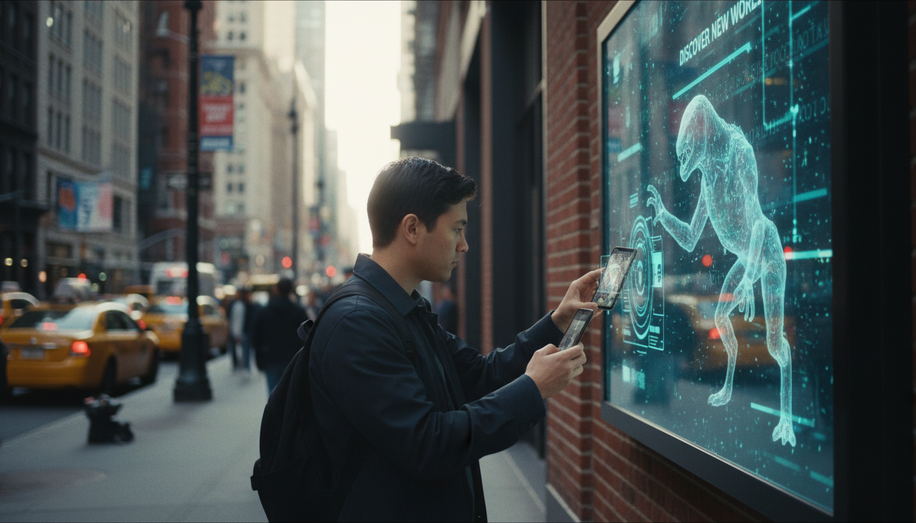

In the bustling streets of modern cities, where static billboards once competed for fleeting glances, augmented reality is breathing new life into out-of-home advertising. By overlaying interactive digital layers onto physical displays via smartphone cameras, AR transforms passive posters and murals into immersive portals, captivating passersby and forging deeper connections with brands. This fusion of the tangible and virtual is not just a novelty; it’s reshaping campaigns, boosting engagement, and delivering measurable results in an era demanding more than mere visibility.
Consider Burger King’s audacious “Burn That Ad” campaign in Brazil, a masterclass in competitive disruption. Users pointed their phones at rival fast-food billboards—McDonald’s included—and watched AR flames consume the ads, revealing a Whopper coupon in their place. Requiring only the Burger King app, the stunt ignited 1 million downloads in a month and spiked in-app sales by 56.4%, proving AR’s power to hijack attention and drive immediate action. Such guerrilla tactics highlight how AR leverages smartphones’ ubiquity, turning competitors’ real estate into promotional gold without altering the physical world.
Healthcare messaging has also found a poignant ally in AR. The UK’s NHS Blood and Transplant initiative placed billboards in Birmingham and London depicting ill patients with empty blood bags. Scanning via a dedicated app overlaid a virtual needle on the user’s arm, simulating a donation that filled the bag and revived the patient on-screen. This empathetic interaction built emotional bonds, encouraging real-world donations by making abstract altruism visceral and immediate. Far from gimmickry, it underscored AR’s ability to evoke positive, lasting feelings through instant feedback.
Wine retailer Jackson Family Wines elevated in-store OOH with the Siduri Holographic Experience, partnering with Rock Paper Reality and Microsoft’s Mixed Reality Capture Studio. QR codes on aisle billboards and bottles summoned a photorealistic 3D hologram of founder Adam Lee, who animatedly shared the brand’s Pinot Noir story with playful flair. Shoppers lingered longer, competitors faded into the background, and distributors gained compelling reasons to stock the product—demonstrating AR’s role in shelf differentiation and narrative-driven sales.
Urban art festivals are another fertile ground. Verizon’s 2024 Art Basel activation in Miami, crafted with BrandXR, deployed AR murals in Midtown, Coconut Grove, and Hialeah. Static paintings of skyscrapers, digital vines, and cultural portraits burst into life via Snapchat’s WebAR: vehicles zipped through cityscapes, circuits intertwined with nature, and community figures evolved into 3D futurism, all tying back to Verizon’s connective ethos. Amid the event’s buzz, social media erupted with user videos, amplifying reach organically while blending art, tech, and brand storytelling. Similarly, metro Detroit’s Electrifly festival animated 15 murals through an app, layering animations, audio narratives, and explorable 3D elements to turn streets into interactive galleries.
Financial services aren’t left behind. Ally Bank’s Monopoly-themed treasure hunt installed 36 game-board squares across six U.S. cities. WebAR scans unleashed Mr. Monopoly dispensing points and cash prizes, gamifying financial literacy. The campaign scored 100,000 plays, with 86% completion rate, enhancing brand affinity through fun, educational immersion. Beverage brands like BON V!V Spiked Seltzer mirrored this in Los Angeles and San Diego, where QR-scanned murals deployed tappable 3D vending machines, blending retail whimsy with WebAR accessibility.
Vodafone pushes boundaries further with AR billboards that surprise with 3D portals, interactive text, and mini-games promoting tech gadgets—static at first glance, explosive upon scan. These experiences thrive on multi-sensory engagement: visuals, audio, even haptic cues foster recall, while shareable “wow” moments fuel viral spread. Brands harvest real-time analytics on dwell time, interactions, and hotspots, refining tactics on the fly. Embedded calls-to-action—coupons, store directions—convert curiosity into foot traffic and sales.
The mechanics are straightforward yet revolutionary. WebAR, needing no app download, uses phone cameras to recognize markers on billboards, triggering overlays via cloud platforms like those from BrandXR or Rock Paper Reality. Digital OOH screens amplify this, morphing any urban spot into an AR canvas through spatial computing. Even traditional posters gain longevity; content updates remotely, sustaining interest without reprinting.
Challenges persist—tech literacy gaps, battery drain, privacy concerns—but adoption surges as smartphones standardize AR capabilities. By 2026, with 5G maturation, expect AR OOH to proliferate, from holographic product demos to location-based hunts. Businesses fuse physical assets with digital depth, extending dwell times, retention, and analytics beyond static limits.
Ultimately, AR elevates OOH from interruption to invitation, where cityscapes pulse with branded universes. As marketers invest, the real world becomes a canvas for boundless interactivity, redefining engagement in public spaces.