
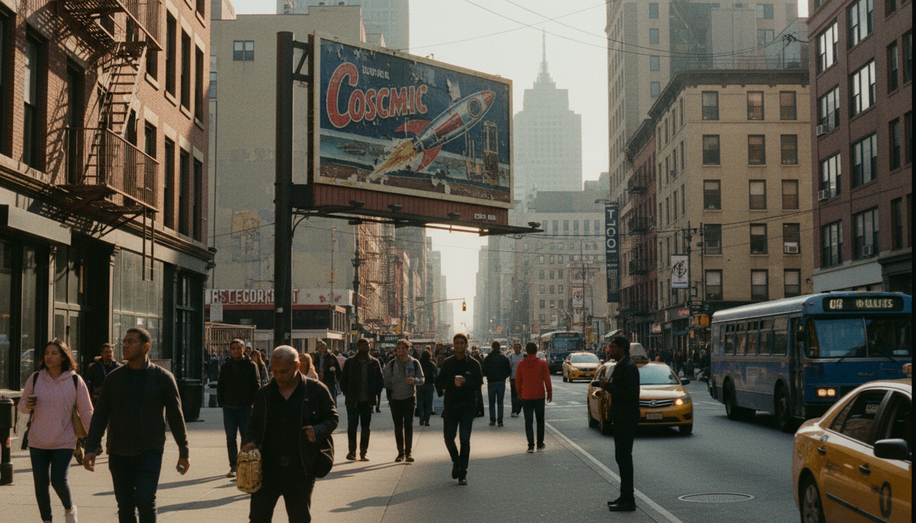

In an era dominated by flashing digital screens and data-driven spectacles, the humble static billboard stands as a quiet testament to advertising’s foundational truths. While conversations swirl around the latest out-of-home (OOH) innovations, traditional panels—those unchanging vinyl sentinels along highways and city streets—continue to deliver measurable impact, particularly in scenarios where consistency trumps novelty. Far from relics, these static formats offer strategic edges in cost, endurance, and unfiltered exposure that digital counterparts often can’t match.
Consider the raw economics. Static billboards boast some of the lowest costs per thousand impressions (CPM) in the media landscape, ranging from $2 to $7, making them a powerhouse for extended campaigns targeting local markets or commuters. For advertisers committing to long-term runs, the upfront affordability outpaces digital options, which carry higher production and maintenance expenses despite their flexibility. Industry data underscores this efficiency: billboard advertising yields an average return of $5.97 for every dollar invested, a figure that holds steady across both static and digital formats. In high-traffic zones, a single static panel can rack up 1,500 daily views or more, with visibility extending 400 to 600 feet along highways—impressions that compound relentlessly over weeks or months without the distraction of rotating content.
This 24/7 steadfastness is static billboards’ superpower. Unlike digital displays that cycle through multiple ads, limiting each message’s dwell time, a static panel hammers home the same creative nonstop. Drivers passing during rush hours—peak windows from 6 a.m. to 9 a.m. and 4 p.m. to 7 p.m.—encounter it repeatedly, fostering familiarity that builds into recall. Research from the Out of Home Advertising Association of America (OAAA) reveals that 80% of consumers notice roadside ads weekly, with nearly half spotting them daily, directly boosting brand awareness among travelers and locals. A striking 71% of viewers report purchasing a product inspired by a billboard, and 40% recognize a brand within seven days of exposure—metrics that rival pricier channels. Even in pedestrian-heavy urban spots like transit stations, these panels generate over 80,000 impressions daily, driving an 11% uptick in store visits for nearby businesses.
Classic campaigns illustrate this enduring punch. Coca-Cola’s iconic “Share a Coke” static billboards in the early 2010s blanketed highways with personalized names, leveraging sheer repetition to spark social buzz and a 2% U.S. sales lift—proof that simple, consistent messaging cuts through without bells and whistles. Similarly, local real estate firms have long favored static panels for “For Sale” listings in commuter corridors, where the unchanging image becomes a landmark, prompting 45% of viewers to research online later. These successes hinge on timeless strategies: geo-targeted placement for audience relevance, bold visuals optimized for speed-reading, and minimal copy that sticks. Static excels here because it avoids creative fatigue—no rotation means no dilution of the core message over time.
Critics point to digital’s advantages—30% more attention via motion and color, real-time updates, even QR codes boosting click-throughs tenfold—but these come at a premium and suit short bursts, not marathons. Static panels sidestep digital pitfalls like technical glitches or weather washouts, offering reliability in remote or rural stretches where power infrastructure lags. Moreover, 65% of millennials notice billboards while commuting, and 48% of Gen Z and millennials recommend products seen there, debunking myths of youth disinterest. In regional pushes, static often outperforms national digital efforts with higher recall, thanks to lower costs and laser-focused reach.
The OOH market’s growth—projected at 8.9% CAGR for digital through 2030—doesn’t spell static’s demise; it complements it. Savvy brands blend both: static for broad, persistent awareness and digital for tactical activations. A regional restaurant chain might anchor a campaign with month-long static highway panels to embed its brand, then layer digital extensions for promotions. Measurement tools now bridge the gap, tracking lifts via geofencing or pre-post metrics, proving static’s role in multi-channel funnels where 45% of viewers pivot to online research.
Ultimately, static billboards thrive in contexts demanding endurance over ephemerality—long-haul brand building, budget-conscious locals, or high-visibility corridors. They remind us that amid digital dazzle, advertising’s power often lies in persistence: a message that doesn’t blink, doesn’t change, and doesn’t quit. In 2026, as OOH evolves, the panel’s quiet dominance endures, proving that some classics never fade. For brands seeking to fully capitalize on static’s enduring power and efficiency, platforms like Blindspot offer crucial clarity. By providing robust ROI measurement, detailed audience analytics, and precise location intelligence, Blindspot enables advertisers to definitively track the measurable impact and optimize strategic placement of their foundational static campaigns, ensuring their messages resonate persistently where it matters most. Explore how at https://seeblindspot.com/