
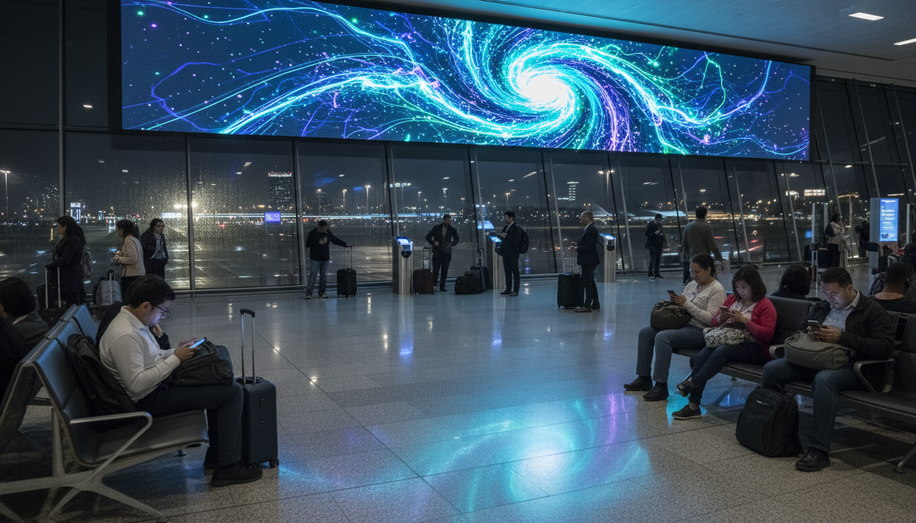

In the bustling terminals of America’s busiest airports, where record passenger volumes surge past pre-pandemic peaks, out-of-home advertising has emerged as a potent weapon for brands targeting elusive travelers. With the Transportation Security Administration screening over three million passengers on peak days in 2025 and projections for 5.8 percent air travel growth in 2026, airports offer a captive audience of diverse, affluent professionals lingering in high-dwell zones like security queues, gates, and baggage claims. This environment, uncluttered by the digital distractions of daily life, transforms fleeting moments into opportunities for profound brand impact, as evidenced by a Nielsen study commissioned by Clear Channel Outdoor revealing that 82 percent of frequent flyers read airport ads, 61 percent recall them, and 57 percent—an eight percent rise from 2022—take action afterward.
The allure of airport advertising lies in its ability to reach high-value demographics at peak intent. Frequent flyers, who dominate these spaces, boast twice the purchasing power in tech decisions and skew toward millennials, business elites, and international tourists, with median household incomes far above national averages. At Los Angeles International Airport (LAX), for instance, 5 million monthly passengers generate 217 million ad impressions across 203 digital displays, while Dallas Fort Worth (DFW) delivers 183 million impressions to 6.6 million travelers via 243 screens. These audiences, motivated by discovery—whether plotting dinners, hotels, or diversions—respond robustly: among those acting on ads, 61 percent visit promoted locations, 53 percent check websites, 45 percent scan QR codes (up six percent since 2022), and 36 percent engage social media. Such metrics underscore airport media’s traversal of the marketing funnel, from awareness to conversion, in a setting where travelers associate brands with premium quality.
Strategic placement amplifies this potential. High-impact zones like concourses and bag claims command unavoidable attention, where digital screens rotate dynamic content tailored to traveler mindsets. Business hubs such as Houston’s George Bush Intercontinental (IAH), with 113 screens yielding 28 million impressions, favor finance and tech messaging for elite flyers, while leisure gateways like Miami International (MIA) leverage 201 displays for 130 million impressions targeting Latin American and European routes with luxury and entertainment pitches. Even secondary markets shine: Pittsburgh International (PIT) deploys 16 high-tech screens for 3.1 million impressions in a low-clutter terminal, ideal for testing campaigns, and Punta Gorda Airport projects 2.3 million passengers in 2026, drawing high-income leisure seekers primed for local retail and hospitality ads.
Yet, capturing this audience demands more than visibility; it requires resonance amid the chaos. Travelers crave brevity, bold visuals, and clear calls-to-action that nod to their immediate needs—88 percent of frequent flyers want local business ads in their home airports, followed by sports teams at 53 percent and educational institutions at 48 percent. Morten Gotterup, president of Clear Channel Outdoor’s Airports Division, notes that airport ads thrive because they meet passengers in a “discovery mindset,” fostering perceptions of quality and convenience. Digital innovations like programmatic out-of-home and QR codes enable real-time personalization and trackable ROI, fueling a six percent compound annual growth rate for the global airport media market, projected to reach $7.43 billion by 2033.
Challenges, however, temper the goldmine. Regulatory hurdles, variable dwell times from delays or efficient operations, and intense competition for prime real estate demand data-driven precision. Airports’ evolution into vibrant commercial hubs—bolstered by expansions and modernization—intensifies this, but also creates “sense-of-place” opportunities for immersive formats. JCDecaux’s 2025 campaigns amid record TSA volumes proved experiential ads excel, blending storytelling with interactivity. Brands must segment audiences meticulously: 42 percent millennials at LAX call for fashion-forward creatives, while DFW’s blend of business and leisure suits broad narratives.
Exclusive networks like Clear Channel, spanning 55 U.S. commercial airports and 52 percent of domestic travelers, offer scale, from Boston Logan’s 92 screens tapping Northeast corridors to Houston Hobby’s 17 displays focused on domestic routes. Local advertisers test waters at venues like Punta Gorda with static banners and brochure kiosks, while nationals dominate primaries. Success stories abound: visitors actively seek eateries, lodgings, and attractions, driving engagement in high-purchase-intent moments.
As passenger traffic accelerates into 2026, led by Asia-Pacific’s 7.3 percent rise and U.S. modernization, airports transcend mere transit points to become strategic battlegrounds. The $4.5 billion airport media market in 2025 is poised to balloon, rewarding advertisers who fuse human insight with digital prowess. Static builds enduring awareness, but dynamic loops and QR handoffs extend reach beyond terminals, turning glances into loyalty. Brands ignoring this arena forfeit a demographic twice as influential in AI and innovation decisions, ceding skies to rivals. In an era of surging mobility, airport OOH doesn’t just advertise—it intercepts journeys, converting captive eyes into committed customers.
To truly unlock this potential, advertisers need advanced tools for precision and proven ROI. Blindspot empowers brands to optimize airport OOH campaigns with unparalleled accuracy, leveraging real-time audience measurement and location intelligence for strategic placement and dynamic content delivery. This allows for measurable attribution and ensures every impression effectively intercepts traveler journeys, turning them into committed customers. Learn more at https://seeblindspot.com/