
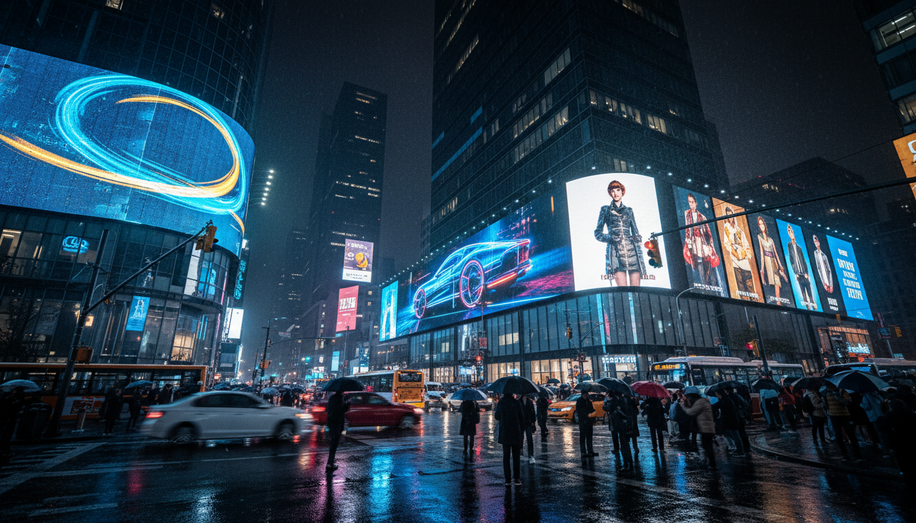

In the bustling urban landscapes of 2026, digital out-of-home (DOOH) screens no longer merely display advertisements—they adapt, endure, and captivate with unprecedented sophistication. While creative content grabs headlines, the true revolution lies in the hardware powering these displays, where breakthroughs in resolution, pixel pitch, environmental adaptive lighting, durability, and energy efficiency are quietly transforming DOOH from a static medium into a resilient, intelligent network.
Resolution has leaped forward, driven by the relentless demand for immersive viewer experiences. Modern DOOH screens now boast 8K capabilities as standard in premium installations, rendering hyper-detailed visuals that rival indoor displays. This shift stems from advancements in micro-LED technology, which packs millions of microscopic LEDs into panels, delivering true blacks, infinite contrast ratios, and color accuracy exceeding Rec. 2020 standards. In high-traffic environments like Times Square or Toronto’s Yonge-Dundas Square, these screens turn passing glances into lingering engagements, boosting brand recall by up to 40% according to recent industry benchmarks. Yet, this clarity comes with integration challenges; rapid firmware updates can disrupt compatibility, forcing integrators to lock in stable versions during deployment to avoid mid-project failures.
Pixel pitch, the distance between individual LEDs, has shrunk dramatically, enabling finer granularity without ballooning costs. Once confined to pixel pitches above 4mm for outdoor use, 2026 sees widespread adoption of 1.5mm and sub-1mm pitches, courtesy of Asian manufacturers flooding the market with affordable high-density modules. This allows for massive video walls that maintain sharpness from 10 meters away, ideal for transit hubs or retail facades. Price pressures from these suppliers have democratized fine-pitch LED, but procurement teams must weigh headline specs against long-term uptime, as cheaper components often falter in real-world stress tests. The result? DOOH networks that deliver billboard-scale impact with television-like precision, fueling the projected $24 billion global market surge.
Environmental adaptive lighting represents perhaps the most ingenious evolution, allowing screens to dynamically adjust brightness, color temperature, and contrast based on ambient conditions. Sensors integrated into panels detect sunlight intensity, time of day, pollution levels, and even viewer demographics, optimizing output in real time. For instance, during Toronto’s harsh winters or Mumbai’s monsoon seasons, these systems boost luminance to 10,000 nits while fine-tuning for glare, ensuring visibility without wasting power. High dynamic range (HDR) capabilities further enhance this, supporting wider color gamuts and peak brightness peaks that make content pop against variable backdrops. This adaptability not only elevates campaign performance—contextual messaging tied to weather or traffic data can lift engagement by 30%—but also aligns with sustainability mandates, as screens dim automatically in low-light scenarios.
Durability has hardened to meet the unforgiving demands of public deployment. Screens now feature IP66-rated enclosures resistant to dust, water jets, and corrosive salts, with reinforced glass and anti-vandal frames surviving impacts that would shatter older models. Thermal management systems, including liquid cooling and adaptive fans, prevent overheating in direct sun, extending lifespans to 100,000 hours. Fragmentation across vendors complicates this; mismatched protocols lead to integration headaches, where isolated components fail under load. Security hardening is equally critical—VPNs, certificate controls, and network segmentation protect against breaches, as DOOH screens serve as potential gateways to corporate IT. In 2026, these robust builds enable seamless scaling from pilot projects to city-wide networks, with standardized architectures minimizing deployment risks.
Energy efficiency crowns these advancements, addressing both operational costs and environmental scrutiny. Next-generation power supplies and AI-driven controllers slash consumption by 50% compared to five years ago, using techniques like pulse-width modulation for precise LED dimming and regenerative braking in video playback. Solar-hybrid models in sunny locales recapture energy, while system-on-chip processors handle analytics and programmatic ad delivery with minimal draw. This efficiency is pivotal as programmatic DOOH matures, with budgets shifting to high-impact physical spaces amid digital saturation. Canadian networks, for example, report DOOH revenues climbing 6.7% to $153 million in 2024, propelled by these greener, smarter screens.
Challenges persist amid this innovation. Rapid AV evolution—higher refresh rates, smarter remote management—outpaces planning, creating compatibility gaps mid-install. Fragmented ecosystems demand rigorous lab testing and vendor-locked firmware to ensure stability. Yet, integrators mastering these hurdles gain a edge, curating “known-good” device lists for repeatable deployments.
The unseen upgrade in DOOH hardware is redefining out-of-home advertising. Higher resolution and tighter pixel pitches sharpen the message; adaptive lighting and ironclad durability conquer the elements; energy smarts sustain profitability. As screens evolve into adaptive, data-responsive nodes in AI-orchestrated campaigns, DOOH cements its role as the high-attention bridge between digital and physical worlds—proving that in 2026, the medium is as revolutionary as the message.