
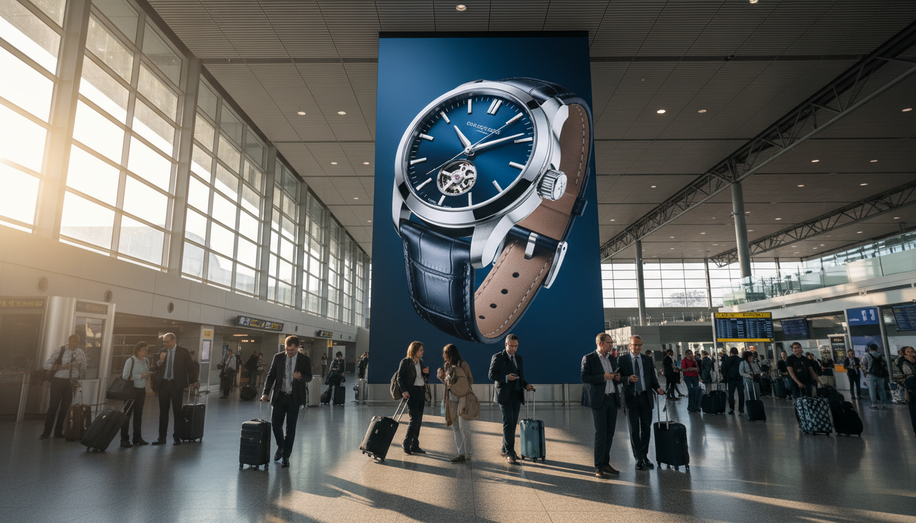

In the bustling terminals of the world’s premier airports, where affluent travelers and business elites converge, out-of-home (OOH) advertising has emerged as a precision tool for brands seeking first-class impressions. With global air passenger volumes surpassing 9.5 billion in 2024 and the airport media market projected to reach $4.5 billion in 2025—climbing to $7.43 billion by 2033—these environments offer unparalleled access to high-value audiences at moments of heightened intent. Frequent flyers, often lingering amid delays in security queues, baggage claims, and gates, provide advertisers with a captive audience in a low-distraction setting, where 83 percent notice ads and 75 percent take subsequent action, from website visits to purchases.
A landmark Nielsen study commissioned by Clear Channel Outdoor in 2025 underscores the potency of this medium among frequent flyers, who are twice as likely to be AI decision-makers with elevated purchasing power. The research found that 82 percent read airport advertisements, 61 percent recall them, and 57 percent—an eight percent increase from 2022—act afterward. Among those responding, 61 percent visited advertised locations, 53 percent accessed websites, 45 percent scanned QR codes (up six percent since 2022), and 36 percent checked social media profiles. These metrics highlight why airports outperform cluttered digital channels: travelers, disengaged from mobile screens, enter a discovery mindset that associates brands with premium quality, with three-quarters of viewers linking airport ads to luxury perceptions.
Major U.S. hubs exemplify this elite targeting opportunity. Dallas Fort Worth International (DFW), handling 6.6 million monthly passengers and generating 183 million ad impressions across 243 digital screens, serves as a crossroads for business travelers and leisure flyers on American Airlines routes. Similarly, Houston’s George Bush Intercontinental (IAH) draws 3.9 million passengers monthly, delivering 28 million impressions via 113 screens to international business connectors and high-income decision-makers. Los Angeles International (LAX) amplifies reach with 5 million monthly passengers and 217 million impressions from 203 displays, appealing to millennials (42 percent of its audience) and affluent tourists drawn to luxury, fashion, and entertainment. At Miami International (MIA), 201 screens yield 130 million impressions, targeting gateways to Latin America and Europe. Even secondary markets like Pittsburgh International (PIT), with 16 high-tech screens and 3.1 million impressions, offer low-clutter testing grounds, while Boston Logan (BOS) leverages 92 screens for 123 million impressions amid Northeast business corridors and university traffic.
Creative strategies must align with these segmented traveler mindsets to maximize impact. Business professionals at IAH respond to finance and tech messaging, while leisure crowds at LAX favor bold visuals promising retail deals or experiential escapes. Morten Gotterup, president of Clear Channel Outdoor’s Airports Division, notes that airport ads resonate by meeting travelers in transitional states, fostering immediate engagement through brevity, cultural relevance, and clear calls-to-action. Static formats build brand equity, but digital out-of-home (DOOH) dominates with rotating loops and interactivity, driving a six percent compound annual growth rate through 2033 amid tourism surges and smart tech integration.
Technological advancements further elevate airport OOH for elite audiences. Programmatic DOOH, expected to capture significant investment by 2026, enables real-time personalization and granular targeting based on audience insights like demographics and dwell times. QR code scans have risen six percent since 2022, bridging physical impressions to digital handoffs for measurable ROI. Networks like Clear Channel’s, spanning 55 U.S. commercial airports and 52 percent of domestic travelers, provide scale—from Hobby Airport’s (HOU) 17 screens and 19 million domestic-focused impressions to LAX’s international sprawl. Brands can test locally at HOU’s low-clutter setup before scaling to primaries like BOS, where long dwell times boost recall.
Yet success demands more than placement and pixels. Advertisers must navigate regulatory hurdles and variable dwell times by prioritizing high-impact zones and data-driven narratives. Frequent flyers crave convenience-oriented content, such as healthcare innovations or AI-enhanced services, tailored to their tech-savvy profiles. Partnerships with operators yield exclusive inventory, while emerging trends like automation—projected to grow ad spend 23 percent to $1.23 billion by 2026—democratize access for precision campaigns.
As U.S. airports evolve into vibrant hubs with expansions and sense-of-place transformations, the stakes intensify. In 2026, with passenger volumes accelerating, elite audiences represent not just transit points but strategic battlegrounds for loyalty. Brands wielding high-impact creatives, programmatic tools, and audience intelligence will convert fleeting glances into enduring connections, claiming premium skies while competitors ground their efforts. Airport OOH isn’t merely advertising; it’s the gateway to influencing the world’s most discerning travelers.