
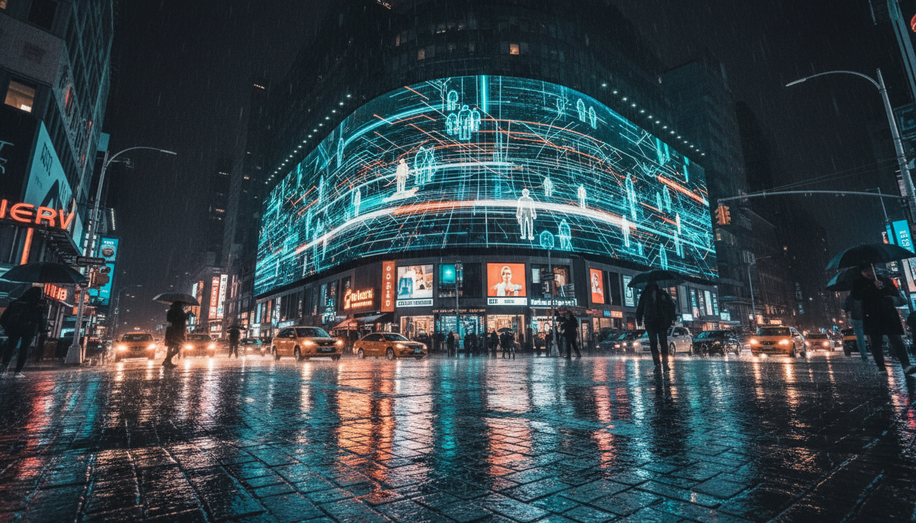

In the bustling arteries of urban life, where billboards flicker and digital screens pulse with messages vying for fleeting glances, a quiet revolution is underway. Artificial intelligence is no longer just optimizing out-of-home (OOH) advertising in the moment—it’s peering into the future, predicting audience flows and reshaping location selection to squeeze every drop of return on investment from campaigns. This predictive placement harnesses machine learning to forecast pedestrian traffic, consumer behaviors, and even external disruptions like weather or events, moving beyond reactive data crunching to proactive strategy.
Traditional OOH placement relied on historical averages—static metrics like rolling foot traffic estimates from third-party geo-services, which often missed the nuances of real-time shifts. AI flips this script by ingesting vast datasets: mobile geolocation signals, social media buzz, satellite imagery, and historical sales lifts. For a global retail chain eyeing a Christmas push, algorithms dissect past holiday patterns, competitor moves, and market trends to pinpoint screens not just near high-traffic zones today, but where shoppers will swarm tomorrow. A sportswear brand, meanwhile, might deploy AI to shadow major events, forecasting surges near stadiums and reserving prime digital out-of-home (DOOH) spots accordingly, capitalizing on emotional peaks in fan engagement.
At the heart of this is predictive analytics, which simulates scenarios to test “what ifs” before a single ad goes live. Machine learning models chew through factors like time of day, weather forecasts, nearby happenings, and demographic profiles to rank locations by projected impressions and conversions. In Madrid’s transport hubs, for instance, AI sifts passenger flows at interchanges like Avenida de América, predicting rush-hour spikes for breakfast promotions or evening lulls for nightlife pitches, prioritizing screens in corridors or bus bays that align with student commutes or family rushes. A fitness chain could extend this logic, forecasting peak workout windows near gyms or trails and dynamically booking billboards to hit young muscle-builders midday and yoga enthusiasts at dusk.
This foresight extends to inventory management, where media operators use AI to anticipate demand. Platforms forecast which DOOH formats will shine under specific conditions—say, a sunny afternoon boosting trail-side visibility or rain driving crowds indoors—freeing up underperformers for reallocation. Brands gain too: predictive tools layer their campaign data with external feeds, spotting anomalies like a tree branch obscuring a billboard via street-view analysis, or modeling how gas prices might reroute commuters. The result? Budgets flow to high-ROI spots, with simulations revealing that a 10% traffic uptick from a local event could double exposure rates.
Real-world deployments underscore the ROI edge. StackAdapt’s AI, for one, blends historical trends with live traffic and weather to generate placement forecasts, ensuring ads land when target audiences are most present. Billups layers nearly two decades of campaign data with social signals to refine programmatic buys, linking DOOH views to foot traffic lifts and sales—making outdoor spend as accountable as digital. Even mobile billboards tap in, with AI optimizing routes via geofencing and behavioral data for hyper-local hits. A gym campaign might intensify near running paths during optimal hours, adjusting on the fly as patterns evolve.
Critics might argue that such precision risks over-reliance on data, potentially sidelining creative intuition. Yet proponents counter that AI amplifies human strategy: it handles the grunt work of pattern-spotting, freeing planners for narrative crafting. In behavioral targeting trends projected for 2025, geofenced campaigns already dominate, with AI dissecting traffic demographics to slot ads seamlessly into daily rhythms. Predictive models even game out competitor strategies, forecasting their placements to carve out uncontested turf.
Challenges persist—data privacy regulations demand careful handling of geolocation streams, and model accuracy hinges on quality inputs. Still, as algorithms refine with more real-time feeds, the gap narrows. Retailers report sales uplifts from AI-vetted Christmas OOH blitzes, while operators tout inventory efficiencies that cut waste by double digits.
Ultimately, predictive placement marks OOH’s leap from static signage to sentient network. By forecasting where eyes—and wallets—will wander, AI doesn’t just optimize locations; it redefines maximum ROI as a forward guarantee, not a hindsight hope. Advertisers who master this will own the streets of tomorrow, turning urban canvases into profit prophets.
To truly master this predictive future, advertisers need robust tools that go beyond historical data. Blindspot empowers this strategic leap with its advanced location intelligence and audience measurement, enabling the precise forecasting of traffic and behaviors for optimal site selection. Further, its competitive intelligence and programmatic DOOH management ensure campaigns are proactively optimized for maximum ROI, turning urban canvases into profit prophets. Learn more at https://seeblindspot.com/