
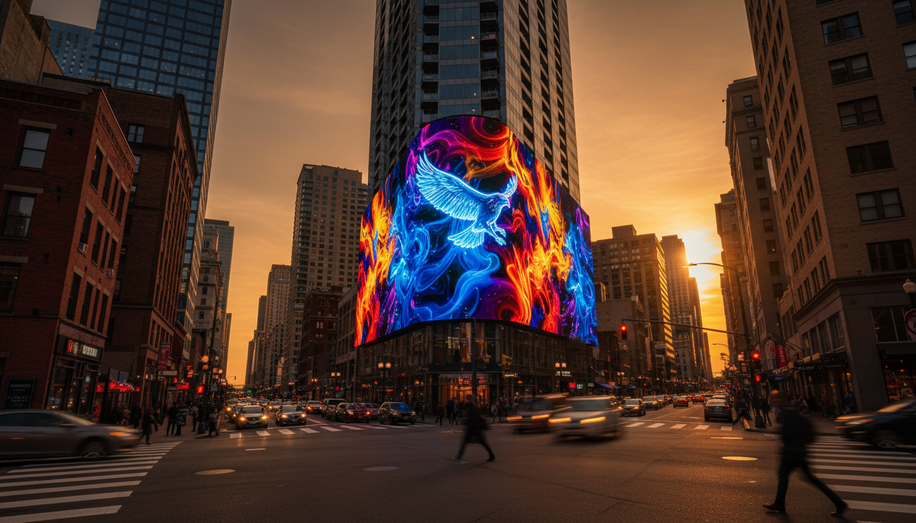

In the bustling flow of urban life, a single out-of-home (OOH) advertisement can pierce through the mental fog, lodging itself in memory long after a commuter has passed by. Cognitive science reveals why certain OOH campaigns achieve recall rates as high as 86%, outpacing digital media’s 35% benchmark: they exploit innate brain mechanisms tuned for survival, emotion, and pattern recognition. Unlike fleeting online impressions measured in milliseconds, OOH demands sustained attention through its physical presence, fostering deeper neural encoding that turns casual glances into lasting brand associations.
At the heart of this memorability lies novelty, which hijacks the brain’s attention system. Human vision evolved to prioritize motion as a primitive survival cue, activating the superior colliculus to reflexively orient gaze toward dynamic stimuli before conscious processing kicks in. A 2020 study in Vision Research underscores this, showing how moving elements in digital billboards or transit ads trigger dopamine responses, especially when appearing unexpectedly in high-traffic zones. This “alerting response” cuts through visual noise, as confirmed by Ocean NeuroScience’s 2023 findings that consumers are 2.5 times more aware of OOH than digital ads, with 83% attention capture in PML Group’s IMPACT study. Static digital banners pale in comparison, lacking the environmental jolt that propels OOH into subconscious awareness.
Emotional resonance amplifies this effect, bypassing rational filters to forge visceral connections. Emotions drive decisions first, with logic rationalizing afterward, making campaigns that provoke laughter, curiosity, or excitement profoundly sticky. Neuroscientists note that emotionally charged visuals activate the brain’s limbic system, enhancing memory consolidation—iconic billboards often become cultural touchstones precisely because they elicit amusement or surprise. Elevator ads from Limited Space, for instance, garnered 100% engagement for 5.32 seconds on average, yielding 68% recall, as sustained emotional pull creates meaningful impressions unattainable in distracted digital scrolling.
Simplicity ensures these emotional hooks endure. The brain favors visual dominance, retaining up to 80% of what it sees versus 20% of read text, so OOH thrives on bold typography, bright colors, and concise messaging. Colorful ads, like Coca-Cola’s signature red, boost recall days later by triggering the reticular activating system (RAS) for standout visibility. Overly complex designs overwhelm working memory, but pared-down creativity—think a single provocative image—leverages frontal lobe attention control and occipital visual pathways, as EEG studies reveal OOH instantly elevates brain vigilance into a high-alert state.
Repetition cements it all through the mere exposure effect, where familiarity breeds trust and retention. Daily commutes expose commuters to the same billboard twice or more, mimicking spaced repetition ideal for long-term memory. This contextual embedding—recalling not just the ad but the route, time, or weather—strengthens brand links, with OOH hitting 47% recall per Nielsen data. Repetition across routes or venues reinforces neural pathways, far surpassing irregular digital hits.
These factors converge to propel consumers down the marketing funnel. Priming via OOH subconsciously associates cues with brands, boosting online engagement by 87% post-exposure and amplifying social media interactions 1.3 times, per Ocean Neuro-Insights. Attribution studies show OOH lifts purchase intent 10-35%, as emotional priming in contextually relevant spots—like gym ads near fitness centers—spurs action. Multi-channel synergy, pairing OOH with digital, further entrenches recall and perception.
Yet not all OOH sticks; poor execution fades into oblivion. Overloaded messages or muted visuals fail to activate RAS or emotional centers, underscoring the need for novelty balanced with simplicity. Neuroscience bridges this gap, quantifying subconscious processing via EEG to refine campaigns—revealing, for example, deeper nighttime engagement when distractions wane.
Ultimately, memorable OOH ads don’t just advertise; they infiltrate cognition by aligning with how brains evolved to notice, feel, simplify, and repeat. Brands mastering this psychology don’t merely compete for eyes—they claim minds, turning everyday environments into persistent recall engines.