
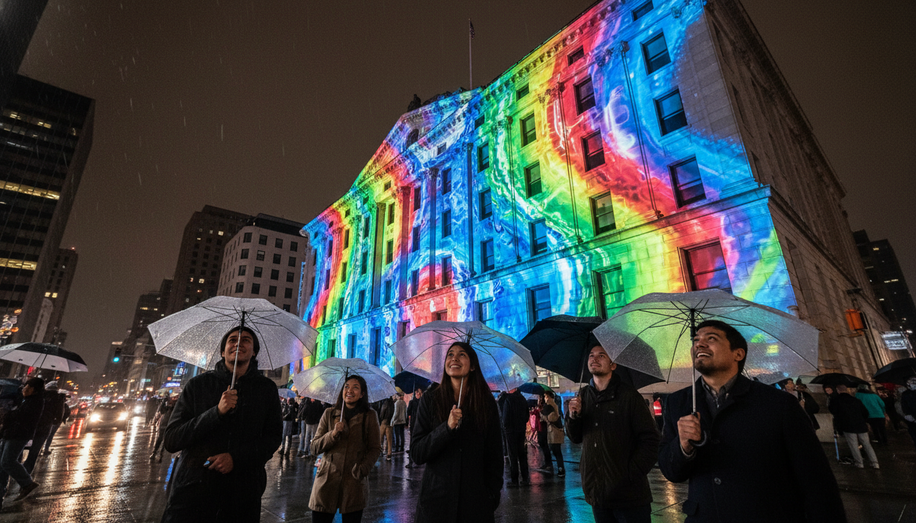

The outdoor advertising landscape is undergoing a profound transformation. Rather than passively displaying static messages, brands are now creating interactive installations and immersive experiences that invite consumers to actively participate in public spaces. This shift from traditional out-of-home advertising to experiential OOH represents a fundamental change in how companies build emotional connections with their audiences.
Experiential OOH goes beyond the conventional billboard by engaging multiple senses and encouraging direct consumer interaction. Digital OOH technology has made this evolution possible, allowing brands to create dynamic, real-time content that responds to weather conditions, time of day, and consumer behavior. What distinguishes experiential installations from standard digital displays is their capacity to transform public spaces into brand universes where consumers become active participants rather than passive viewers.
Recent campaigns demonstrate the creative possibilities within this space. Carvel launched an innovative soft serve-dispensing billboard in New York, where passersby could physically interact with the installation to sample the brand’s vanilla soft serve. Similarly, Visit Las Vegas transformed the Exosphere of Sphere Las Vegas into an interactive mobile game, inviting consumers to register and compete for experiential prize packages. These installations exemplify how 3D immersive experiences combine visual elements with interactive features to create memorable brand moments.
The sensory dimension of experiential OOH proves particularly effective. Tata Coffee Gold created a multi-sensory 3D installation in New Delhi that brought consumers through the coffee journey from bean to cup, engaging shoppers through immersive storytelling. This approach integrates 3D images, sound, and sometimes tactile elements to engage consumers on multiple levels, making brand interactions significantly more effective than traditional advertising.
Technology plays a critical role in enabling these experiences. Augmented reality advertising overlays digital material onto users’ actual environments, providing personalized encounters and interactive product demonstrations. Gesture-controlled displays and gamified experiences represent additional interactive innovations that leverage the emotional connection potential of outdoor advertising. These technological tools allow brands to create targeted messaging that adapts in real time, making outdoor activations more relevant and engaging to specific audiences.
The economics of experiential OOH differ from traditional billboard placements. While standard billboard advertising typically runs for four weeks to six months, interactive OOH advertising installations often operate on shorter timelines of one to four weeks. Though more costly than static outdoor advertising, DOOH and 3D experiences offer significantly greater flexibility and audience engagement, justifying the investment through enhanced consumer interaction and brand recall.
Brands increasingly recognize that not every live engagement requires an elaborate event. Approachable, efficient interactive installations positioned in high-traffic public spaces can deliver measurable results. This democratization of experiential marketing means that brands of various sizes can leverage immersive outdoor advertising to create meaningful connections with consumers.
The shift toward experiential OOH reflects deeper changes in consumer expectations. Audiences no longer want to be talked at; they want to participate in brand experiences. Outdoor advertising that combines art, architecture, and advertising creates spaces where community and communication intersect, fostering authentic engagement. These installations work particularly well for immersive brand activations and experiential marketing events, offering sensory-rich experiences that stick with consumers long after the campaign ends.
Looking forward, the evolution from traditional OOH to immersive 3D experiences and interactive installations will likely accelerate. As the advertising industry continues innovating with cutting-edge technologies, brands can build fascinating interactive narratives that captivate audiences and transform public spaces into dynamic brand environments. The future of outdoor advertising promises increasingly engaging, interactive, and memorable consumer experiences that blur the line between marketing and entertainment.
As brands navigate this evolving landscape, platforms like Blindspot become indispensable, offering advanced tools for precise location intelligence and site selection to maximize interaction. Crucially, their real-time campaign performance tracking and ROI measurement capabilities provide the essential data needed to optimize these complex, high-investment experiential OOH activations and demonstrate their tangible impact on consumer engagement and brand recall. Learn more at https://seeblindspot.com/