
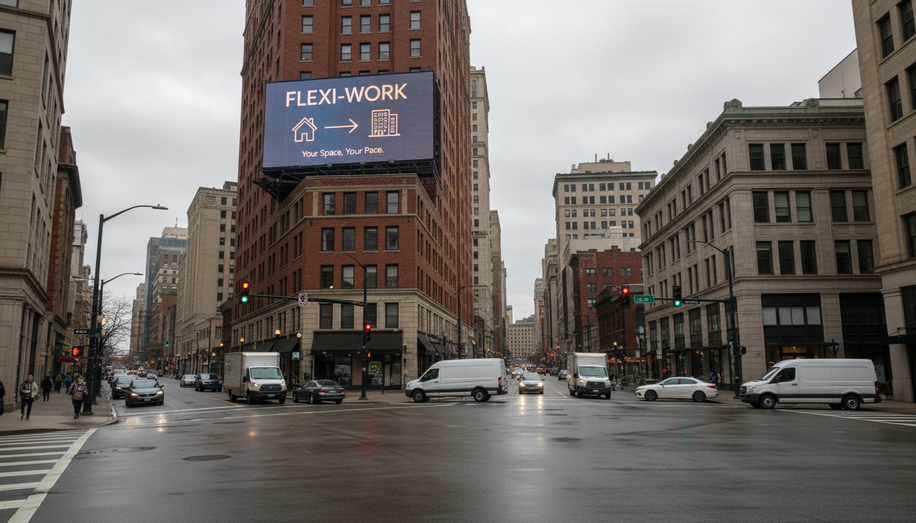

The out-of-home advertising industry faces a fundamental recalibration. As remote and hybrid work models reshape how millions move through cities, the traditional playbook for site selection and audience targeting no longer applies with the same certainty it once did.
For decades, OOH advertising thrived on predictability. Commuters followed routines. Rush hour meant guaranteed eyeballs on transit displays and roadside billboards. But the pandemic accelerated a shift that continues to reshape urban mobility. With 13.8% of full-time workers now working remotely part-time or more, up from 5.7% in 2019, those predictable traffic patterns have fragmented. Workers willing to tolerate longer commutes if they only need to make them a few times per week have fundamentally altered when and where audiences appear.
The data underscores this transformation. While over three-quarters of employed adults still travel to work at least part of the week, the distribution has become uneven. Some days see traditional commute volumes; others do not. One-fifth of the workforce operates on hybrid schedules, and another 20% work entirely from home. For an industry accustomed to selling predictable impressions during 7–9 AM and 4–7 PM windows, this fragmentation demands new thinking.
Yet the opportunity remains substantial. Urban commuters still reach OOH at remarkably high rates—roughly 90% of people in urban areas see OOH advertising each week. The average city commuter views over 5,000 OOH ads monthly. Drivers spend approximately 300 hours annually in vehicles, creating continuous exposure to roadside messaging. These figures suggest that OOH’s fundamental strength—reaching people in motion—has not diminished; rather, the patterns of that motion have become more complex.
The challenge lies in adaptation. An Out-of-Home media company like Intersection discovered this firsthand in early 2021 when pandemic-driven shifts made it harder to predict traffic volumes at commuting hubs with the precision that had previously defined the industry. Traditional metrics became unreliable guides. Companies needed new data on where audiences were actually going and when.
Forward-thinking advertisers are responding by expanding beyond traditional commute-time placements. Transit OOH remains powerful—British commuters spend an average of 58 minutes daily on public transport, creating consistent touchpoints. But the strategic focus is broadening. Transport advertising increasingly bridges physical and digital commerce, with 26% of transport users actively browsing retail sites during journeys. This convergence between out-of-home exposure and immediate digital action opens new measurement pathways that transcend traditional frequency metrics.
Location-based targeting has become more sophisticated as well. At least half of all adults report noticing OOH ads more often when they are aligned with personal needs and interests or tailored to specific locations. This suggests that in an environment where commuting patterns are less uniform, the relevance of messaging matters more than sheer volume. An evening rush-hour campaign for a food delivery service resonates differently than the same message at midday, when hybrid workers scattered across distributed locations may never see it.
The data also reveals that OOH’s influence on purchase behavior remains robust despite these shifts. Among those who visit a store, business, or restaurant within 30 minutes of seeing an OOH ad, four-in-five made a purchase. Additionally, 40% of consumers visit a website or search for a brand within minutes of seeing outdoor advertising. These conversion metrics suggest that reaching the right audience at the right moment—even if that moment is less predictable than before—still drives measurable results.
The path forward requires embracing complexity rather rather than resisting it. Hybrid work is not reversing; it is evolving. This means OOH placements must become more dynamic, informed by real-time mobility data, and designed around the fragmented but still substantial audiences moving through urban spaces. Advertisers who invest in understanding how work flexibility is reshaping their specific markets will find that out-of-home advertising remains one of the most effective ways to connect with people exactly where they are.