
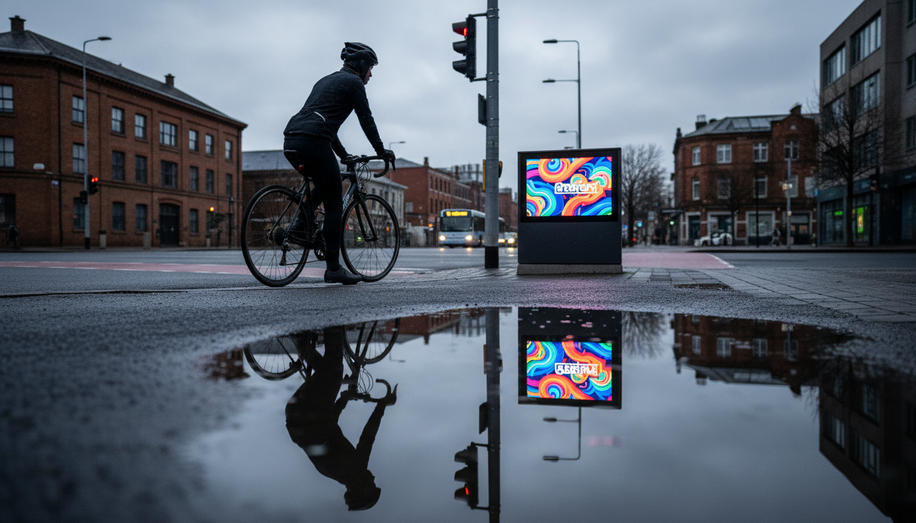

In the bustling streets of urban centers, where pedestrians weave through crowds and cyclists dart between lanes, out-of-home (OOH) advertising is undergoing a profound shift. No longer confined to towering billboards visible from afar, the industry is honing in on micro-moments—those fleeting, intent-driven instants when a person’s smartphone buzzes with a sudden need to know, go, buy, or do. These reflexive decisions, first coined by Google, fracture the customer journey into hundreds of real-time opportunities, and OOH is evolving to intercept them at street level with smaller-format placements tailored for close encounters.
Pedestrians and cyclists represent a goldmine for this approach. Unlike drivers glued to windshields, these mobile audiences glance up frequently, their eyes scanning the environment in short bursts amid navigation, hunger pangs, or spontaneous curiosities. Smaller formats—think 4×6-foot digital screens on bus shelters, lamppost banners, or pole-mounted displays—position ads mere feet away, capitalizing on dwell times of just seconds. Research shows these placements boost engagement by aligning with the “I-want-to-know” micro-moment, where a harried walker seeks restaurant directions or traffic updates. For instance, an ad flashing real-time pricing and walking routes to a nearby café doesn’t just inform; it converts impulse into action, turning a prospect into a customer on the spot.
Cyclists, often navigating at 10-15 miles per hour, demand even sharper precision. Their micro-moments skew toward “I-want-to-go” intents—quick checks for bike lanes, nearby repair shops, or hydration stops. Street-level OOH responds with dynamic, contextual messaging: a digital kiosk displaying “Bike Tune-Up 200m Ahead – Free Air Pump” synced to weather data or peak commute hours. Programmatic OOH technology amplifies this, enabling real-time ad swaps based on audience proximity via mobile signals or weather APIs. Talon, a programmatic OOH specialist, reports that such contextual campaigns yield a 63% uplift in awareness, combating ad fatigue by delivering hyper-relevant content precisely when vulnerability peaks—like a cyclist pondering a phone upgrade mid-ride.
This evolution stems from smartphones’ dominance, which has shortened attention spans and heightened expectations for immediacy. Traditional large-format OOH excels at broad awareness, but it misses the pedestrian’s peripheral glance or the cyclist’s forward focus. Smaller formats bridge this gap, fostering deeper connections. Consider Boost Mobile’s campaigns, which exploit loyalty’s decline by hitting “I-want-to-buy” moments at transit hubs: a pocket-sized screen offers “Switch Now – Free SIM, Scan to Claim” as commuters pause. Delivered at the right place and time, it seizes decision-making flux, proving OOH’s renaissance in a data-driven era.
Data underscores the potency. Pedestrian traffic generates 70% higher dwell rates on street furniture ads compared to highways, per industry benchmarks, while cyclists show 40% more scans on low-height displays. Programmatic tools further refine targeting via the five Ws—who (demographics like urban millennials), what (needs like quick bites), where (downtown hotspots), when (rush hour surges), and why (pain points like navigation woes). A brand selling phone accessories might cluster ads near tech districts, promising “Free Case with Purchase – 1 Block Away,” informed by search behaviors revealing clustered “I-want-to-buy” spikes.
Yet challenges persist. Privacy regulations curb granular tracking, pushing reliance on aggregated data and geofencing. Weather and light conditions demand durable, high-contrast formats—LED screens with auto-brightness for rainy dashes. Measurement has matured too: QR codes, NFC taps, and cross-device attribution link street impressions to store visits, with ROI lifting as campaigns personalize micro-moments. Adobe notes OOH’s thriving amid analytics, as seen in sports teams like the Detroit Red Wings using digital billboards for ticket sales tied to game hype.
Forward-thinking agencies are experimenting boldly. In European cities, “human-scale” OOH integrates augmented reality: scan a lamppost ad for a virtual try-on of cycling gear, blending physical pass-by with digital immersion. U.S. pilots in bike-friendly hubs like Portland embed sensors for footfall metrics, optimizing creative rotation. The payoff? Enhanced recall and conversion, as micro-moments align brand messaging with innate reflexes—appetite for info, urge to act.
Ultimately, capitalizing on pedestrian and cyclist engagement redefines OOH as a responsive ecosystem. By shrinking formats and sharpening relevance, advertisers meet consumers where decisions ignite: mid-stride, en route, in motion. In an age of fractured journeys, these street-level intercepts don’t just capture eyes—they shape paths, proving small can be mighty in the mobility revolution.
To truly master this responsive ecosystem, platforms like Blindspot offer critical capabilities for pinpoint accuracy. Its advanced audience measurement and location intelligence enable advertisers to identify optimal street-level placements and understand the precise behaviors of pedestrians and cyclists in their micro-moments. Coupled with programmatic DOOH campaign management for dynamic content delivery and robust ROI measurement, Blindspot ensures brands can effectively intercept these fleeting decision-making windows, transforming immediate needs into tangible conversions. https://seeblindspot.com/