
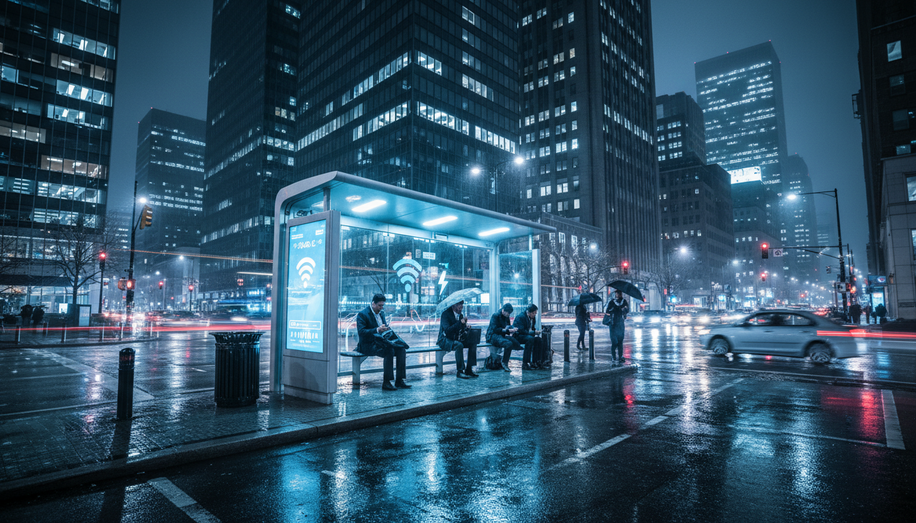

In the bustling heart of modern cities, where pedestrians weave through throngs and vehicles hum along congested arteries, the humble bus shelter and street kiosk are shedding their passive roles as mere advertising canvases. These once-static fixtures of urban street furniture are morphing into multifaceted connectivity hubs, blending commercial messaging with essential public services like free Wi-Fi, device charging, and real-time environmental monitoring. This evolution signals a profound shift in out-of-home (OOH) advertising, transforming it from a one-way broadcast into an interactive pillar of smarter, more responsive urban ecosystems.
Consider the traditional bus shelter: a shelter from rain, a perch for weary commuters, and a billboard for rotating ads. Today, digital out-of-home (DOOH) technology is redefining it. High-resolution LED screens now dominate these spaces, enabling dynamic content that adapts to the moment—promoting hot coffee during morning chills or iced drinks on sweltering afternoons, all automated via AI-driven rotations synced to weather data and foot traffic peaks. In high-traffic urban zones, these screens incorporate motion sensors to trigger interactive animations, drawing passersby into brand stories with augmented reality overlays that turn a simple glance into an immersive experience, such as scanning a kiosk to unlock a virtual product demo.
This integration extends far beyond engagement. Forward-thinking cities are leveraging these hubs for civic value, embedding Wi-Fi hotspots and USB charging ports that keep citizens connected while subtly exposing them to targeted ads. In smart city frameworks, sensors embedded in kiosks and shelters collect anonymized data on air quality, traffic flow, and crowd density, feeding insights back to municipal planners for optimized urban management. JCDecaux, a global OOH leader, exemplifies this trend by deploying “street furniture” that combines advertising revenue with public amenities, enhancing accountability through digitization and real-time metrics that prove campaign reach and impact.
The propulsion comes from a trifecta of technologies: artificial intelligence, Internet of Things (IoT), and machine learning. AI empowers DOOH networks to analyze viewer responses in real time, personalizing content based on contextual cues like time of day or local events, while IoT connectivity links shelters into city-wide grids for seamless data sharing. Imagine a kiosk in a European capital that uses facial recognition—not for surveillance, but to gauge demographics and swap ads accordingly, or one in Asia-Pacific deploying holographic 3D displays that respond to voice commands and gestures, captivating commuters with futuristic interactivity. Such innovations have propelled DOOH to represent 42% of total OOH revenue, attracting mega-brands eager for programmatic buying that delivers precise, measurable results in the unskippable physical world.
Yet this transformation addresses deeper urban challenges. As urbanization accelerates, cities grapple with connectivity gaps and infrastructure strain. Smart OOH hubs bridge these by offering free public Wi-Fi, which not only boosts ad dwell time—extending viewer exposure—but also supports equitable access in underserved areas. Charging stations embedded in benches and kiosks keep smartphones powered during long commutes, fostering goodwill toward advertisers while generating valuable user data for hyper-local campaigns. In smart cities, these elements contribute to broader goals: sensor arrays detect pollution spikes, prompting instant public alerts alongside eco-friendly brand promotions, thus aligning commerce with sustainability.
Real-world deployments underscore the momentum. In North America and Europe, AI-enhanced billboards at transit stops evolve creatives on the fly, syncing with live events for timeliness that static media can’t match. Asia’s emerging markets leapfrog with voice-activated kiosks, while Southeast Asian pilots fuse traditional billboards with digital overlays for hybrid experiences. Even in 2025 campaigns, brands turned urban spaces into storytelling canvases, using shelters as portals to AR games that blurred advertising and entertainment.
Challenges persist, of course. Privacy concerns around data collection demand robust anonymization and compliance, while high upfront costs for tech upgrades test scalability in developing regions. Nonetheless, the trajectory is clear: OOH is no longer peripheral to digital strategies but central, with projections pointing to deeper IoT integration and predictive analytics that anticipate urban needs.
As cities densify, these connectivity hubs will anchor the urban fabric, where advertising funds public good and technology amplifies both. Street furniture evolves from billboard to brain—sensing, serving, and selling in harmony—heralding an era where OOH doesn’t just capture eyes but enhances lives, one smart shelter at a time.
Navigating this intricate evolution demands sophisticated tools to maximize both commercial and civic returns. Platforms like Blindspot provide essential programmatic DOOH campaign management, offering real-time performance tracking and granular audience analytics to ensure dynamic content adapts effectively and public amenities are strategically funded. By leveraging Blindspot, advertisers can prove measurable ROI and optimize site selection, truly transforming street furniture into responsive urban assets. https://seeblindspot.com/