
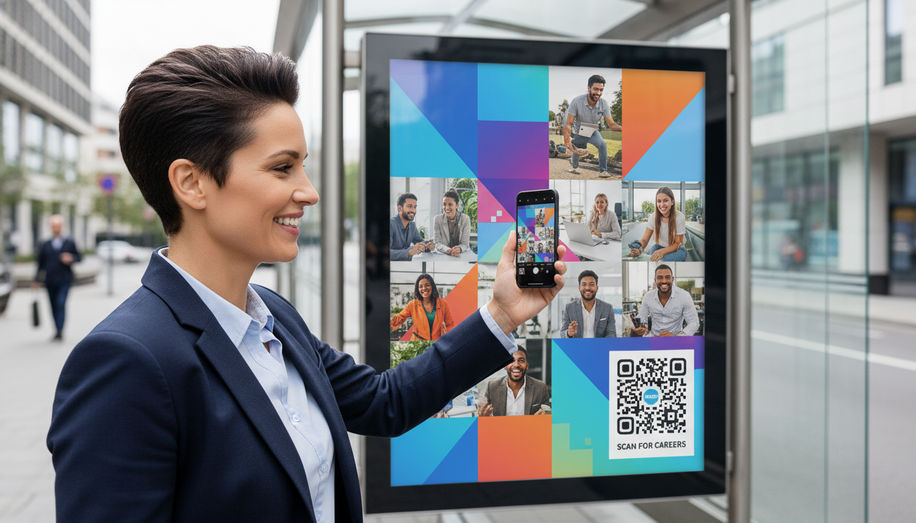

In today’s fiercely competitive job market, where top talent scrolls endlessly through digital feeds, companies are turning to out-of-home (OOH) advertising to cut through the noise and make unforgettable impressions. Billboards, digital screens, and transit ads offer a bold canvas to showcase company culture, spotlight open roles, and draw in local candidates who might otherwise overlook traditional online postings.
OOH’s power lies in its unignorable presence. Research from the Out of Home Advertising Association of America (OAAA) and ComScore reveals that 41% of people exposed to an OOH ad later search for the advertiser online, while OOH drives online activity at over five times the expected rate and 382% more effectively than TV. For recruiters, this translates to a recruitment turbocharge: commuters stuck in traffic or pedestrians rushing to work suddenly encounter vibrant visuals of thriving teams, competitive perks, and urgent calls to apply. Unlike fleeting social media posts, these messages linger in high-traffic zones, fostering repeated exposure that builds familiarity and trust.
Strategic placement is the linchpin of successful OOH recruitment campaigns. Companies aren’t casting a wide net blindly; they’re using location intelligence to target precise talent pools. A logistics firm battling for warehouse workers might erect billboards near industrial hubs and public transport routes, where shift workers congregate. Healthcare providers could position digital out-of-home (DOOH) screens outside medical facilities, highlighting sector-specific benefits like continuing education or flexible schedules. Universities recruiting faculty or graduates place ads on routes to rival campuses or directly in vocational schools and student hangouts. For high-volume hiring in retail or manufacturing, ads in shopping centers or along city highways ensure maximum visibility among dense local populations.
This precision extends to messaging that humanizes the employer brand. OOH excels at conveying culture in ways static job boards can’t. Imagine a tech startup blanketing business districts with DOOH loops showing diverse teams brainstorming over coffee, overlaid with text like “Join our hybrid culture—unlimited PTO, career progression, and real work-life balance.” Such visuals create a “halo effect,” associating the company with stability and appeal, making it the preferred choice when candidates compare offers. For specialized roles, urgency amps up the impact: real-time digital displays can flash “Immediate Start: Leadership Positions—Apply Now” with QR codes linking straight to applications, capitalizing on impulse responses from professionals in nearby offices.
Cost-effectiveness seals the deal for budget-conscious HR teams. OOH boasts the lowest cost per thousand impressions (CPMs) among traditional media, rivaling digital while reaching audiences bypassed by online channels—think blue-collar workers who prioritize real-world commutes over screen time. Clients report repeat success, noting OOH’s ability to amplify other tactics: a billboard sparks curiosity, driving traffic to career sites where detailed applications convert. In one scenario, production firms advertise commuting perks like corporate shuttles on transit ads, luring talent from neighboring cities who might never browse remote job listings.
Real-world examples underscore OOH’s edge in saturated markets. Construction companies near trade schools use billboards to flaunt apprenticeships, while retailers in competitive urban zones deploy transit wraps for seasonal hires. DOOH’s always-on flexibility shines for dynamic needs—screens in career fair vicinities or university campuses rotate graduate programs and internships, adapting messages for entry-level seekers. Even long-term employer branding benefits: sustained exposure shapes perceptions of prestige, turning passive observers into active applicants months later.
Yet, OOH isn’t a one-size-fits-all; success demands tailoring to the audience and integrating with broader strategies. For local firms without relocation support, city-center billboards or bus-stop digital displays suffice, while larger campaigns leverage data-driven commuter mapping for precision. Avoid generic creatives—bold visuals, concise calls-to-action, and scannable QR codes boost engagement. Regulations in some shopping centers may limit recruitment ads, so vetting placements upfront is essential.
As digital fatigue sets in and talent wars intensify, OOH stands out as a trusted, tangible medium that humanizes hiring. It doesn’t just list jobs; it paints a compelling picture of belonging, strategically positioned to intercept candidates at pivotal moments. Companies embracing this approach report not only more applications but stronger, culture-aligned hires that thrive. In an era where visibility equals viability, OOH is redefining recruitment as an art of bold, community-rooted persuasion.