
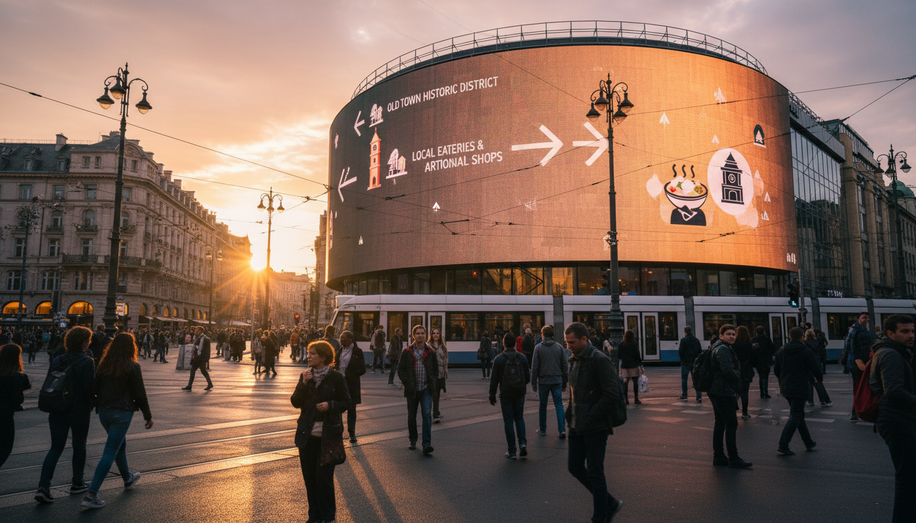

In the labyrinth of modern cities, where skyscrapers cast long shadows and streets pulse with hurried footsteps, out-of-home (OOH) advertising is evolving from a mere billboard spectacle into a vital urban navigator. No longer confined to hawking products, OOH now guides pedestrians and tourists alike, directing foot traffic toward hidden gems and enhancing the rhythm of city life with contextual intelligence. Imagine a family weaving through Times Square, their eyes catching a digital display not just promoting the 9/11 Museum but overlaying real-time directions via QR code, turning a passive glance into an active journey.
This transformation hinges on OOH’s unparalleled ability to intercept people in motion—on sidewalks, at transit hubs, or in bustling shopping districts—delivering information that feels intuitive rather than intrusive. Traditional billboards once shouted generic messages from highways, but location-based OOH flips the script, tailoring content to hyperlocal contexts. Ads near Chicago’s Willis Tower might highlight nearby botanical gardens with vivid imagery of blooming exhibits, enticing locals to rediscover their backyard while luring tourists off the beaten path. Geographic targeting ensures relevance: screens in tourist-heavy zones flash event schedules for festivals or conferences, capitalizing on surging foot traffic to boost engagement.
The power lies in precision. By analyzing movement patterns and high-traffic zones, advertisers place OOH formats—static posters, digital out-of-home (DOOH) screens, or place-based installations—in spots where audiences naturally congregate. Public transportation stops become beacons, with displays showing the quickest route to a pop-up art exhibit or a trendy café, seamlessly blending promotion with utility. In fitness centers or college campuses, place-based OOH targets Gen Z with lifestyle-aligned cues, like directions to nearby entertainment venues, fostering a sense of discovery rather than disruption. This isn’t random; data analytics reveal behaviors, allowing dynamic updates for weather alerts, promotions, or even geo-conquesting tactics that siphon crowds from competitors with irresistible local offers.
Consider London’s Covent Garden, where DOOH screens pulse with augmented reality overlays: scan a panel promoting a theater show, and your phone reveals walking paths avoiding construction, complete with estimated times and crowd levels. Such integrations bridge physical and digital realms, using QR codes or short URLs for instant interaction, driving immediate conversions and footfall. In New York, OOH near cultural hubs like aquariums or zoos employs bold visuals to evoke emotional pulls—stunning animal portraits or architectural marvels—that not only advertise but orient visitors, creating memorable bridges between awareness and action.
Urban navigation through OOH extends beyond tourism to everyday dwellers. Hyperlocal messaging resonates deeply: a screen in a neighborhood shopping district might spotlight a community market with turn-by-turn guidance, strengthening communal ties and spurring spontaneous visits. Contextually relevant creatives amplify this—ads referencing surrounding landmarks feel authentic, boosting relevance and authenticity in ways generic campaigns never could. For small businesses, this means heightened visibility; a restaurant’s OOH nearby a retail strip draws diners with mouthwatering visuals and precise directions, turning passersby into patrons.
Yet, the real innovation surges with digital evolution. DOOH’s real-time adaptability sets it apart: content shifts with events, promotions, or even traffic flows, ensuring ads remain navigational lifelines amid urban flux. Place-based OOH, projected to grow rapidly through 2027, thrives in venues like coffee shops or entertainment spots, where it embeds brand stories into lived experiences without the skip-button fatigue of digital scrolls. Cost-effective impressions and unblockable exposure make it a high-ROI choice, especially for cultural attractions vying for attention in saturated media landscapes.
Critics might dismiss OOH as visual clutter, but when wielded as a navigator, it declutters the urban chaos. Strategic placements in high-traffic intersections or event vicinities not only guide but enrich encounters—reminding residents of that overlooked zoo exhibit or steering tourists to iconic landmarks with flair. Cities like Berlin and Tokyo already experiment with OOH-linked apps for personalized routes, hinting at a future where advertising anticipates needs: “Hungry? 200 meters left to street food heaven.”
Ultimately, OOH redefines city experiences by making advertising functional. It funnels foot traffic efficiently, uncovers local treasures, and weaves commerce into the urban tapestry without seams. As pedestrians glance up from their screens, these vibrant sentinels don’t just sell—they steer, illuminating paths to joy, culture, and connection in the world’s most dynamic environments. In an era of disconnection, OOH stands as the ultimate urban compass, proving that the best guides are the ones you can’t ignore.