
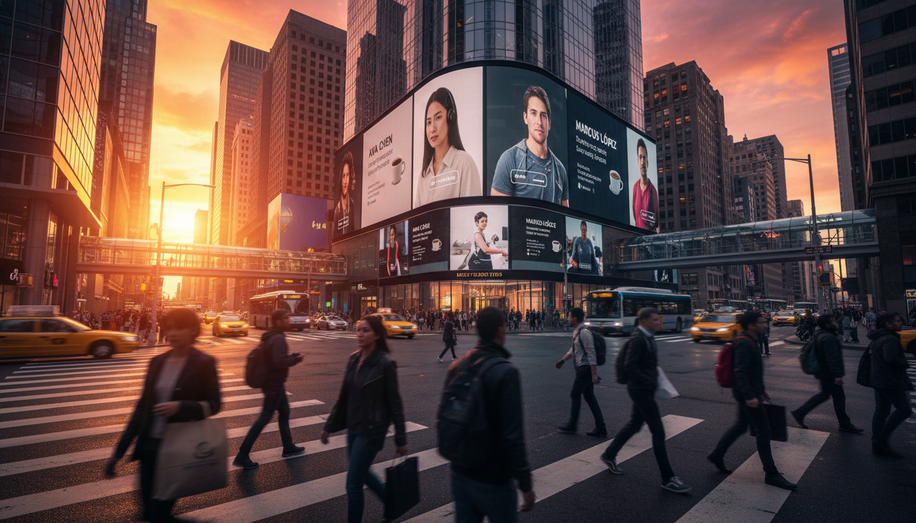

In the bustling digital billboards of urban centers, where ads flicker to life in sync with the rhythm of city streets, Dynamic Creative Optimization (DCO) is redefining out-of-home advertising. No longer confined to static images or basic triggers like time of day, DCO platforms for Digital Out-of-Home (DOOH) harness real-time data streams to craft hyper-personalized messages that adapt instantaneously to audience segments, environmental shifts, and campaign objectives, delivering relevance at unprecedented scale.
At its core, DCO transforms rigid creatives into fluid, responsive assets. Advertisers upload modular templates—interchangeable elements such as headlines, images, videos, and calls to action—that platforms populate dynamically using live inputs. Weather data might swap a sunny beach promo for a cozy hot chocolate ad during a downpour; traffic patterns could prioritize quick-service restaurant offers amid gridlock; or audience demographics, gleaned from nearby device signals, might tailor fashion messaging to passing shoppers’ inferred age groups. This goes beyond simple contextual triggers, integrating machine learning to analyze performance in real time and optimize elements like text overlays or visual motifs for maximum impact. Research from Clear Channel UK underscores the payoff: contextually relevant DOOH messaging boosts campaign effectiveness by 17% on average, while Analytic Partners found dynamic creatives yield 2.5 times higher returns.
Programmatic DOOH amplifies this capability, enabling seamless execution across vast networks. Platforms like those from Perion and Displayce pull from diverse feeds—flight destinations at airport screens, sports scores for stadium displays, or even local events—to ensure ads resonate deeply. For a retail chain, this means showing inventory-specific promotions to nearby demographics during peak shopping hours, or adjusting urgency based on foot traffic data. The result? Ads that feel intuitively personal, fostering higher engagement; studies cited by Perion indicate dynamic creatives generate 38% more ad impact than static alternatives. Marketers set targeting criteria upfront—such as full-funnel goals from awareness to conversion—then let algorithms fine-tune delivery, swapping assets to prioritize top performers without manual intervention.
What sets advanced DCO apart is its layered intelligence, blending audience segmentation with environmental and goal-oriented logic. Consider a beverage brand’s campaign: For young professionals detected via mobile signals in a business district, the platform might display an energy-boost variant mid-afternoon; shift to a relaxation theme for evening commuters; or pivot to hydration messaging if temperatures spike. This hyper-personalization extends to behavioral nuance—past purchase data or loyalty app signals could customize offers, while campaign goals dictate frequency caps or sequencing across screens for storytelling arcs. Displayce’s approach exemplifies this, automating ad updates with inputs like match odds for sports venues or traffic for highway billboards, reducing production costs and slashing time-to-market by eliminating bespoke static assets.
Efficiency gains are profound. Traditional DOOH required pre-producing countless variations, a logistical nightmare for national rollouts. DCO streamlines this: One template set supports infinite permutations, with real-time A/B testing across variants to identify winners. Platforms monitor metrics like dwell time, impressions, and downstream actions—such as in-store visits tracked via geofencing—feeding insights back into the system for continuous refinement. Broadsign notes this fluidity enables cohesive narratives, like sequential ads that build from awareness at transit hubs to action prompts near stores, all personalized by location and time.
Yet, scaling hyper-personalization demands robust infrastructure. Data privacy regulations like GDPR and evolving consent frameworks require anonymized signals and opt-in mechanisms, ensuring ethical deployment. Integration with demand-side platforms (DSPs) is key: Advertisers define parameters, feed in creatives, and connect external APIs for bespoke triggers, such as stock levels or competitor activity. Challenges persist—latency in data processing can blunt real-time magic, and creative quality hinges on initial template design—but maturing tech addresses these, with AI now handling granular optimizations like color schemes tied to mood-influencing weather.
The proof lies in performance. Brands using DCO report not just elevated engagement but tangible ROI: reduced waste from irrelevant impressions, amplified footfall, and cross-channel synergy where DOOH primes digital or in-store conversions. As DOOH inventories expand—projected to blanket malls, transit, and workplaces—DCO positions it as a precision powerhouse. For advertisers, it’s no longer about shouting into the void; it’s about whispering exactly what the audience needs, exactly when they need it, at scale. This evolution cements DOOH’s role in a fragmented media landscape, where relevance isn’t optional—it’s the currency of connection.