
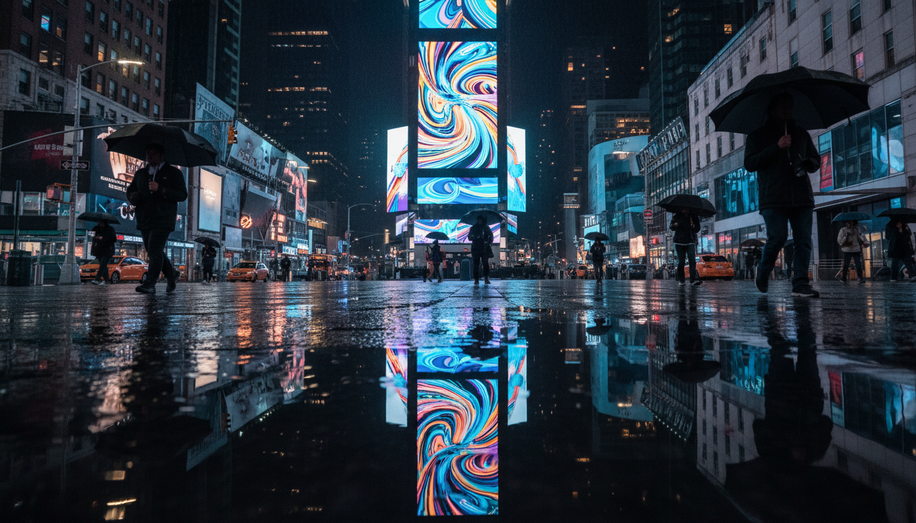

In the high-stakes world of out-of-home (OOH) advertising, where a single billboard can capture millions of fleeting glances, artificial intelligence is emerging not as a replacement for human ingenuity, but as an indispensable creative collaborator. Agencies and brands are harnessing AI tools to streamline concept generation, refine visuals, forecast audience reactions, and iterate designs at unprecedented speeds, transforming static campaigns into dynamic, data-driven powerhouses. This shift is particularly potent in digital out-of-home (DOOH), where real-time adaptability meets massive scale.
The creative process in OOH has long been a labor-intensive blend of intuition, sketching, and trial-and-error revisions. AI upends this by accelerating ideation from the outset. Text generative tools like ChatGPT, Google Bard, and Jasper AI serve as virtual brainstorming partners, prompting users with queries such as “What’s trending in outdoor advertising right now?” or “What ads is X company running?” to spark fresh concepts tailored to urban environments or seasonal events. These platforms don’t just spit out ideas; they synthesize market trends, competitor strategies, and cultural pulses, helping creatives bypass weeks of research in hours. Clear Channel Outdoor, for instance, leverages AI for ideation and generating custom artwork, as noted by EVP and CMO Dan Levi, allowing teams to produce screen-specific variations without starting from scratch.
Once concepts take shape, AI dives into visual optimization, where it truly shines. Tools like Stockimg AI, Adobe Generative Fill, and Getting AI enable designers to input descriptive prompts—”a vibrant urban scene with eco-friendly cars on a rainy city street”—and instantly generate reference art, mockups, or even simulated billboards in real-world settings. This isn’t mere gimmickry; AI analyzes engagement data from past campaigns to recommend elements like optimal color palettes, layouts, or typography that historically drive attention. A WARC/JCDecaux study revealed that DOOH campaigns with AI-optimized creative achieved up to 20% higher engagement, as algorithms generate multiple design variants, resize them across formats, and predict performance based on factors like viewer demographics and dwell time. Brands like PODS exploited this by deploying AI-driven dynamic billboards that created over 6,000 hyperlocal messages, boosting website visits by 60%.
Predicting audience reception elevates AI from tool to oracle. By processing vast datasets from mobile geolocation, social media, facial recognition, and gaze-tracking, AI forecasts how ads will land before they launch. Platforms dissect consumer behavior patterns—identifying which messaging resonates during rush hour or which visuals spike interaction in high-traffic zones—offering predictive analytics that refine targeting from broad reaches to hyper-personalized strikes. Automaker Kia, for example, saw an 8% sales lift from AI-powered DOOH at EV charging stations, where algorithms adjusted content in real time based on audience data. “AI enables advertisers to deliver more contextually relevant messages that adapt to changing environments,” explains Charel MacIntosh, Global Head of Business Development at Clinch. This foresight minimizes flops and maximizes ROI, turning guesswork into precision.
Iteration, the iterative heart of campaign refinement, benefits most from AI’s speed. Traditional A/B testing in OOH could take days or weeks across dispersed screens; now, machine learning loops in real-time feedback. If engagement metrics show a call-to-action underperforming, AI suggests tweaks—altering tone via Jasper AI for punchier copy or swapping visuals based on heatmaps of viewer attention. Shawn Spooner, Global CTO at Billups, highlights how live data allows marketers to “change it on the fly,” swapping copy or reallocating budget to high-performers mid-campaign. StreetMetrics’ AI tools exemplify this by mining consumer data to pinpoint winning creative elements, enabling continuous evolution without halting momentum.
Yet, AI’s role in OOH creative is symbiotic, not solitary. It automates drudgery—reformatting for varied screen sizes, programmatic bidding adjusted for weather or events, even omnichannel syncing with digital video—freeing humans for strategic leaps. Clear Channel’s implementation underscores this: AI supports analytics and research while humans steer the narrative. Critics wary of “AI billboards” flooding tech hubs like San Francisco note that the tech’s true edge lies in enhancement, not domination—planning, attribution, and testing where data reigns supreme.
As OOH evolves amid digital proliferation, AI promises a renaissance. Programmatic DOOH integrates with broader media plans, using contextual triggers like sports scores or traffic for seamless relevance. Predictive traffic analytics from GPS and DOT data optimize placements, ensuring ads hit peak impression windows. The result? Campaigns that learn, adapt, and outperform, with accountability tied to outcomes like foot traffic and conversions. For agencies, this means faster turnarounds and bolder risks; for brands, measurable impact in an attention-scarce world. AI isn’t just partnering with creatives—it’s redefining the canvas of OOH itself.
Ultimately, the fusion of AI with OOH unlocks unprecedented levels of optimization and accountability, ensuring campaigns are not just seen but felt and acted upon. Platforms like Blindspot are pivotal in harnessing this potential, providing real-time campaign performance tracking, advanced audience measurement, and robust ROI attribution to validate the impact of AI-driven creative and placements. Discover how to transform your OOH strategy into a measurable powerhouse at https://seeblindspot.com/