

In an era where digital screens dominate daily life, out-of-home (OOH) advertising stands out as a timeless force for public good, cutting through the noise to deliver urgent messages on billboards, bus shelters, and transit hubs. For public service announcements (PSAs), OOH has proven itself not just visible, but transformative, amplifying awareness of critical social issues and sparking community action. Governments, nonprofits, and advocacy groups have long harnessed its power, from voter turnout drives to public health alerts, turning passive passersby into engaged citizens.
The inherent strength of OOH lies in its ubiquity and inescapability. Unlike scrolling social feeds that users can dismiss with a swipe, OOH ads command attention in the real world—where people commute, shop, and gather. A landmark study from the Outdoor Advertising Association of America (OAAA) underscores this edge: campaigns incorporating OOH boosted audience reach by up to 100 percent when paired with other media, while a Harris Poll revealed that 76 percent of digital OOH viewers took follow-on actions, such as visiting a store or discussing the message with others. For PSAs, this translates to measurable impact. During the COVID-19 pandemic, for instance, OOH campaigns urging mask-wearing and vaccination reached millions in high-traffic urban areas, correlating with spikes in compliance rates, as reported by public health agencies.
Consider the civic engagement arena, where OOH has fueled voter participation and policy advocacy. Public sector campaigns have deployed billboards and transit wraps to remind eligible citizens of election dates, resulting in documented upticks in turnout. CommsRoom highlights how these efforts extend to broader community involvement, informing the public about local projects and decision-making processes. In one notable example, nonprofit organizations used strategically placed OOH ads to rally support for environmental policies, creating a sense of urgency that mobilized petitions and town halls. By positioning messages in everyday public spaces—bus stops near schools for child safety PSAs or billboards along highways for anti-drunk driving initiatives—OOH ensures broad demographic coverage, from commuters to pedestrians, fostering a shared sense of responsibility.
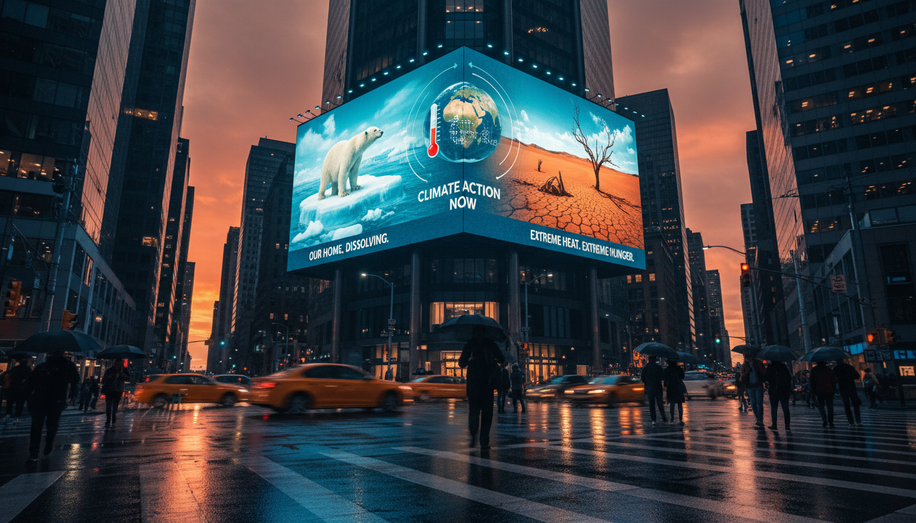
Beyond reach, OOH excels in driving behavioral change through creative, high-impact visuals. Research published in PLOS Climate demonstrates the medium’s potency for social issues like climate action. Creative OOH campaigns, such as those featuring bold imagery of melting ice caps or polluted waterways, garnered higher engagement than targeted digital ads. General messaging on climate change outperformed niche topics like sustainable fashion, proving that provocative, large-scale displays provoke reflection and action. Activists have taken note: organizations like Forest and Bird in New Zealand leveraged celebrity-backed OOH installations to fundraise and shift public opinion, bypassing echo chambers to reach skeptics in the physical world.
Cost-effectiveness further cements OOH’s role in resource-strapped public campaigns. Traditional and digital formats alike offer high return on investment, with impressions measured in the millions for a fraction of TV ad spends. Wilkins Media points to home services PSAs—think roofing safety or disaster preparedness—that use OOH to target local audiences precisely, generating leads for community programs. Digital OOH adds interactivity: QR codes on billboards link to resources, motion sensors trigger personalized messages, and augmented reality overlays invite shares on social media, exponentially amplifying a PSA’s footprint.
Real-world results abound. OAAA data shows OOH enhancing consumer journeys, from awareness to advocacy. In public health drives against opioid abuse, transit ads in affected cities correlated with increased hotline calls. Anti-smoking campaigns blanketed stadiums and street furniture, contributing to declining youth tobacco rates. Even in fostering social cohesion, OOH has bridged divides—immigration awareness efforts or mental health PSAs placed in diverse neighborhoods have destigmatized help-seeking, as evidenced by upticks in service utilization.
Critics might argue that OOH’s static nature limits depth, but evolving technologies counter this. Programmatic digital OOH enables real-time tailoring—weather-triggered flood warnings or election-day reminders—while analytics track foot traffic and online conversions. As Broadsign notes, these tools quantify influence, proving OOH’s synergy with mobile and social channels.
Looking ahead, with OOH projected to dominate media mixes into 2026 and beyond, its role in PSAs will only grow. Governments and nonprofits must invest strategically: prioritize high-traffic locales, embrace creativity, and measure outcomes rigorously. In a fragmented media landscape, OOH remains the great unifier, plastering public spaces with calls to action that resonate long after the commute ends. By driving awareness and igniting engagement, it doesn’t just inform communities—it empowers them to change.