
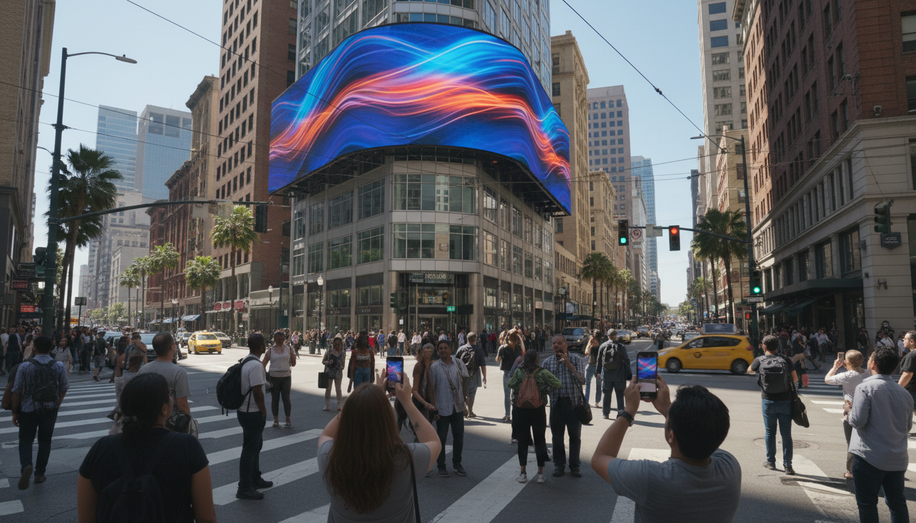

In an era where consumer attention spans are fragmenting across countless digital touchpoints, out-of-home advertising has emerged as an unexpectedly powerful anchor in integrated marketing strategies. Far from being a relic of traditional media, OOH has evolved into a critical catalyst that drives consumers from physical spaces directly into digital channels, creating a seamless brand experience that extends far beyond the billboard or transit ad.
The fundamental shift in how marketers view OOH begins with understanding its unique strength: unavoidability. Unlike digital ads that consumers can skip, scroll past, or ignore through ad blockers, out-of-home advertising commands attention through sheer physical presence. A commuter cannot ignore a well-placed billboard on their daily route, nor can a pedestrian avoid an eye-catching transit advertisement. This forced engagement creates a critical first impression that serves as the perfect launching point for deeper digital interaction.
What makes OOH truly transformative in modern marketing is not the advertisement itself, but what happens after someone sees it. The integration of QR codes, branded hashtags, and memorable short URLs transforms passive billboard viewers into active digital participants. A consumer sees a striking creative on Reforma Avenue, scans the QR code with their smartphone, and immediately lands on a personalized mobile experience. They engage with a landing page, follow a social media account, or discover a location-based promotion. In that single moment, OOH has accomplished what digital alone struggles to do: it has pulled an audience member into a branded ecosystem with intentionality and purpose.
This integration works precisely because it leverages the distinct strengths of each channel. OOH excels at creating mass awareness and perception. Billboards in high-traffic areas establish legitimacy and cultural relevance, signaling to audiences that a brand is significant enough to command premium advertising real estate. This perception of scale and importance cannot be easily replicated through digital channels alone. Conversely, digital channels excel at driving measurable engagement, conversion, and ongoing dialogue. Social media allows brands to tell deeper stories, respond to consumer feedback, and create community around their offerings.
When strategically combined, these channels amplify each other’s impact exponentially. Research consistently demonstrates that consumers exposed to both OOH and digital messaging from the same brand are significantly more likely to take action than those exposed to either channel in isolation. The repetition across channels reinforces messaging while the variation in format maintains novelty and engagement.
The data supports what intuition suggests: this integrated approach works especially well with younger, urban, and diverse audiences who are simultaneously consumers of traditional and digital media. A millennial seeing a photo-worthy billboard design is incentivized to capture and share it on Instagram, extending the campaign’s reach far beyond the physical location. That social share introduces the brand to the original viewer’s entire network, creating organic amplification that pure paid media cannot achieve.
For brands implementing integrated campaigns, the key principle is consistency with adaptability. The core message and brand identity must remain recognizable across OOH and digital channels, yet each medium should play to its strengths. A billboard should communicate the essential brand idea in seconds, while a social media follow-up can provide nuance, storytelling, and interactivity. A transit advertisement might drive traffic to a specific landing page, while a retargeting campaign builds on that initial exposure with personalized messaging.
The most successful brands recognize that OOH and digital are no longer separate ecosystems competing for attention and budget. Instead, they function as interconnected components of a unified strategy. OOH builds awareness and drives initial consumer action, while digital sustains engagement and facilitates conversion. Together, they create multiple opportunities for brand interaction across the customer journey.
As marketing continues to evolve, out-of-home advertising’s role as a powerful amplifier of digital strategy will only grow more important. In a world of infinite digital choices, the tangible, unavoidable presence of OOH provides the foundation upon which truly integrated, multi-touchpoint marketing campaigns are built.