
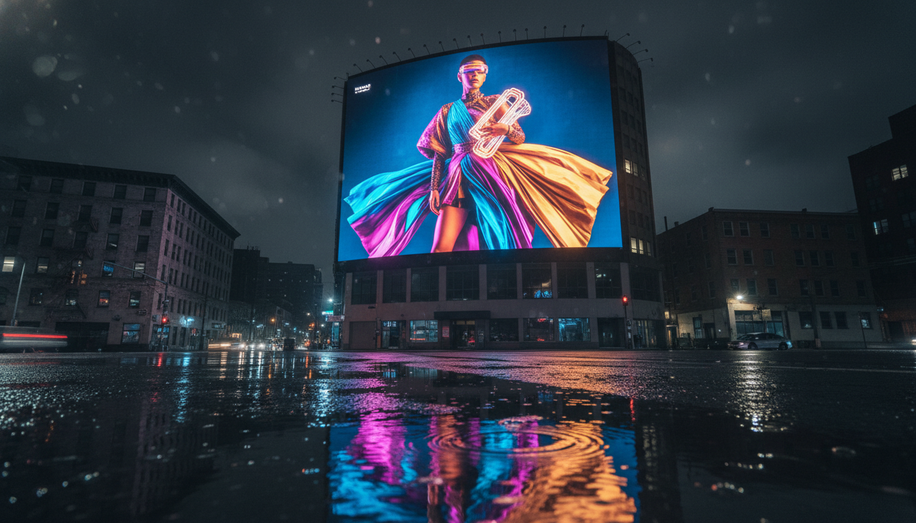

Artificial intelligence is no longer just a back-end efficiency tool for advertisers; it is increasingly shaping the creative work itself. In out-of-home advertising, where messages must compete with traffic, motion, weather, and the split-second attention of passing audiences, AI is becoming a practical assistant from the earliest brainstorming stages through final campaign optimization. What once required long creative cycles, multiple rounds of mockups, and heavy manual testing can now be accelerated with systems that generate concepts, draft copy, adapt visuals, and help predict what will resonate in a specific location or format.
The first major shift is happening at the idea stage. OOH campaigns have always depended on a simple but demanding premise: say something memorable, instantly, and in a way that makes sense in context. AI tools can help creative teams explore more ideas faster by analyzing brand inputs, audience data, seasonal trends, and even cultural references relevant to a market. A planner designing for a commuter rail platform may receive different conceptual directions than one working on a highway billboard or a mall digital screen. AI can surface those distinctions quickly, suggesting themes, taglines, and visual metaphors that fit the medium. Rather than replacing strategists, it expands the range of possible starting points, which is especially valuable when brands need to localize campaigns across multiple cities or neighborhoods.
Once a concept is established, AI is also proving useful in visual generation. Generative image tools can produce rough layouts, product scenes, environmental backdrops, or stylized compositions that help creative teams move from abstract ideas to tangible executions. For OOH, where sightlines and scale matter, this capability is particularly useful. Designers can ask AI to create variations that emphasize bold contrast, large typography zones, or simplified compositions better suited to quick viewing distances. A campaign that will appear on a transit shelter, for instance, may require a different visual hierarchy than one designed for a massive roadside format. AI-generated prototypes allow teams to test those differences early, before investing time in full production.
Copywriting is another area where AI is changing the workflow. OOH copy has always demanded discipline: fewer words, sharper hooks, and immediate clarity. AI can help generate headline options, condense verbose messaging, and adapt tone for different placements. A witty line for a pedestrian-heavy district might not work on a freeway-facing board, where legibility and instant comprehension are paramount. AI can draft multiple versions tailored to those scenarios, allowing writers to compare approaches and refine the message with more speed. The strongest use cases tend to be collaborative, with human editors sharpening the language to preserve brand voice and ensure that the final line feels deliberate rather than machine-made.
Beyond ideation and drafting, AI is increasingly valuable in design refinement. By analyzing previous campaigns, engagement patterns, and performance data, AI systems can identify which creative elements drive attention. Colors, pacing, iconography, image density, and text length can all be assessed against location-specific outcomes. For digital OOH, where content can change dynamically, this becomes even more powerful. A campaign can be adjusted based on time of day, traffic flow, audience profile, or local conditions, enabling advertisers to match creative to context in near real time. That flexibility gives OOH something closer to the responsiveness long associated with digital channels, while preserving the scale and visibility that make the medium distinctive.
The optimization phase may be where AI delivers the clearest value. Instead of treating OOH creative as a static asset, advertisers can use AI to learn from performance and iterate continuously. Digital screens can rotate multiple versions of an ad, while analytics tools assess which executions appear to drive stronger attention or downstream response. Over time, AI can help brands decide whether a campaign performs better with a product-led visual, a lifestyle image, a stronger offer, or a simplified headline. This matters in OOH because effectiveness often depends on tiny creative decisions that are hard to evaluate intuitively. AI adds a layer of evidence to what was once largely a judgment call.
Still, the promise of AI in OOH creative generation is not about automation for its own sake. The medium remains fundamentally human in how it works: it relies on cultural relevance, emotional timing, and an understanding of place. AI is best viewed as an accelerant, not an author. It can help teams explore more options, react faster, and optimize more intelligently, but the most effective campaigns will still depend on human oversight, brand strategy, and a strong grasp of what makes a message land in the physical world.
As OOH becomes more data-rich and digitally connected, the role of AI in creative development is likely to deepen. The next generation of campaigns will probably be built through a more fluid loop: concept, generation, review, test, optimize, repeat. For advertisers, that means faster production and more relevant messaging. For the medium, it could mean creative that is not only bigger and bolder, but also smarter.
Blindspot directly complements this AI-driven evolution by providing the essential data backbone for informed creative decisions. Its real-time campaign performance tracking, audience measurement, and location intelligence empower advertisers to validate AI-generated creative variations, dynamically optimize messaging across programmatic DOOH networks, and ensure smarter, more relevant campaigns land with precision. Discover how at https://seeblindspot.com/.