
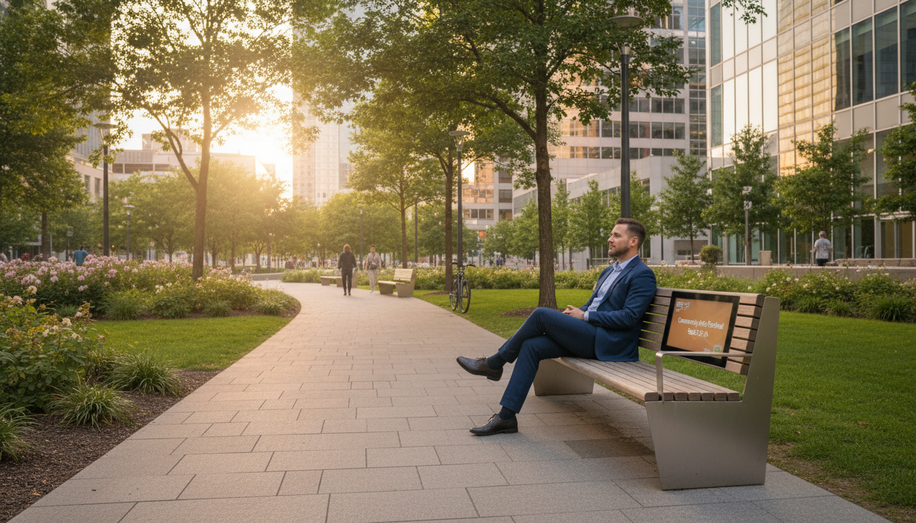

The return to outdoor mobility has not been a simple snapback to pre-pandemic norms. For out-of-home advertisers, the biggest change is not just where people are traveling, but when, why, and how often they move. A growing share of the workforce now splits time between home, office, and a third set of places—cafés, gyms, coworking spaces, neighborhood parks, and school-run routes—creating a more fragmented audience and forcing OOH planners to think beyond the old commuter corridor.
That shift matters because the traditional logic of OOH was built around predictable flows: morning inbound traffic, evening outbound traffic, weekday station capture, and repeat exposure along a fixed route. Hybrid and remote work have weakened those patterns. Office districts still matter, but many workers appear there only on selected days, often later in the week, while Monday and Friday traffic can be noticeably lighter. At the same time, suburban and secondary-market movement has become more important as people spend more time near home. For brands, the implication is clear: audience planning can no longer rely on a single peak-commute model. It must account for distributed routines and local, recurring trips that now create the new high-frequency exposure opportunities.
This is where OOH has regained strategic value. Far from being less relevant in a remote-work era, the channel has become more adaptable to it. Digital out-of-home, in particular, allows advertisers to place messages closer to where remote workers actually spend their day. That may mean roadside boards near residential clusters, transit shelters in mixed-use neighborhoods, screens in grocery and fitness environments, or placements near business districts on the specific days when office attendance rises. The shift from mass commuter targeting to micro-mobility targeting is one of the defining planning changes of the post-pandemic period.
Local relevance has become a stronger currency than sheer scale. Remote workers are not a monolithic segment, but they do share certain patterns: they are more likely to move around their immediate area during the day, to make spontaneous purchases, and to respond to contextually useful messaging. Ads near lunch spots, weekend retail hubs, and neighborhood recreation areas can capture attention when people are out of the home and receptive to nearby offers. For brands seeking frequency rather than just reach, these local networks can be more valuable than a handful of premium downtown assets that only see part-time traffic.
The creative brief has changed too. With a dispersed audience, OOH messages need to work in moments that are less routinized and more situational. The old formula of “big brand, big image, big message” still has power, but it is increasingly effective when tied to an immediate need or environment. For remote workers who may be juggling errands between meetings, creative that speaks to convenience, flexibility, or a nearby solution can outperform generic awareness messaging. That is why dayparting, weather triggers, and location-specific copy have become more important in DOOH. A lunch offer, a same-day service pitch, or a commute-to-coworking nudge can feel far more relevant than a broad brand statement.
There is also a social dimension to the new OOH landscape. Remote workers are still digitally connected, even when they are physically dispersed. A well-placed outdoor execution can become a social asset if it is visually distinctive, locally resonant, or interactive enough to be photographed and shared. That makes creative consistency across OOH and social especially important. The most effective campaigns often do not stop at exposure; they create a bridge to mobile search, social discovery, or direct response. In a market where people are harder to catch in one fixed place, the handoff from physical attention to digital action becomes critical.
Planning for the remote workforce also means rethinking measurement. If the audience is less concentrated at rush hour and more spread across neighborhoods and dayparts, advertisers need more sophisticated ways to evaluate performance. Footfall near media sites, device exposure data, search lift, social engagement, and store visitation can all help determine whether a campaign is reaching the right mix of hybrid workers, fully remote professionals, and office returners. In many cases, the goal is not just broad awareness, but influence across multiple local touchpoints.
The post-pandemic workforce has made OOH more complex, but also more interesting. Advertisers are no longer chasing a single commuter mass; they are navigating a moving mosaic of routines. That demands more precise site selection, more flexible creative, and closer integration with digital channels. For the brands willing to adapt, the payoff is significant: OOH can still deliver public-scale visibility, but now with a level of contextual relevance that matches the way people actually live and work today.