
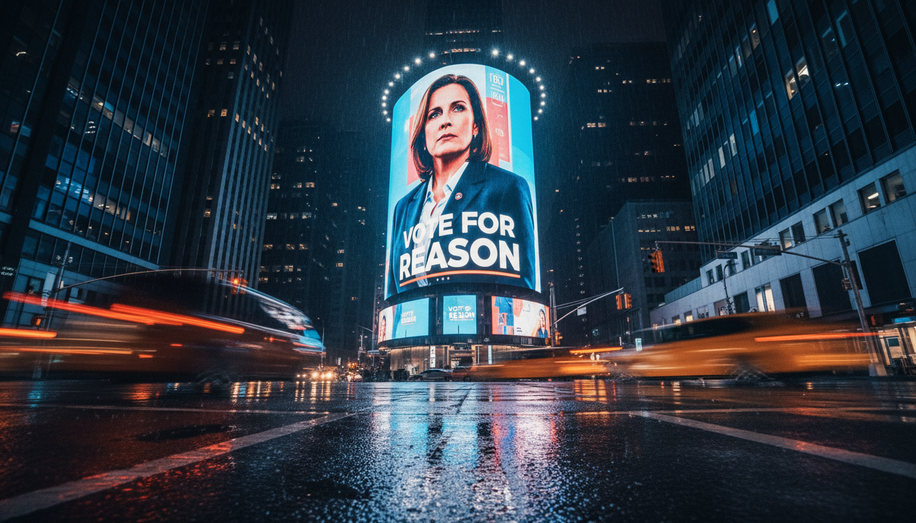

In an election cycle defined by fragmented media habits and voter fatigue, out-of-home advertising has become one of the few channels that can still command broad, real-world attention. Political campaigns are rediscovering an old truth: you can’t scroll past a billboard on your commute. From freeway spectaculars to digital transit screens, OOH is emerging as a central tool for building candidate awareness, shaping narratives, and nudging turnout in precisely the neighborhoods that matter most.
Part of OOH’s appeal is structural. As linear TV ratings erode and digital platforms face growing skepticism over misinformation and ad clutter, OOH offers a high-visibility environment with comparatively low noise. Recent industry research shows OOH ad revenues hitting record highs, with political spend a key growth driver. The Out of Home Advertising Association of America reports that a large majority of likely voters have seen political messages on OOH formats, and a significant portion describe those messages as influential and trustworthy. That trust premium matters in a polarized environment where voters increasingly question what they see online.
Political strategists are also drawn to OOH’s cost efficiency. When TV inventory in battleground markets sells out or commands premium rates, billboards and transit posters often deliver lower CPMs and CPPs while still reaching mass audiences. Campaigns that once treated OOH as a nice-to-have brand play are now making it a core pillar of their media plans, especially in the final stretch of a race when fundraising spikes and every impression counts. The channel’s ability to “work while everything else sleeps” – continuously visible, unskippable, and always on – provides a kind of ambient presence that digital banners or 30-second spots struggle to replicate.
Crucially, OOH’s power in politics is not just about scale but geography. Roughly 85 percent of political OOH spend is local, reflecting how carefully campaigns map their priorities onto specific ZIP codes, commuter corridors, and neighborhoods. A statewide candidate may blanket major interstates and urban cores to create a drumbeat of name recognition, while a congressional challenger zeroes in on swing suburbs and exurban park-and-ride lots where undecided voters park their cars every weekday. By aligning message and medium with local context – a crime-focused message near a transit hub, an economic pitch in a business district, a voting-rights reminder near a college campus – campaigns turn everyday journeys into repeated impressions.
Digital out-of-home has pushed this localization even further. Programmatic DOOH platforms allow campaigns to buy impressions around specific points of interest and dayparts, using anonymous mobility and demographic data to align creative with audience patterns. A campaign can rotate Spanish-language spots during evening commute hours in a heavily Hispanic corridor, then shift to issue-based messaging in the same location during morning drive when a different mix of commuters is on the road. When a breaking news event shifts the conversation, creatives can be swapped within hours across digital billboards and transit networks, letting campaigns respond in near real time without reprinting a single poster.
This agility extends beyond the screen. Many political media teams now pair DOOH buys with mobile retargeting, using device IDs exposed to a board or transit screen to later serve digital ads on smartphones and connected TVs. In practice, that means a voter who sees a billboard touting a candidate’s economic plan on the highway might later receive a video ad with deeper policy detail or a prompt to register for an early voting reminder. OOH becomes both the first touch and a high-quality seed for broader omnichannel engagement, knitting together offline visibility and online persuasion.
The creative strategy behind political OOH has evolved to match these capabilities. Campaigns have learned that a crowded message board is a wasted board; the most effective executions are stripped down and declarative, designed for a two-second glance at 55 miles per hour or a quick look across a bus platform. Name, office sought, and a single positioning line remain foundational, but message discipline has sharpened. In competitive races, one candidate might dominate with positive, trust-building themes while outside groups deploy contrast or attack creatives on separate boards, using the same physical environment to frame a narrative battle.
Turnout operations are also harnessing OOH’s strengths. In the weeks before Election Day, static and digital units increasingly pivot from persuasion to mobilization, counting down to registration deadlines, early voting windows, and the final day of voting. Transit shelters near historically low-turnout precincts carry reminders of polling locations and hours, sometimes paired with QR codes that direct voters to official information. Because these messages appear in the same neighborhoods where people live and commute, they can normalize the idea of voting as a routine civic errand rather than a burdensome exception.
For OOH media owners, the surge in political demand brings both opportunity and responsibility. Rate regulations and equal-access rules require careful management of candidate inventory, particularly in hotly contested markets where every board becomes a strategic asset. At the same time, the sector’s growing political role underscores the importance of maintaining high standards around verification, disclosure, and content policies, especially as digital formats enable more dynamic and potentially contentious messaging.
What is clear heading into the next rounds of elections is that out-of-home has moved from the margins to the heart of political communication strategy. In an era when so much of the campaign conversation is mediated by algorithms and filtered feeds, OOH occupies a different kind of space: shared, physical, and hard to ignore. By meeting voters where they live and commute – on highways, city streets, and transit lines – campaigns are rediscovering that sometimes the most effective way to influence public opinion is still the simplest: show up, in the real world, again and again.