
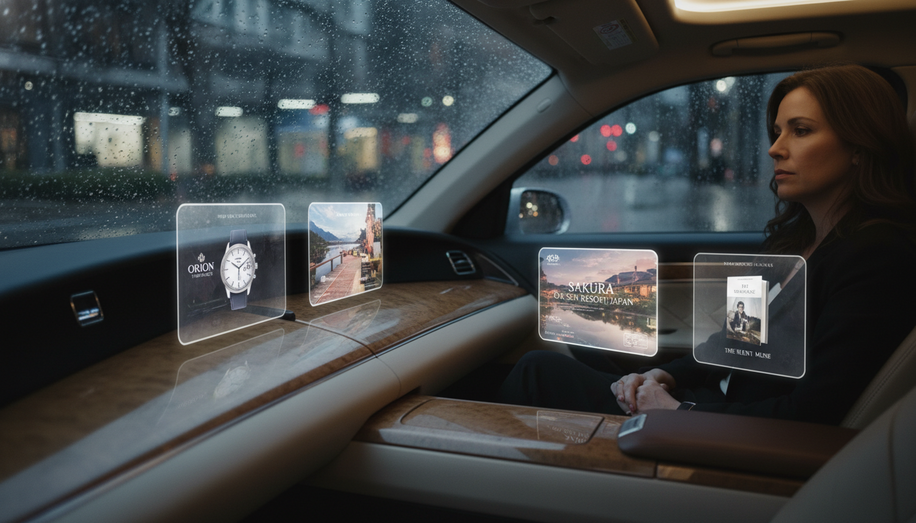

For more than a century, out-of-home advertising has relied on a simple truth: people in cars look out of windows. The rise of autonomous vehicles won’t change that fundamental behavior, but it will radically reshape when, how, and why people engage with what they see. As driving duties migrate from human hands to intelligent systems, OOH is on the cusp of a new commuter experience—one where time, attention, and connectivity converge in ways the industry has never seen before.
Consultants like McKinsey estimate that autonomous vehicles could free up as much as 50 minutes per day for former drivers. That’s not just a productivity gain; it’s an attention windfall. Instead of staring at the bumper ahead or checking mirrors, riders will be free to read, watch, scroll—and look around. The windshield becomes less of an instrument panel and more of a cinema screen framing the city. For OOH, this means the traditional “glance” might evolve into something closer to a “session,” with longer dwell times and more opportunities to initiate deeper interactions.
Placement strategy will feel the impact first. Today’s roadside inventory is often optimized for safety and legibility at 65 miles per hour, designed for fleeting peripheral vision. In a driverless future, speed will still matter, but the mental load of driving will not. That opens the door to more immersive storytelling along key corridors, particularly on routes popular with shared autonomous fleets. High-frequency commuting paths, airport connectors, and hub-to-hub logistics arteries—already central to many OOH plans—could become even more valuable as captive-audience channels. At the same time, we should expect growth in street-level and near-curb assets as cities slowly reallocate parking and driving lanes for mixed-use, pedestrian-friendly spaces where AVs pick up and drop off passengers.
The shift to autonomous mobility is also a shift in what the “ride” means. Transportation researchers point out that AVs are likely to encourage longer trips and more distributed living patterns, especially if travel becomes more comfortable and productive. That could reshape the balance between urban cores and suburbs—and with it, the OOH map. As underused parking lots are redeveloped and some road space is repurposed, media owners and city planners will have both a challenge and an opportunity: reimagining OOH as part of a more flexible, mixed-use public realm rather than a static roadside fixture. Screens integrated into smart benches, transit shelters, sidewalk kiosks, and mobility hubs will become critical touchpoints that complement what riders see from the vehicle itself.
Inside the vehicle, the experience will be defined by connectivity. Autonomous cars will be rolling media environments, equipped with high-speed data, large displays, and personalized interfaces. That’s where the relationship between OOH and digital ecosystems gets genuinely interesting. As several industry reports have suggested, once the car takes on the cognitive load of driving, external screens can “talk” to the vehicle and, by extension, to the passengers. The billboard becomes a trigger: a dynamic, geotargeted prompt that hands off to an in-car app, a second-screen experience, or even an augmented-reality overlay on the windows.
The implication for creative content is profound. OOH will still need the punchy simplicity that works at a distance, but the call to action can evolve. Rather than asking someone to remember a URL or scan a QR code at a red light, ads can prompt a one-tap interaction on a dashboard or mobile device the moment the screen comes into view. That enables sequential storytelling: a bold visual and short message on the roadside, followed by richer content—video, configurators, utility-based tools—inside the vehicle. A restaurant ad could seamlessly offer a menu, wait times, and an instant reroute. A retail brand could turn a passing impression into a personalized offer that follows the rider to their next destination.
Of course, this more intimate relationship raises questions about privacy, consent, and intrusiveness. The technical ability to connect an external screen with an individual’s device or in-car system does not automatically mean it should be used to its full extent. Regulators are already grappling with how to govern data flows in connected vehicles, and the OOH sector will need to be proactive in setting standards. Transparency, opt-in mechanisms, and clear value exchange will be essential if passengers are to welcome, rather than resist, heightened levels of interaction.
Content itself will likely become more contextual and experiential. If autonomous vehicles reduce crashes and congestion, as many expect, the emotional tenor of commuting could shift from stress and urgency to something closer to “me time.” Marketers are already being advised to frame the driverless experience around freedom, productivity, and well-being. That ethos is tailor-made for OOH. Instead of shouting for attention, ads can position themselves as part of a curated journey: entertainment recommendations synced to travel time, neighborhood stories surfaced as you enter a district, sustainability narratives aligned with low-emission mobility.
At the same time, the physicality of OOH will remain a strategic advantage in an increasingly virtual media world. As AV adoption grows, cities may reduce on-street parking, introduce new greenways, and reconfigure curb space. The inventory that survives and the inventory that’s created will be more tightly integrated into architecture and urban design—digital murals, responsive façades, media-enabled public furniture. Seen from a driverless car, these won’t just be “ads”; they’ll be landmarks and wayfinding cues in a reimagined cityscape. In an environment where in-car screens can deliver hyper-targeted feeds, the shared visibility of OOH may become even more valuable as a cultural and commercial common denominator.
The timeline matters. Fully autonomous, Level 5 vehicles operating everywhere are still years away, and forecasts suggest a gradual build-up through semi-autonomous features and dedicated fleets. That gives OOH stakeholders time to experiment. Early partnerships with mobility providers, pilot programs around smart corridors, and data-sharing initiatives with cities can help the industry understand how attention shifts as automation increases. Crucially, media owners and advertisers should think less in terms of “billboard versus screen” and more in terms of an integrated commuter experience spanning street, vehicle, and device.
As vehicles learn to drive themselves, the real competition will be over how people choose to spend their liberated minutes in motion. Out-of-home has a rare opportunity: it sits at the intersection of physical place, digital connection, and everyday routine. Designing for the new commuter experience means leaning into that position—not just to be seen, but to be genuinely useful, entertaining, and memorable to passengers who, for the first time, have the time and freedom to truly look around.
As the industry navigates this transformation, sophisticated tools will be indispensable. Platforms like Blindspot, with their advanced location intelligence, audience measurement, and programmatic DOOH capabilities, will empower media owners and advertisers to strategically identify optimal placements, quantify the new attention windfall, and orchestrate integrated campaigns that bridge the physical and digital commuter experience. This will ensure OOH remains not just visible, but genuinely useful and impactful in the age of autonomous mobility. https://seeblindspot.com/