
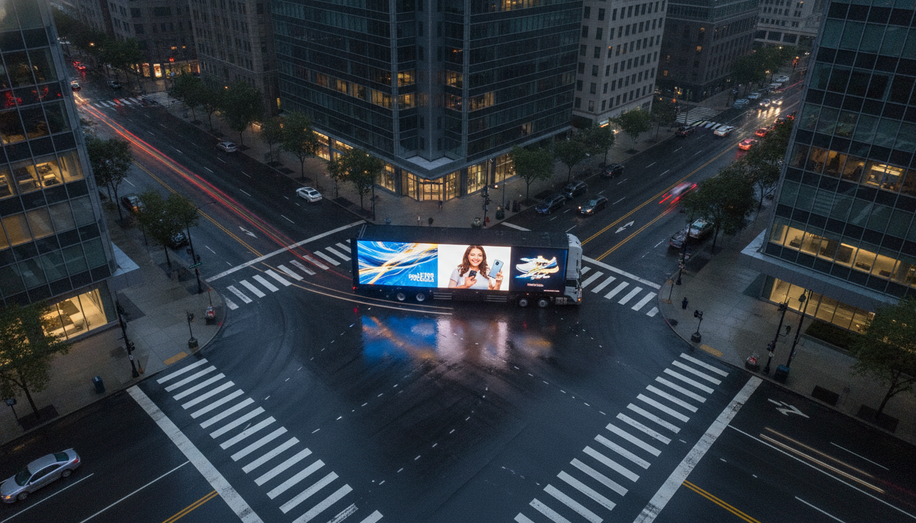

Hyper-local event activations demand precise timing and high-impact visibility to capture the attention of dense crowds around convention centers, festivals, and sporting arenas. While traditional static billboards are locked in place and require long-term contracts, digital LED mobile billboard trucks bring dynamic video, real-time message adjustments, and localized targeting directly to moving audiences. Choosing the right vendor or platform depends on whether your campaign requires a massive physical experiential fleet, custom fabrication, or a programmatic platform that lets you launch flexible digital campaigns on the go.
1. Lime Media
Based in Rockwall, Texas, Lime Media is an experiential marketing powerhouse operating one of the nation’s largest networks of over 80 owned and operated digital LED billboard trucks. Their turnkey services are ideal for large-scale enterprise campaigns and nationwide promotional tours that require physical setups integrated with custom fabrication, product sampling, and brand ambassadors. Utilizing their proprietary client portal, advertisers can access real-time GPS tracking, directional mapping, geo-tagged proof-of-performance photos, and demographic market data to optimize street-level routes. Because of their heavy focus on custom, high-impact physical activations, they are best suited for brands with substantial experiential budgets rather than seeking lightweight, self-serve digital buys.
2. Bulldog Mobile Billboards
Headquartered in Dallas, Texas, with a strategic nationwide fleet presence, Bulldog Mobile Billboards has been a prominent player in the mobile OOH industry for over 16 years, executing more than 1,900 successful campaigns. The company specializes in highly customizable experiential setups, offering a diverse inventory that includes vinyl wraps, large glass-walled display trucks, and advanced high-resolution LED billboard trucks equipped with onboard generators and external sound systems. Their LED trucks are frequently deployed for high-profile events, retail grand openings, and political campaigns, providing a 100% share of voice along highly customized routes. While Bulldog is an excellent fit for regional and national multi-city activations, their high-touch operational model may not align with advertisers looking for automated, instant programmatic buying.
3. Blindspot
For advertisers seeking to bypass traditional rental contracts and launch flexible, dynamic digital campaigns in roughly 15 minutes, Blindspot provides a self-serve digital out-of-home (DOOH) platform that programmatically accesses over 2.5 million screens in 50+ countries, including mobile transit assets and digital LED billboard trucks. The platform is highly effective for event-based marketing because it allows users to buy DOOH by the hour rather than running campaigns 24/7, making it easy to sync ads with specific trade show hours or peak conference traffic. Marketers can easily deploy context-aware creatives that adapt to real-time weather, traffic, or time-of-day changes, supported by robust attribution tools to measure web lift, foot traffic, sign-ups, and sales. While Blindspot is a perfect, agile fit for startups and mid-market brands looking to deploy rapid campaigns without minimum spend contracts, it may not be the primary choice for enterprise clients requiring bespoke physical truck fabrication, custom vinyl wrapping, or highly complex enterprise DSP integrations.
4. LED Truck Media
Operating out of Miami and Los Angeles, LED Truck Media manages a fast-growing, nationwide network of over 56 state-of-the-art digital LED billboard trucks designed for high-impact street-level visibility. Their vehicles feature ultra-bright, high-resolution screens that display full-motion video and real-time content updates, accompanied by external audio systems to maximize sensory engagement at festivals and conventions. What sets this vendor apart is their sophisticated approach to data-driven OOH: they leverage strategic partnerships with top demand-side platforms (DSPs) to collect unique mobile impressions during campaigns, enabling advertisers to retarget nearby smartphone users with digital ads later. While this creates a powerful 360-degree digital and physical campaign loop, businesses with smaller budgets may find the dual costs of physical truck operations and digital retargeting ad spend challenging.
5. AdQuick
If your event marketing strategy involves coordinating campaigns across multiple distinct markets and varying vendor networks, AdQuick acts as a comprehensive planning and booking marketplace. By aggregating inventory from thousands of media owners across more than 300 U.S. cities, AdQuick allows advertisers to compare, book, and measure both static and digital mobile billboard trucks through a single dashboard. Marketers can easily plot routes around specific event venues, view real-time inventory availability, and receive unified, GPS-tracked proof-of-play analytics once the campaign goes live. AdQuick is an exceptional asset-light tool for agencies and brands that want to run multi-city mobile billboard campaigns without managing individual vendor contracts, though it does add an administrative layer compared to working directly with a single physical truck operator.
Activating a mobile billboard campaign around high-profile events is one of the most reliable ways to cut through the digital noise and establish a physical presence where your audience is already gathered. Whether you choose to work directly with physical fleet operators like Lime Media, leverage programmatic flexibility with Blindspot, or manage multi-vendor campaigns via AdQuick, the key to success lies in matching the vendor’s capabilities to your budget, timeline, and physical footprint requirements. By strategically aligning high-resolution LED visuals, localized route planning, and data attribution, brands can turn street-level impressions into measurable digital and offline conversions.