
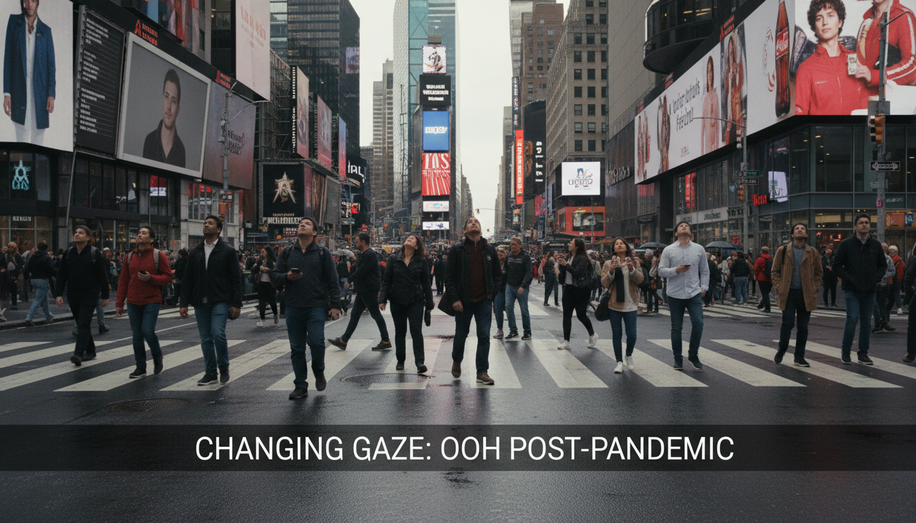

The COVID-19 pandemic fundamentally reshaped how consumers interact with public spaces, forcing out-of-home advertisers to fundamentally reimagine their strategies and adapt to dramatically altered behavioral patterns. What emerged from this disruption is an industry transformed by technological innovation, pricing flexibility, and a renewed focus on understanding where consumers actually spend their time in the post-pandemic world.
During lockdowns, the outdoor advertising industry faced an existential crisis. Foot traffic plummeted as people remained indoors, and advertisers encountered a stark reality: traditional billboard placements along highways and in transit hubs became far less valuable when commuters disappeared. Pricing collapsed during this period, reflecting the brutal economics of empty streets and shuttered venues. However, this contraction revealed a critical insight about consumer behavior that would reshape OOH strategies going forward. Advertisers discovered that when people were confined to their homes and immediate neighborhoods, they focused their outdoor activities on essential services and local destinations. Grocery stores, banks, and neighborhood retail locations became the new high-value advertising real estate, replacing the premium rates traditionally commanded by airport displays and downtown transit hubs.
As vaccination campaigns accelerated and restrictions eased, the industry witnessed a dramatic reversal. People returned to public spaces, and with them came a resurgence in OOH advertising value. Airport advertising rates soared by 10-15% in 2024-2025 as travel resumed and commuting patterns normalized. Yet this recovery was not simply a return to pre-pandemic conditions. Instead, it catalyzed a permanent shift in how the industry approached consumer targeting and campaign flexibility. Advertisers recognized that consumer behavior had become more volatile and unpredictable, necessitating greater adaptability in their media buying strategies.
This need for flexibility gave rise to one of the most significant post-pandemic trends: the widespread adoption of short-term contracts and dynamic pricing models. Rather than committing to fixed-length campaigns with static messaging, brands now increasingly demand the ability to pivot campaigns quickly in response to changing circumstances. Digital out-of-home advertising emerged as the ideal solution, enabling advertisers to update creative content in minutes rather than weeks. By 2023, digital outdoor advertising spending had grown to $17.6 billion, representing a 19.2% increase and demonstrating that brands recognized the value of this flexibility.
The pandemic also accelerated the integration of data analytics into OOH advertising pricing and strategy. Where location alone once determined rates, sophisticated measurement now plays an increasingly central role. Advertisers can now leverage artificial intelligence and real-time viewership analytics to understand exactly how many people see specific advertisements and how they engage with them. This data-driven approach has made pricing more precise and equitable, allowing advertisers to invest their budgets more strategically based on actual performance metrics rather than assumptions about foot traffic patterns.
Consumer behavior itself has undergone lasting changes that extend beyond simply returning to previous routines. Research indicates that consumers have developed heightened awareness of their surroundings and altered preferences for where they spend time. Additionally, consumers increasingly gravitate toward brands that demonstrate empathy and social responsibility, with preferences for environmentally conscious companies becoming more pronounced. These shifted values have prompted the OOH industry to explore sustainable solutions, including solar-powered billboards and energy-efficient displays that align with consumer expectations.
The path forward involves hybrid models that blend traditional and digital OOH formats, allowing advertisers to leverage the strengths of both approaches while maintaining adaptability. Premium high-traffic locations remain valuable, but their value is now properly calibrated based on genuine performance data rather than historical assumptions. As the industry continues its evolution, success increasingly depends on understanding these transformed consumer behaviors and responding with strategies that offer flexibility, measurability, and alignment with contemporary values. The pandemic did not simply disrupt OOH advertising; it fundamentally modernized the industry’s approach to reaching consumers in an increasingly complex and unpredictable world.