
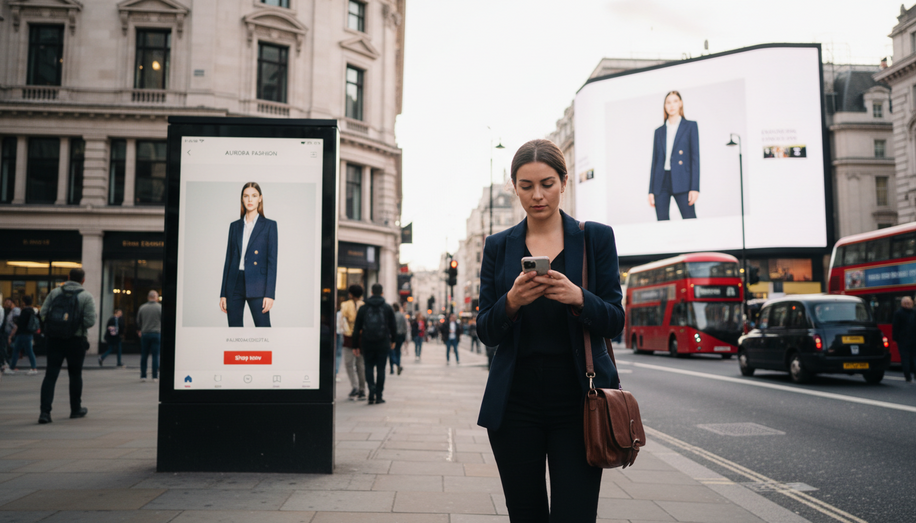

In the evolving landscape of advertising, out-of-home (OOH) campaigns are no longer standalone spectacles but vital components of seamless cross-channel strategies that blend physical presence with digital precision. By integrating OOH with online platforms, brands achieve unified messaging that amplifies reach, boosts engagement, and drives measurable conversions, creating immersive experiences consumers encounter across their daily journeys.
This convergence harnesses OOH’s unmatched ability to capture broad audiences in high-traffic environments—think bustling commutes, urban billboards, and transit hubs—while digital channels provide the data-driven targeting and interactivity that turn passive impressions into active interactions. Brands that synchronize these mediums report extended reach and frequency, with consumers encountering consistent narratives from a roadside digital screen to their social feeds, fostering deeper brand recall and affinity. For instance, a commuter spotting a provocative OOH ad might later receive a tailored mobile retargeting ad, reinforcing the message and guiding them toward purchase.
Central to effective integration is the use of interactive elements embedded directly into OOH displays. QR codes, NFC tags, and augmented reality (AR) experiences invite immediate smartphone engagement, bridging the physical ad to digital realms. A consumer scans a QR code on a billboard, unlocking personalized content, promotions, or gamified challenges that encourage sharing on social media. This not only heightens interactivity but also generates user-generated content, extending the campaign’s lifespan organically. Mobile-optimized calls-to-action ensure these transitions feel effortless, directing users to dedicated landing pages or microsites where they can explore offers, enter contests, or complete purchases.
Social media serves as a powerhouse amplifier in this ecosystem, transforming OOH moments into shareable viral phenomena. Branded hashtags displayed prominently on digital OOH screens prompt real-time participation, while geo-targeted social ads align with physical placements to create synchronized local experiences. Brands like those leveraging Clear Channel Outdoor’s dynamic billboards aggregate live social feeds, reposting user content to fuel community-driven momentum. Social listening tools then monitor conversations sparked by OOH exposures, allowing real-time sentiment analysis and responsive tweaks that keep campaigns agile and resonant.
Data integration elevates these efforts from intuitive to empirical. By merging OOH impression data with digital analytics—via mobile attribution models, geolocation tracking, and brand lift surveys—marketers gain holistic visibility into consumer paths. Proximity-based targeting, for example, has driven over 1.3 million additional store visits in proven campaigns, while cross-channel approaches yield 2-3 times higher engagement than siloed efforts. Retargeting reconnects those exposed to OOH with personalized online ads, boosting conversion rates by up to 65 percent through coordinated messaging across email, display, and connected TV.
Consider the practical orchestration: A national beverage brand launches OOH displays in key commuter corridors featuring AR filters tied to a campaign hashtag. Viewers interact via their phones, sharing filtered selfies that populate live social walls on the same screens. Geo-fencing captures nearby devices for retargeting with e-commerce discounts, while integrated analytics track lift in app downloads and sales. This closed-loop strategy ensures every touchpoint contributes to a unified story, maximizing ROI in an omnichannel world.
Challenges persist, particularly around measurement in a fragmented media environment. Traditional OOH metrics like impressions have evolved with digital tools, yet attribution remains complex amid privacy regulations and cross-device behaviors. Savvy advertisers counter this by prioritizing high-ROI locations—urban districts, retail vicinities—where exposure aligns with intent, and by employing advanced platforms for clean data flows.
Looking ahead to 2026, digital out-of-home (DOOH) innovations will further blur lines, with programmatic buying enabling real-time ad swaps based on weather, events, or social trends. Pairing this with AI-driven personalization promises hyper-relevant messaging, while multisensory and influencer-tied activations add experiential depth. Brands ignoring this integration risk dilution in crowded feeds; those embracing it command attention across screens, streets, and scrolls.
Ultimately, cross-channel OOH success demands strategic alignment from inception—unified creative assets, synchronized timing, and shared KPIs. Agencies specializing in location-based synergies, like those streamlining mobile attribution, empower this fusion, proving that OOH’s visceral impact, when digitally extended, forges lasting consumer connections in a hyper-connected era.