

In an era dominated by digital screens and fleeting online attention, out-of-home (OOH) advertising is staging a powerful comeback, forging unexpected bridges to the virtual world. Far from being a relic of the analog age, OOH—particularly its digital variant, DOOH—is proving instrumental in driving website traffic and online engagement, complementing sophisticated digital strategies with tangible, real-world impact. Recent data underscores this synergy: 65% of consumers search online immediately after encountering an OOH ad, while 40% visit a brand’s website or conduct a search within minutes. This seamless connection between physical exposure and digital action is reshaping how marketers allocate budgets, with DOOH now accounting for 34% of total OOH spend and growing at 7.5% annually.
The mechanics of this digital propulsion are rooted in OOH’s unique ability to capture undivided attention in high-traffic environments, where ad blockers and banner blindness hold no sway. Unlike online display ads, which suffer from high annoyance rates and evasion tactics, OOH delivers impressions at a fraction of the cost—often $2 to $7 per thousand, the lowest among major channels—and boasts lower irritation scores than pop-ups or forced videos. Pedestrian-heavy intersections generate visibility above 95%, and digital screens extend dwell times, boosting message retention by up to 40%. This primed audience, fresh from a billboard glance or mall screen encounter, naturally transitions online: OOH exposure lifts branded search volume by 10-50%, and search campaigns see a 20-40% performance boost when backed by OOH.
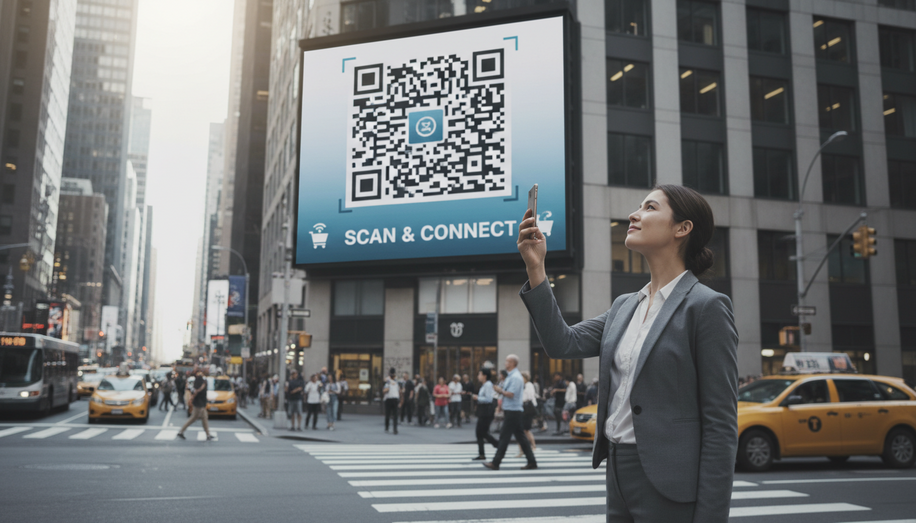
QR codes and short URLs have emerged as the linchpin of this traffic funnel, revitalizing static formats with scannable calls-to-action. Campaigns featuring QR codes report conversion rates of 0.5-4%, depending on placement, and double or quadruple response rates compared to print equivalents. Gas pump screens and retail digital displays, with dwell times 10-30 times longer than roadside billboards, spur impulsive QR scans that funnel users straight to landing pages. Beyond basic scans, DOOH’s technological edge amplifies results. Real-time updates, weather-triggered messaging, and dayparted content increase engagement by up to 50%, while geo-fenced retargeting post-exposure lifts conversions by 20-30%. Programmatic DOOH, rapidly expanding with AI-driven dynamic messaging, allows brands to align physical ads precisely with online behaviors, creating a feedback loop of familiarity that enhances paid social performance and retargeting efficacy.
Real-world campaigns illustrate the potency of this hybrid approach. When paired with mobile ads, OOH can amplify ROI by 316%, delivering $6 in return for every dollar spent on billboards. A four-week Austin rollout for Cash App, blending billboards, murals, and wild postings, generated 15.5 million impressions, priming a funnel that yielded compelling returns through strong audience-message alignment. OOH’s cross-channel lift extends further: it boosts online conversion rates, cross-device purchases, and walk-in traffic tracked via mobile GPS, with 48% of exposed consumers more likely to visit stores—often after an initial online check. In crowded markets, OOH establishes share-of-voice dominance, making subsequent digital touchpoints more effective; one-third of TikTok virality trends now originate from or feature OOH displays, driving social mentions and app installs near activity zones.
This OOH-digital interplay builds deeper trust and recall, critical for sustained online engagement. Consumers deem brands 58% more trustworthy after OOH exposure, compared to online-only efforts, with recall surging 30-60% across formats. Interactive or animated DOOH fares even better, spurring shares among Gen Z and teens immersed in social culture—human faces and humor amplify emotional pulls, while 3D extensions invite photography and reposts. Localized copy hikes engagement 20-45%, and high-frequency placements near decision points like stores reinforce ubiquity, nudging online searches. OOH + TV or TikTok pairings create “reality confirmation,” elevating influencer credibility and mental availability.
As DOOH commands nearly 60% of UOH revenue in the U.S. and eyes $58 billion globally by 2030, its role in omnichannel arsenals is non-negotiable. Simple creatives—one bold message per board, high-contrast colors, motion on digital screens—maximize readability and recall by up to 60%, outperforming complexity. For city-specific businesses, OOH’s targeting radius matches store drive distances, cost-effectively funneling footfall and clicks. Analytics tools now enable precise attribution, from impressions to conversions, revolutionizing accountability once dismissed as elusive.
Yet success demands integration: OOH thrives not in isolation but as a catalyst, priming audiences for digital conversion. Marketers blending it with search, social, and retargeting unlock lifts unattainable online alone—497% ROI multipliers in some OAAA-studied cases. With 52% of consumers noticing digital signage over online ads and 83% recalling dynamic content, DOOH’s daily reach of 65% in urban areas positions it as the ultimate traffic driver. In a fragmented media landscape, OOH reclaims attention, propelling users from street to screen with unmatched efficiency and authenticity.
For marketers aiming to master this potent OOH-digital interplay and drive measurable online actions, platforms like Blindspot offer the essential tools to bridge the physical-digital gap. Through programmatic DOOH campaign management, real-time performance tracking, and granular ROI measurement and attribution, Blindspot empowers brands to not only integrate their strategies but also quantify their combined impact, turning OOH impressions into trackable online conversions. Discover how to unlock this synergy at https://seeblindspot.com/