
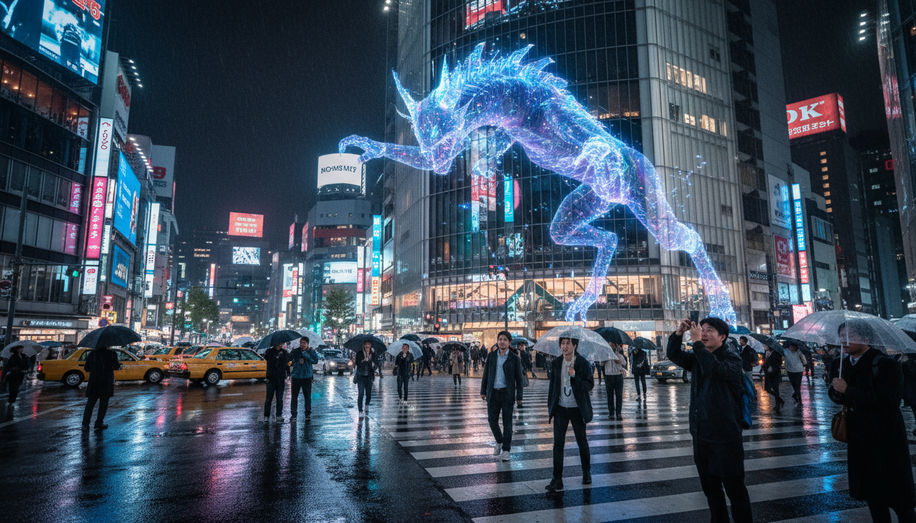

In the bustling streets of modern cities, where static billboards once dominated the skyline, augmented reality (AR) is transforming out-of-home (OOH) advertising into dynamic portals that pull passersby into immersive worlds. By overlaying digital elements onto the physical environment via smartphones, AR campaigns bridge the gap between two and three dimensions, turning fleeting glances into memorable interactions that drive engagement and social sharing. This fusion of technology and public space is not just a gimmick; it’s reshaping how brands captivate audiences in an era of short attention spans.
Consider the groundbreaking G2A campaign, where a digital billboard in a busy urban canopy became a literal gateway to gaming adventures. Equipped with a camera capturing real-time footage from the street, the screen displayed a portal shaped like the G2A logo—”A”—through which 3D animated characters emerged, interacting directly with startled pedestrians. Users standing in front of the billboard saw game-inspired figures react to their movements, captured via motion-capture technology for lifelike precision. The result? Spontaneous reactions filmed by onlookers flooded social media, amplifying the campaign organically and proving AR’s power to make viewers unwitting stars of the ad.
Burger King’s audacious “Burn that Ad” stunt in Brazil took rivalry to a fiery new level, hijacking competitors’ billboards through AR mischief. Pedestrians downloaded the BK app, pointed their phones at rival fast-food posters, and watched them burst into digital flames—revealing a Whopper coupon in their place. This playful disruption not only generated buzz but also redeemed coupons at nearby stores, blending humor with immediate calls-to-action. Similarly, Pepsi Max’s iconic 2015 “Unbelievable” bus shelter in New York created viral illusions: a hidden camera fed live street views to screens, superimposing giant robots, falling asteroids, and writhing tentacles that seemed to invade the real world. The campaign’s footage amassed millions of views, illustrating how AR can turn mundane waiting spots into spectacle theaters.
These examples highlight AR’s versatility across OOH formats, from static posters to digital screens and transit hubs. Ally Bank’s Monopoly-themed treasure hunt across six U.S. cities installed 36 physical game-board squares, each unlockable via Web AR scans—no app required. Players collected points from Mr. Monopoly himself, with 100,000 interactions and 86% completion rates boosting financial literacy awareness in a gamified frenzy. Red Bull elevated extreme sports hype with its World Series cliff diving experience; QR scans on OOH ads let users witness a vertigo-inducing 70-foot dive from their phone, simulating the thrill for those unable to attend live events.
Web AR platforms like 8th Wall have democratized access, making app-less experiences feasible even on printed murals. BON V!V Spiked Seltzer deployed interactive vending machines in Los Angeles and San Diego—passersby scanned QR codes to “place” virtual dispensers in their environment, pouring digital drinks and unlocking promotions. Kinder’s African safari portal brought animated animals leaping from billboards, complete with educational pop-ups, engaging families without downloads. Meanwhile, horror fans at a Vienna tram stop faced zombie hordes in “The Walking Dead” promotions, where live feeds merged with AR undead for a pulse-pounding scare that won OOH awards and sparked season hype.
The appeal lies in emotional resonance and measurability. AR fosters instant feedback loops—tap, scan, react—that forge bonds far beyond passive viewing. NHS’s blood donation billboard let users “give” virtual blood and watch lifelike effects, humanizing a critical call to action. Jackson Family Wines holographed founder Adam Lee on in-store billboards, letting scanners converse with his photorealistic avatar. Metrics like dwell time, shares, and redemptions provide advertisers with real-time data, outperforming traditional OOH.
Challenges persist: technical glitches in varying light or device compatibility can disrupt magic, and accessibility for non-smartphone users remains a hurdle. Yet, as digital out-of-home (DOOH) proliferates, spatial computing turns any urban surface into a canvas. Transit ads at bus shelters now host mini-games; towering billboards spawn epic spectacles viewable from below.
Looking ahead, gamified OOH—powered by AR—points to a future where ads evolve into competitions or explorations, sustaining engagement amid ad fatigue. Brands like Pizza Hut, which sold 10.6 million pies via AR Pac-Man boxes, show the commercial payoff. As 2026 unfolds, AR isn’t just bridging dimensions; it’s redefining OOH as a participatory medium, where the street itself becomes the stage.