
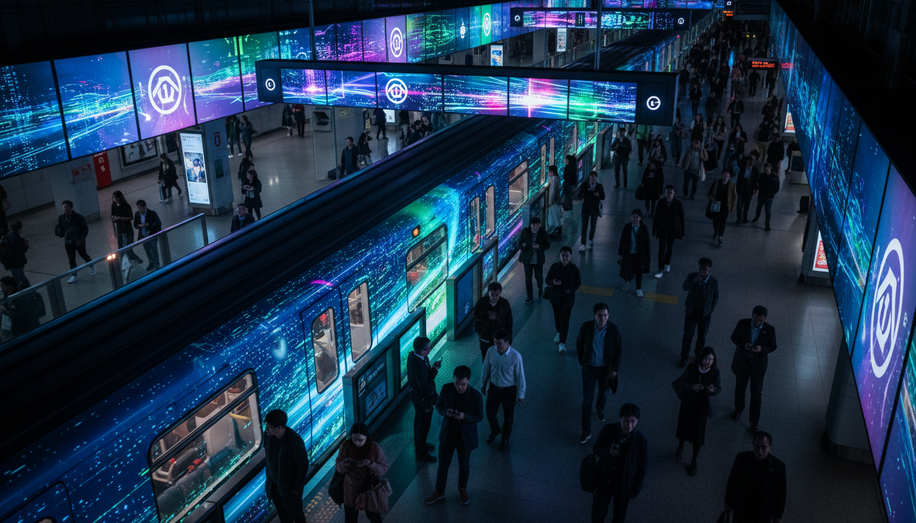

In the bustling arteries of urban life, where millions navigate daily commutes, transit advertising stands as a powerhouse of out-of-home (OOH) media, capturing over 19% of the U.S. outdoor market through sheer commuter volume exceeding 130 million trips each day. This segment, projected to surge from $3,962.9 million globally in 2025 to $6,523.4 million by 2033 at a 6.5% CAGR, thrives on its ability to deliver predictable, high-frequency exposure to captive audiences. As cities modernize rail and bus networks with digital screens tied to programmatic trading, transit OOH evolves from static wraps to dynamic ecosystems, enabling brands to weave cohesive campaigns across buses, subways, trains, and stations that resonate deeply with the on-the-move consumer.
The commuter journey offers a natural narrative arc for advertisers: anticipation at stations, immersion en route, and reflection at arrival points. Buses, as rolling billboards, excel in this by traversing high-traffic streets, reaching 30 million viewers weekly with full wraps, side panels, or interior cards that reinforce messaging through repeated citywide exposure. A healthcare brand, for instance, might launch with bold exterior wraps on buses to build awareness during morning rush hours, transitioning seamlessly to interior digital screens displaying tailored promotions for retail-clinic services—capitalizing on the 5.08% CAGR in pharmaceutical OOH spend driven by direct-to-consumer campaigns. This integration not only amplifies reach but optimizes cost per thousand impressions, as audience predictability allows precise alignment with peak commuting windows.
Subways and trains extend this impact into underground and intercity realms, where dwell times foster deeper engagement. Printed ads on platforms and car interiors draw notice from 37% to 40% of riders in recent surveys, while digital variants in commuter rail hit 19% to 32% awareness depending on demographics. Agencies maximize cohesion by synchronizing content: a national retailer could deploy station dominations—large-format posters and digital totems at entrances—with train-car screens cycling geo-targeted offers based on route-specific data. Transit routes’ hyper-local nature enables neighborhood-level precision, placing ads in exact zip codes or corridors without diluting broader campaign goals. In Asia Pacific, the world’s largest transit revenue generator in 2025, such strategies have propelled growth by blending static reliability with digital flexibility, where screens enable real-time updates and daypart targeting.
Stations serve as the connective hubs, transforming wait times into prime storytelling opportunities. With 57% of adults noticing transit ads weekly and 75% over 30 days, these environments command attention through a mix of place-based formats like digital kiosks (47% weekly notice) and platform posters. Effective campaigns layer assets hierarchically: eye-level digital ads in bus terminals for quick hits, combined with subway station wraps for extended views during 60-minute-plus dwells akin to airports’ affluent appeal. Programmatic integration across these touchpoints—now accelerating at 5.88% CAGR for digital transit units—allows automated buying that matches creative flights to commuter flows, boosting occupancy and ROI. Brands like those in amusements or services, top OOH spenders, leverage this for immersive narratives, such as a ride-share promo flowing from taxi-top illuminations visible at night to station digital extensions.
Emerging formats like bike and scooter branding add agility to the mix, targeting eco-conscious millennials with 88 million annual trips and pedestrian-eye-level panels ideal for hyper-local pushes. Integrated here means fleet-wide cohesion: a sustainability-focused brand might wrap shared bikes in one district’s stations, extend to bus interiors citywide, and culminate in subway digital calls-to-action, turning fleeting glances into sustained recall. Static formats retain 55.30% market dominance for their constant presence, but digital’s 5.71% CAGR underscores the shift toward hybrid campaigns that blend both for versatility.
Challenges persist, from planning complexities to competition in cluttered spaces, yet data affirms transit’s edge: 78% of adults engage OOH weekly, with transit matching billboards and place-based at 57-60% notice rates. Success hinges on audience research—profiling rush-hour professionals versus evening leisure riders—and creative that cuts through: dynamic visuals for motion-heavy buses, narrative depth for station pauses. Healthcare’s rising investments exemplify this, using transit’s “up close and personal” proximity to drive behavior amid clutter.
Ultimately, integrated transit strategies transcend siloed buys, creating a commuter companion that guides audiences from origin to destination. As out-of-home remains the fastest-growing ad sector, brands prioritizing cross-format synergy across buses, subways, trains, and stations not only capture attention but convert it, proving transit’s enduring power in a fragmented media landscape.