
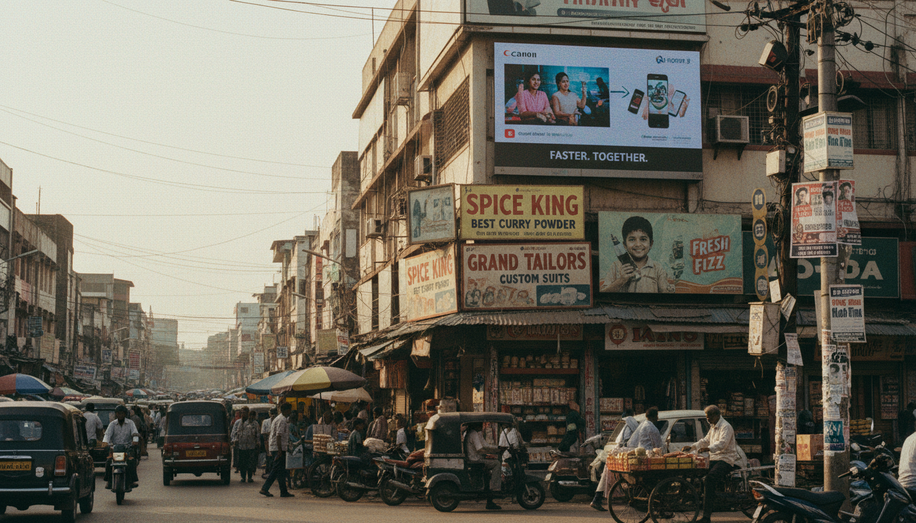

In the bustling streets of Mumbai, where rickshaws weave through throngs of pedestrians and towering digital billboards flicker with vibrant promotions, out-of-home (OOH) advertising is not just visible—it’s inescapable. Emerging markets like India, Brazil, Mexico, and South Africa are witnessing explosive growth in OOH, particularly its digital variant (DOOH), as urbanization accelerates and consumer aspirations collide with limited indoor media options. Global OOH revenues have surged past $9 billion annually, with DOOH projected to claim 45.2% of total spend by 2028, up from 22% in 2016, and emerging economies are at the forefront of this transformation.
These regions offer unparalleled opportunities for advertisers. Rapid infrastructure development and population booms create high-traffic hubs ideal for OOH dominance. In Latin America, for instance, improving economic conditions in Brazil and Mexico are fueling double-digit gains in digital advertising, including OOH, as brands tap into unavoidable exposure in transit systems and retail spaces. PQ Media ranks Brazil, Mexico, Argentina, India, and South Africa among the top 20 global OOH markets, with DOOH rebounding sharply post-pandemic—global spend soared 24.9% in 2022 after a 20.4% recovery in 2021. China’s DOOH market, a bellwether for Asia, is forecast to hit $4.84 billion in 2025, growing at a 6.57% CAGR to $6.65 billion by 2030, propelled by digital screen networks in megacities. Similarly, India’s urban expansion supports programmatic DOOH, which globally is expected to reach $1.22 billion in 2026, a 22.6% year-over-year jump.
Yet challenges abound in these dynamic landscapes. Power instability in parts of Africa and Southeast Asia hampers DOOH reliability, while fragmented regulations and informal economies complicate inventory management. In Nigeria or Indonesia, for example, advertisers grapple with counterfeit media and uneven digital penetration, where only 50-60% of urban populations have reliable internet, making OOH’s offline strength a double-edged sword. Economic volatility adds risk; currency fluctuations in Argentina or Brazil can erode ROI, and piracy of ad creatives undermines premium pricing. Moreover, intense competition from mobile-first behaviors demands OOH evolve beyond static billboards—DOOH must integrate data for real-time relevance, but privacy laws lag in many emerging markets.
Success hinges on cultural adaptation, a strategy brands ignore at their peril. In Saudi Arabia’s evolving society, OOH campaigns for beauty products now feature modest imagery aligned with Vision 2030 reforms, boosting engagement by 30% through localized storytelling. Brazilian agencies excel by syncing ads with Carnival rhythms, using transit screens to pulse with samba beats and soccer icons, resonating in a culture where 80% of media consumption is communal. In India, Unilever’s DOOH for Lifebuoy soap transformed hygiene messaging into Bollywood-style narratives on Mumbai trains, incorporating regional languages and festivals like Diwali to drive 25% sales uplift in targeted zones. These tactics underscore audience-first planning: measuring dwell time and visitation over impressions, tailoring content to local mindsets rather than imposing Western templates.
Technological adoption is the great equalizer. Programmatic DOOH, enabling real-time bidding and dynamic creative optimization, is penetrating emerging markets via platforms expanding screen networks in roadside, retail, and transit venues. In Mexico City, programmatic buys on digital billboards adjust for traffic patterns and weather, amplifying reach during monsoons when indoor alternatives falter. South African malls deploy AI-driven screens that swap ads based on footfall demographics, blending OOH with omnichannel lifts—campaigns pairing DOOH with social media see 40% higher engagement. Sustainability emerges as a edge; solar-powered screens in rural India reduce costs and appeal to eco-conscious youth, positioning OOH as a green alternative amid urban heatwaves.
Looking ahead to 2026, OOH in emerging markets is poised for acceleration. Global spend will climb from $37.18 billion in 2025 to $40.42 billion in 2026, with DOOH’s 7.6% CAGR outpacing traditional formats. Urbanization and 5G rollout will unlock hyper-local targeting, turning OOH into a “global operating system” for brands. Yet advertisers must prioritize partnerships with local operators versed in cultural nuances—failure to adapt risks backlash, as seen in failed Western fast-food launches ignoring halal preferences in Indonesia.
The payoff is immense: in markets where trust in OOH rivals word-of-mouth, culturally attuned, tech-savvy campaigns deliver unmatched ROI. As Brazil’s commerce media evolves and India’s screens multiply, OOH isn’t just growing—it’s redefining advertising’s frontiers, bridging digital divides one illuminated panel at a time. For global brands, the message is clear: conquer emerging markets by listening to them.