
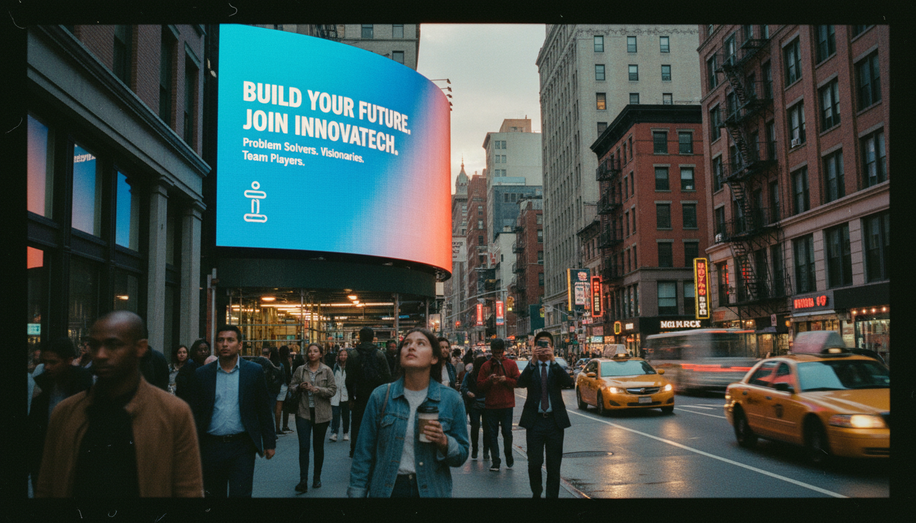

In today’s fiercely competitive job markets, where top talent is scarce and digital noise drowns out traditional recruiting channels, companies are turning to out-of-home (OOH) advertising to cut through the clutter. Strategic placements of billboards, transit ads, and digital displays are reshaping employer branding, building awareness among passive candidates, and driving a surge in applications. By leveraging location data, real-time targeting, and bold creative messaging, brands are positioning themselves not just as employers, but as destinations for ambitious professionals.
Consider Betterment, the digital investment platform, which targeted urban professionals with precision-placed digital billboards along high-traffic routes linking transit hubs and commercial districts. Using mobile data to identify commute patterns, the campaign zeroed in on moments when professionals were likely to linger—stuck in traffic or waiting at stations—and absorb the message: “Join the future of finance.” The result was a measurable lift in brand recognition among finance-savvy millennials and Gen Z workers, alongside spikes in new account sign-ups and app downloads from targeted zip codes. One billboard in a key financial district far exceeded averages, prompting an extension of the placement and proving how behavioral insights can amplify OOH’s reach for talent acquisition.
This approach mirrors broader trends in OOH recruitment, where companies like WAEPA, a federal employee benefits provider, combined billboards, mobile integrations, and digital displays in Washington, D.C., to attract government workers. The multi-channel blitz emphasized job security and perks, reaching commuters during peak hours and yielding higher inquiry rates than digital-only efforts. Similarly, Sam Aguiar Injury Lawyer in Louisville deployed digital OOH alongside social amplification to recruit legal talent, capitalizing on local visibility to draw applicants who valued community-rooted firms. These cases underscore OOH’s superpower: its unskippable presence in real-world environments where job seekers encounter ads organically, fostering top-of-mind awareness.
Tech giants and consultancies have long dominated employer branding, but OOH levels the playing field for mid-sized firms. Recruiters note that in sectors like finance, healthcare, and tech—where 75% of candidates are passive, not actively job-hunting—billboards humanize companies in ways LinkedIn profiles cannot. A campaign by Life Alive Café in Washington, D.C., used transit and billboard combos to spotlight flexible hours and wellness culture, appealing to health-conscious millennials and boosting applications by showcasing the brand’s vibe amid daily routines. Bushnell University took it further with a custom-illuminated billboard featuring a towering pop-out extension, designed to captivate drivers and pedestrians alike, drawing enrollment inquiries that doubled as talent pipelines for campus roles.
What makes these efforts strategic? Data-driven execution. Providers like Clear Channel Outdoor employ RADAR solutions—privacy-conscious mobile location analytics—to map audience movements, optimizing placements near universities, business districts, or tech parks. Real-time adjustments, akin to Guinness’s weather-triggered billboards that boosted pub traffic by syncing messages to local conditions, allow employers to tailor creatives dynamically. QR codes, as tested by Expedia in airports, offer direct paths to career pages; imagine a transit ad scanning to a personalized “Apply Now” landing page pre-filled with commute-derived insights. The Out-of-Home Advertising Association of America (OAAA) categorizes such tactics under proven KPIs like employment recruitment, with case studies showing OOH drives 20-40% lifts in applications when paired with trackable calls-to-action.
Yet, success hinges on bold, authentic storytelling. Outdoor brands like Patagonia have mastered this with anti-consumerism campaigns—”Don’t Buy This Jacket”—that flipped traditional messaging to build cult-like loyalty, a blueprint for employers. REI’s #OptOutside Black Friday shutdown, amplified via OOH, generated billions in earned media and deepened staff devotion by prioritizing values over sales. Forward-thinking companies adapt this: a software firm might billboard “Work Hard, Play Harder” near adventure hubs, or a consultancy “Solve Tomorrow’s Problems Today” in innovation corridors, resonating with purpose-driven talent.
Challenges persist in measurement, but advancements bridge the gap. Programmatic OOH platforms enable geofencing, foot traffic attribution, and cross-media lift studies, proving ROI where digital fatigues. In competitive markets like New York, where ESPN and Spotify Wrapped dominate transit ads, niche players like Friend carved space with cheeky employer pitches, blending billboards and social for viral recruitment.
As remote work evolves and hybrid models demand local appeal, OOH’s tactile impact endures. Firms reporting talent shortages—from startups to enterprises—are investing heavily, with placements near co-working spaces and airports yielding qualified leads at lower costs than targeted social ads. In an era of algorithm overload, a well-placed billboard doesn’t just advertise jobs; it builds legacies, turning passersby into applicants and employees into advocates. For brands serious about hiring in the open, OOH isn’t optional—it’s the ultimate brand builder.
For companies seeking to harness OOH’s strategic power in talent acquisition, platforms like Blindspot offer crucial tools to navigate this evolving landscape. By leveraging sophisticated audience measurement, location intelligence for precision site selection, and robust ROI attribution, Blindspot empowers employers to execute data-driven campaigns that effectively reach passive candidates, optimize spend, and convert brand awareness into measurable application surges. Explore how at https://seeblindspot.com/