
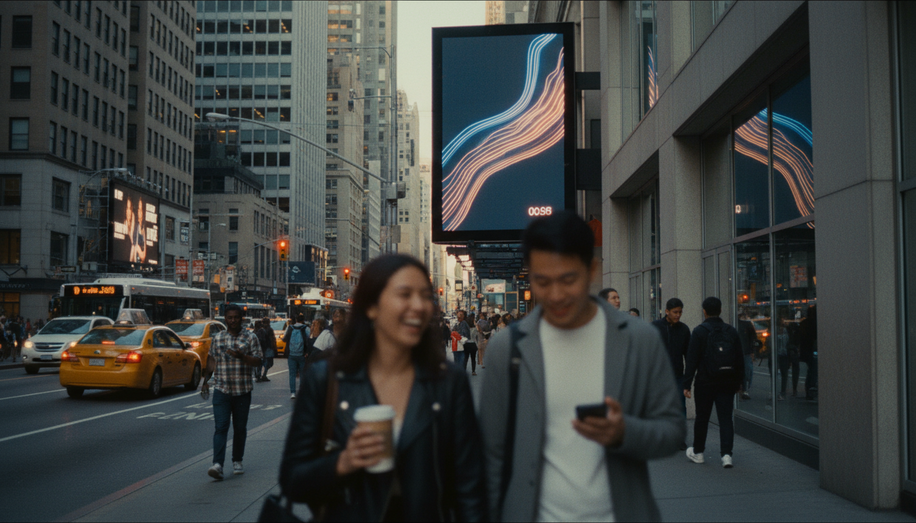

In the crowded arena of modern advertising, out-of-home (OOH) media has emerged not as a standalone player, but as a potent amplifier that supercharges the performance of every other channel in the mix. Far from the outdated relic some dismiss it as, OOH—encompassing billboards, transit ads, and digital displays—delivers unavoidable visibility that primes audiences for digital engagement, television spots, and radio broadcasts, creating a multiplier effect on reach, recall, and conversions. This synergistic power stems from OOH’s unique ability to cut through digital noise and ad fatigue, forging real-world connections that ripple across the media ecosystem.
Consider the neuroscience at play. The human brain processes visual images from OOH in as little as 13 milliseconds, far faster than text, thanks to high-contrast colors and bold visuals that demand instant attention during fleeting exposures like commutes or walks. This immediacy triggers the mere exposure effect, where repeated sightings build familiarity, preference, and trust—31% of consumers trust OOH more than social media, lending authenticity that digital channels often lack. When layered atop traditional media, this trust translates to heightened impact. Research from the Out of Home Advertising Association of America (OAAA) shows OOH extends the reach of every major media channel to over 90% in a typical week, amplifying TV effectiveness by 17%, search by 54%, and social media by 20%.
Television advertisers, battling fragmented viewership and DVR skipping, find OOH acts as a physical anchor. A TV spot might air during prime time, but its message fades amid zapping. Pair it with strategically placed billboards, and the combination creates a “surround-sound” reinforcement. Attribution studies reveal OOH-exposed consumers are 50% more likely to convert through digital channels than those seeing only online ads, with OOH lifting overall campaign ROI across the funnel. For instance, highway billboards targeting commuters extend TV’s emotional storytelling into daily routines, turning passive viewers into active seekers. Recent 2025 data underscores this: OOH drives a 13.3% higher lift in ad awareness than digital alone, proving its role in sustaining TV’s narrative momentum.
Radio, with its emotive audio punch, benefits even more profoundly from OOH’s visual complement. Drivers tuning into broadcast or streaming radio might channel-surf ads, but a serendipitous billboard sighting at the same moment fuses sight and sound into a subconscious imprint. Imagine hearing a jingle for a new car model, then spotting its sleek image on a roadside display—the sensory blend heightens recall without relying on ad blockers or premium skips. OOH’s geographic precision—highway ads for commuters, transit for urbanites—ensures relevance, making radio’s fleeting messages stickier and more actionable.
Digital platforms, dominant yet ad-saturated, gain the most from OOH’s “second screen effect.” Physical exposure prompts immediate mobile searches, with OOH boosting digital clicks, social engagement, and page views more efficiently than any other medium. Privacy regulations and selective consumption have made digital targeting trickier, but OOH reaches millions indiscriminately, signaling brand legitimacy that makes online audiences more receptive. A 2023 study cited by The Campus Agency found OOH yields the highest consumer recall among ad types, creating lasting impressions that enhance future digital efforts. Digital out-of-home (DOOH) takes this further, enabling real-time updates tied to weather, news, or events, seamlessly bridging to social and mobile for omnichannel cohesion.
Real-world campaigns illustrate this amplifier in action. Carlsberg’s interactive beer-dispensing poster transformed a static ad into a shareable event, sparking viral social media and earned coverage that extended far beyond the site. Brands integrating OOH with digital pushes report up to 300% reach increases, as physical presence primes users for online follow-through. Premium locations transfer positive associations instantly, making campaigns feel massive and market-leading.
Cost-efficiency seals the deal. OOH often beats digital on cost per thousand impressions, with some formats delivering 495% ROI through guaranteed exposure and mass scale. In an era of tightening budgets, this makes OOH indispensable for integrated strategies: use consistent creatives across channels, time OOH bursts with TV or digital peaks, and leverage data-driven attribution for refinement.
Ultimately, OOH doesn’t compete with other media—it elevates them. By building trust in public spaces, sparking cross-channel lifts, and driving measurable outcomes, it turns fragmented campaigns into unified forces. Marketers ignoring this amplifier risk leaving performance on the table, while those embracing it witness their entire mix resonate louder than ever.