
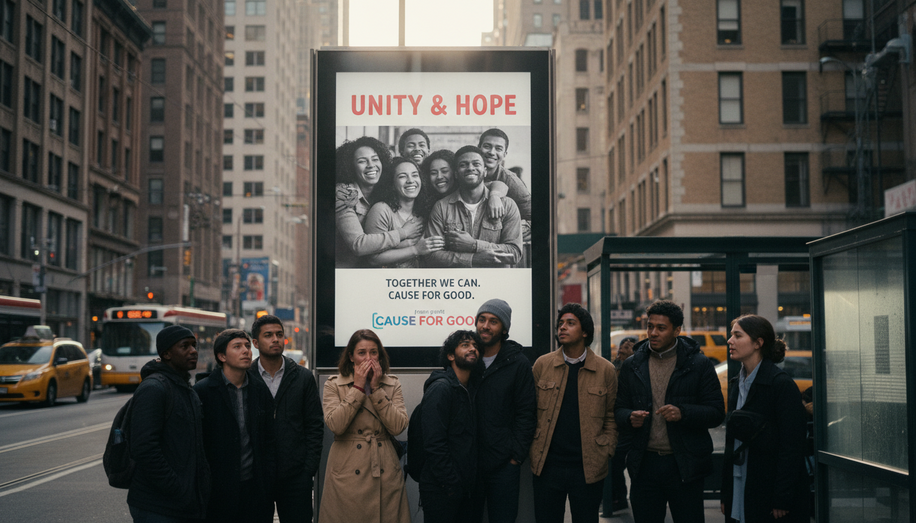

In the bustling streets of Kenosha, Wisconsin, a simple billboard on Roosevelt Road and 26th Avenue came alive last May, not with commercial pitches but with stories of shelter, food, and hope. Adams Outdoor Advertising donated the space for a year-long campaign with the Shalom Center, a nonprofit aiding the homeless, featuring designs that humanized its mission and spotlighted community impact. Executive Director Esther Roberts praised the partnership for capturing the “human side” of their work, from food pantries to winter warm-ups, proving out-of-home (OOH) advertising’s power to elevate nonprofits without budgets for big buys.
Nonprofits have long turned to OOH—billboards, digital screens, wild postings, and street installations—to cut through digital noise and spark immediate, visceral responses. Unlike online ads that can be scrolled past, OOH commands attention in everyday commutes and walks, fostering awareness that translates to action. Agencies like DASH TWO, which specializes in nonprofit work, offer discounted or pro bono services for causes from climate change to reproductive rights, crafting campaigns that connect emotionally while attracting donors. Their portfolio includes Fridays for Future’s stark “The Earth is no toy” visuals on billboards and wild postings, Revolt TV’s youth-voting “Vote or Die” push, and Immigrants Are Essential’s economic-role highlights, all designed to rally supporters organically through word-of-mouth success.
Creativity amplifies OOH’s reach for social good. The World Wildlife Fund’s shadow billboards cast silhouettes of endangered animals across urban landscapes, symbolizing extinction’s quiet threat and drawing eyes to conservation pleas. Donate Life Kentucky Trust’s “Save My Human” integrated billboards with bus shelters, using heartwarming pet-human imagery to boost organ donor registrations amid high engagement. UNICEF flipped the script on digital OOH with “The Worst Soap Opera,” screens showing dramatic scenes that dissolved into water crisis facts, hooking passersby before delivering the call to donate. These tactics turn public spaces into storytelling arenas, where bold visuals and concise messaging inspire shares, visits, and contributions.
Beyond traditional billboards, ambient OOH innovations immerse communities in causes. Women’s Aid in London deployed facial-recognition posters detecting onlookers; as eyes lingered, digital bruises on a victim’s face faded, revealing the message: “If you can see it, you can change it.” Proximity alerts via apps prompted donations, merging technology with empathy to combat domestic violence. Israel’s Food Bank grated plates of fresh food into sewer covers on busy streets, visually screaming waste amid hunger and surging website traffic and funds. An anti-drunk driving effort in Malaysia welded a wrecked car’s parts into a wheelchair at a college, prompting over 10,000 student pledges in a month. Parkinson’s Victoria’s mall arcade games mimicked tremors with everyday tasks like opening milk cartons, raising $5,000 in hours while educating on the disease’s toll. Alzheimer’s Germany’s blank street maps in hotels evoked memory loss confusion, yielding a 19% call spike and 5% donation bump.
These campaigns excel by blending provocation with participation. OOH for nonprofits prioritizes high-visibility formats like wild postings in urban hubs or digital screens for real-time relevance, as DASH TWO recommends, ensuring messages linger in collective memory. Fliphound’s gallery of top nonprofit billboards underscores this, with examples from pet rescues to symphonies using humor, stark stats, or emotional pulls to drive traffic to stpatrickcenter.org or maha.la. Outfront Media’s case studies further show global scalability, from transit wraps to street furniture amplifying PSAs on everything from voting to skin cancer awareness.
Donation drives thrive on OOH’s unskippable nature. Shalom Center’s year-long exposure built lasting awareness of its programs, from Eagle Scout projects to United Way awards, without a dime spent on media. Planned Parenthood’s prescient Roe v. Wade warnings via DASH TWO gained traction pre-ruling, while Elta MD’s skin cancer alerts merged health facts with urgency. Metrics bear out the impact: increased registrations, pledges, and funds flow from OOH’s ability to humanize crises and issue direct calls—scan a QR, text to give, visit now.
Yet success demands strategy. Nonprofits must pair eye-catching creative with clear actions, targeting high-traffic zones where audiences align—commuter billboards for working donors, mall ambient for families. Agencies like Vistar Media highlight data-driven digital OOH, triggering ads based on weather or events for timeliness, as in measurable lifts for social campaigns. Blip Billboards’ nonprofit examples, like Angels Among Us Pet Rescue, prove even modest rotations yield outsized engagement when messaging resonates.
In an era of ad fatigue, OOH remains nonprofits’ megaphone for equity. From Kenosha’s hope hubs to global wildlife shadows, these campaigns don’t just advertise—they mobilize, proving public spaces can heal divides, fund futures, and forge communal resolve. As Jakob Gransee of Adams Outdoor put it, such partnerships shine by making real differences in lives. To truly harness OOH’s potential and ensure every message lands with impact, nonprofits need robust strategy and verifiable results. Blindspot elevates these efforts by providing precise location intelligence and audience measurement for optimal site selection, alongside real-time campaign performance tracking and ROI attribution, ensuring their powerful stories translate into measurable action and sustained support. Learn more at https://seeblindspot.com/