
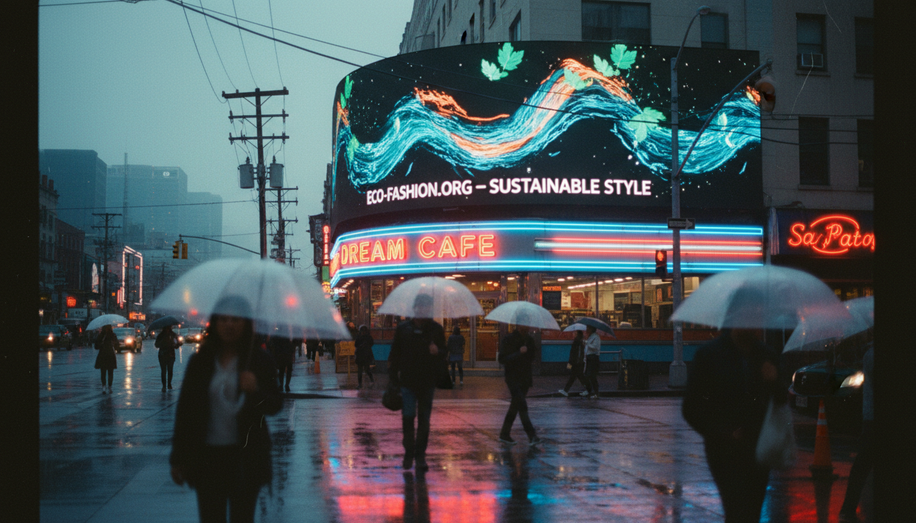

In the flickering haze of early 20th-century nights, neon tubes first cast their hypnotic glow over city streets, transforming static billboards into mesmerizing spectacles that captured the attention of motorists and pedestrians alike. Introduced in the 1920s and gaining prominence by the 1930s, neon lighting—bent glass tubes filled with noble gases like neon and argon—offered a vibrant, otherworldly radiance that incandescent bulbs could not match, illuminating Foster and Kleiser’s art deco painted bulletins and marking a pivotal shift from daytime-only displays. This era’s illuminated outdoor advertising service, launched on San Francisco’s Market Street in 1916, evolved rapidly; by 1947, reflective Scotchlite materials enhanced nighttime visibility on highway bulletins without constant power, while 1950s innovations like black light fluorescent paints and Pabst’s revolving prisms added dynamic embellishments to painted bulletins.
Yet neon’s allure came at a steep cost. The technology demanded high voltage and constant electricity, prone to frequent failures in harsh weather, and its mercury-laden tubes posed environmental hazards upon disposal. Energy inefficiency defined the medium: a single neon sign could consume thousands of watts, straining urban grids during peak hours. By the mid-1950s, Foster and Kleiser tested slimline fluorescent lighting on poster panels in Long Beach, California, a step toward brighter, more reliable illumination that reduced bulb counts while maintaining visibility. These fluorescent units, slimmer and more uniform than incandescents, hinted at future efficiencies, but they still guzzled power and emitted unwanted heat, limiting scalability for larger bulletins.
The 1965 Highway Beautification Act imposed the first federal constraints on billboard lighting, mandating standards for size, spacing, and illumination to preserve scenic vistas along interstates. This legislation forced advertisers to innovate within bounds, spurring refinements like the 1956 adoption of fluorescent slimlines and the 1960s shift to single-post unitized poster panels that integrated lighting more seamlessly. Compliance bred creativity: Loewy poster panels with lighter stainless steel moldings in 1949 paved the way for sleeker designs, while multivision bulletins in Sacramento rotated three designs on triangular sections, illuminated by efficient backlighting.
A seismic transformation arrived in the early 2000s with the dawn of digital out-of-home (DOOH) networks. Clear Channel Outdoor’s 2004 initiative converted 80 Manhattan street displays into the first “Digital Street Network,” employing LED pixels for remotely changeable static signage—a leap from painted posters requiring manual reposting. By 2005, the first full digital networks emerged, harnessing light-emitting diodes (LEDs) that offered unprecedented flexibility: content could update instantaneously via software, cycling multiple ads on a single face to boost reach and frequency, as validated by early A.C. Nielsen studies from the 1960s onward.
LEDs revolutionized OOH lighting on multiple fronts. Unlike neon’s fragile glass, LEDs are solid-state semiconductors encased in durable housings, resistant to vibrations from traffic or storms. Their energy profile is staggering: a modern LED billboard uses up to 80% less electricity than neon or fluorescent equivalents, with lifespans exceeding 100,000 hours—over a decade of continuous operation without replacement. Visibility soared too; high-resolution modules deliver 10,000+ nits of brightness, adjustable via light sensors to ambient conditions, eliminating glare and ensuring 24/7 readability even in direct sunlight. Aesthetic enhancements followed: programmatic DOOH now supports 4K video, animations, and interactivity, turning billboards into immersive canvases that blend seamlessly with smart city integrations like weather-triggered messaging.
Sustainability became the defining narrative of this evolution. The 2010 shift to ecoflex posters marked an eco-conscious pivot, but LEDs elevated it further by slashing carbon footprints—equivalent to planting thousands of trees annually for a single large display. Solar-powered variants, increasingly common by the mid-2020s, pair photovoltaic panels with battery storage, rendering remote billboards grid-independent and ideal for highways governed by beautification laws. Innovations like micro-LEDs promise even finer pixel pitches for hyper-detailed visuals, while recyclable modules address end-of-life concerns neon never could.
This journey from neon’s extravagant glow to LED’s precise brilliance underscores OOH’s adaptability. Early pioneers like Foster and Kleiser illuminated the path with illuminated services in 1916 and fluorescent tests in 1956, navigating regulations like the 1965 Act to prioritize efficiency. Today’s LED dominance enhances visibility—critical for the 94% of consumers who notice OOH ads—while curbing energy use amid global net-zero mandates. Visually, the shift yields crisper contrasts and dynamic storytelling, from Coca-Cola’s iconic 1930s holiday boards to hyper-local digital campaigns. As urban landscapes densify, LED-powered DOOH not only sustains OOH’s relevance but propels it into a greener, more captivating future, where illumination serves both commerce and conservation.