
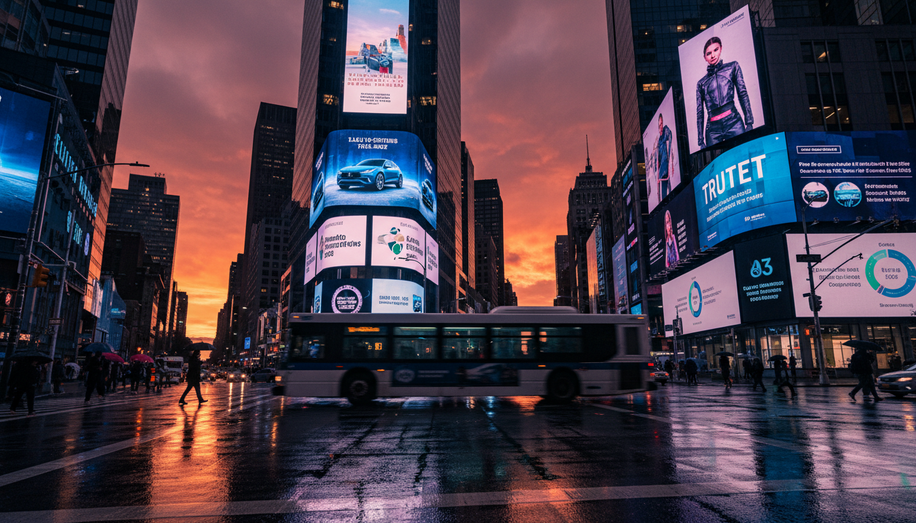

In the bustling digital landscape of out-of-home advertising, programmatic DOOH has emerged as the linchpin of real-time inventory transactions, automating what was once a labyrinth of manual negotiations. This ecosystem hinges on a trio of core components—demand-side platforms (DSPs), supply-side platforms (SSPs), and ad exchanges—that orchestrate the buying and selling of screen space with unprecedented precision, fueled by data streams and auction dynamics.
At the heart of programmatic DOOH, DSPs empower advertisers and agencies to navigate vast inventories across millions of screens, from urban billboards to airport displays. These platforms aggregate demand, enabling buyers to set parameters like audience demographics, geographic proximity, time of day, or even weather conditions, then bid in milliseconds via real-time bidding (RTB). Clear Channel Outdoor, for instance, integrates 90% of its premium airport digital inventory and 80% of roadside assets into over 20 DSP partners, allowing seamless omnichannel purchases alongside mobile and video ads. Platforms like those from Vistar Media or Hivestack process these bids, leveraging machine learning to optimize campaigns on the fly, adjusting creatives or budgets based on performance metrics. The result is agility: a brand targeting commuters can surge spend during rush hour or pivot creatives in response to live events, all without human intervention.
On the opposite flank, SSPs represent the publishers’ arsenal, connecting media owners—think screen networks in malls, transit hubs, or bars—with the programmatic marketplace. These platforms maximize yield by auctioning inventory in real time, often through header bidding that pits multiple DSPs against each other for the highest value. Screenverse, a DOOH innovator, routes its screens through leading SSPs like Vistar Media, Place Exchange, Hivestack, and Broadsign, ensuring publishers extract premium pricing while maintaining control over brand safety and content suitability. SSPs handle the technical heavy lifting: they standardize diverse screen formats, inject contextual data (such as foot traffic or local events) without compromising privacy, and provide transparent reporting on fill rates and revenue. For operators like Ocean Outdoor or Leeads, this means transforming static digital signage into dynamic revenue engines, where screens in high-traffic spots like restaurants or urban environments command bids tailored to real-world contexts.
Bridging these worlds are ad exchanges, the neutral marketplaces where supply meets demand in open or private auctions. Much like their online counterparts, DOOH ad exchanges facilitate RTB, clearing transactions in under 100 milliseconds to deliver ads just as a viewer approaches a screen. They aggregate SSP feeds, anonymize data for compliance, and enforce frequency capping or viewability standards, creating a liquid market projected to hit $2.2 billion globally in 2025—10.9% of total DOOH spend. Players like Place Exchange exemplify this, curating premium inventory from major operators and enabling cross-channel synergies, where a DSP buying video ads can effortlessly layer in DOOH for amplified reach.
This technology stack thrives on layered data providers, which infuse the ecosystem with actionable intelligence. Unlike cookie-dependent digital ads, programmatic DOOH leans on privacy-safe signals: geofencing for location-based targeting, time-of-day triggers, or environmental data like traffic patterns. Advanced setups incorporate dynamic creative optimization (DCO), swapping ad variants—say, promoting umbrellas during rain—based on live inputs. Yet challenges persist: media fragmentation across disparate networks demands robust standardization, while brand safety hinges on contextual controls to avoid inappropriate placements. The industry counters with enhanced transparency, such as unified reporting dashboards that track impressions, attribution, and ROI across channels.
Full-stack platforms are blurring lines further, integrating DSP, SSP, and exchange functions for end-to-end automation. Taggify, for example, unifies these for brands, enabling real-time forecasting and cross-media campaigns that blend DOOH with TV or online video. Lamar Advertising’s programmatic networks allow instant activation of pre-built packages for key locations, with data re-engagement loops capturing consumer signals for retargeting. Navori’s digital signage software optimizes placements programmatically, maximizing engagement through precise scheduling.
As global OOH investment surges past $49.8 billion in 2025, programmatic DOOH’s growth underscores its maturation. Advertisers gain efficiency and measurability—proven lifts in awareness and sales—while publishers unlock scalable revenue. Navigating this ecosystem requires savvy: selecting DSPs with strong DOOH integrations, partnering with SSPs boasting clean inventory, and mastering exchanges for optimal pricing. The payoff is a medium that fuses OOH’s massive scale with digital precision, redefining real-time advertising in the physical world.