
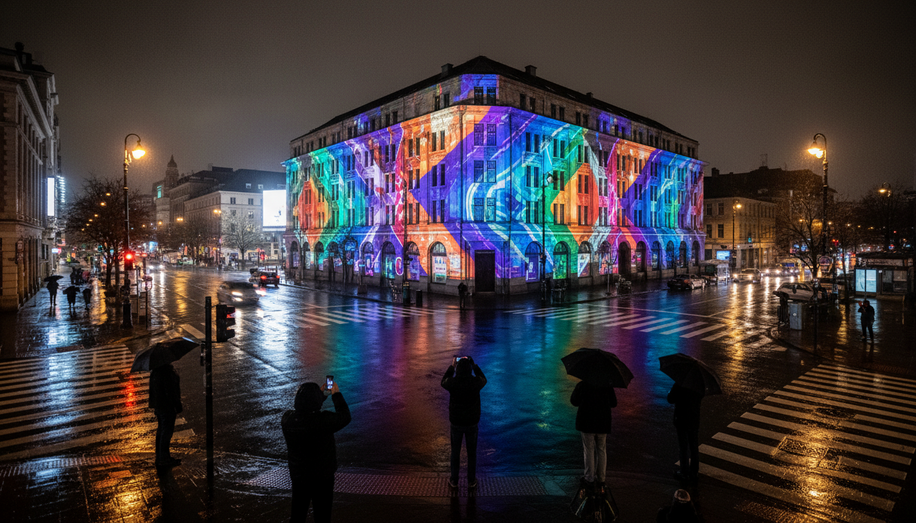

In the bustling heart of urban landscapes, out-of-home (OOH) advertising has evolved far beyond static billboards and fleeting posters. Today, it manifests as immersive experiential marketing, where temporary installations and pop-up activations transform public spaces into interactive playgrounds that demand attention and foster deep emotional connections. Brands are no longer content with mere visibility; they craft multisensory encounters that turn passersby into participants, generating buzz that ripples across social media and lingers in collective memory.
Consider Airbnb’s collaboration with Mattel for Polly Pocket’s 35th anniversary, where a life-sized, 42-foot-tall pink shell house rose in Littleton, Massachusetts. This wasn’t just a display—it was a rentable nostalgia bomb, complete with 90s-era vanities, retro snacks, and gummy-textured outfits inside a two-story compact mimicking the original toy. Millennials and Gen Xers flocked to relive childhood dreams, snapping photos that exploded online, while Airbnb reinforced its promise of unforgettable stays. The activation’s success lay in its tangibility: by scaling a toy to human proportions, it bridged emotional nostalgia with real-world immersion, proving OOH’s power to make abstract brand stories physically inhabitable.
Festivals like Coachella amplify this trend, turning OOH into exclusive oases amid chaos. American Express conjured a winter wonderland VIP lounge themed around Reneé Rapp’s Snow Angel album—a stark, snowy escape from desert heat. Cardholders accessed fast-lane merch, glam pop-ups, fashion boutiques, and digital tarot readings, blending luxury perks with personalized tech. Similarly, Heineken House emerged as a futuristic urban garden with lush greenery, AR photo booths, swing seats, and gamified tastings. These installations contrasted sharply with their surroundings, drawing crowds for Instagram-worthy moments that elevated brand prestige and created FOMO-driven virality.
Digital integration catapults these experiences further, merging OOH’s physicality with virtual wizardry. Pepsi’s “Unbelievable Bus Shelter” in London used augmented reality to unleash giant robots, flying saucers, and stampeding animals onto a mundane stop, with live reactions captured for social sharing. Netflix took it darker for Stranger Things, deploying “glitching” digital billboards equipped with motion sensors that reacted to pedestrians, morphing into show scenes and sparking user-generated content. Nike’s Reactland treadmills let runners control avatars in a video game world, testing React shoes in a retail-meets-gaming frenzy. These hybrid activations demonstrate how AR, sensors, and touchscreens turn passive OOH into dynamic dialogues, captivating urbanites who crave shareable novelty.
Temporary installations thrive on surprise, channeling guerrilla marketing’s ethos into large-scale spectacles. AXE transformed an Athens bus stop into a life-sized claw machine for its Cherry Fizz body spray, where waiters grabbed prizes laced with fragrance samples—fun, fragrant, and fragrant with scent. In Basel, traffic lights swapped green men for sporty figures ahead of UEFA Women’s Euro 2025, a citywide reskinning that turned commutes into celebratory statements. Kellogg’s erected a 21-foot weathervane shaped like mascot Cornelius the Cockerel at Britain’s easternmost point, a functional giant catching sunrises and eyes alike. Even Sharpie and Paper Mate commandeered urban walls for massive murals and doodle labs at events, letting attendees co-create with giant markers and coloring books, embodying creative rebellion.
Guerrilla tactics extend to street-level ingenuity, like sidewalk branding or pop-up labs that hijack daily routines. Coca-Cola’s “Small World Machines” vending units linked India and Pakistan via live-streamed AR, enabling cross-border drawing of peace symbols—a poignant unity message amid geopolitical tension. These low-cost, high-impact stunts leverage public environments for organic amplification, as startled encounters prompt smartphone videos that outpace traditional media buys.
What unites these campaigns is their defiance of OOH’s traditional passivity. Projection mapping animates blank walls into storytelling canvases; geotargeting tailors content to local vibes; VR/AR overlays reality with brand fantasy. Transit hubs become unskippable theaters—buses wrapped in illusions, subways pulsing with interactive wallpaper—reaching diverse commuters who can’t swipe away. Data analytics refine personalization, ensuring activations resonate with overlooked segments, while pop-ups and live events ignite virality.
Yet, execution demands precision. These aren’t set-it-and-forget-it ads; they require logistical wizardry to navigate permits, weather, and crowds. Success metrics shift from impressions to dwell time, shares, and sentiment—gauging how deeply an installation embeds in urban psyche. As cities densify and attention fragments, OOH’s experiential pivot positions it as marketing’s bold frontier, where temporary marvels don’t just advertise; they architect moments that brands—and audiences—won’t forget.
Navigating this new OOH frontier demands sophisticated tools that can manage such dynamic, temporary installations. Blindspot empowers brands to move beyond traditional impressions, offering real-time campaign performance tracking and granular audience measurement and analytics to truly gauge dwell time, sentiment, and social virality. By also providing location intelligence for optimal site selection and robust ROI attribution, Blindspot ensures these ephemeral, experiential marvels are not only unforgettable but also strategically impactful and measurable in a crowded urban landscape. https://seeblindspot.com/