

Long before the glow of LED screens illuminated cityscapes, out-of-home advertising carved its messages into the very fabric of public life. Ancient Egyptians etched hieroglyphics onto towering stone obelisks around 3000 B.C., proclaiming laws and royal decrees to passersby in bustling markets—early precursors to the billboards that would one day dominate highways. In Pompeii, merchants painted vibrant advertisements directly onto building walls, hawking everything from bread to gladiatorial events, a practice that echoed through Roman streets and foreshadowed the painted walls of future eras.
The true dawn of modern out-of-home (OOH) advertising arrived with the printing revolution. In 1450, Johannes Gutenberg’s invention of movable type democratized the production of printed materials, making posters feasible for the masses. But it was the perfection of lithography in 1796 that birthed the illustrated poster. This technique, using smooth limestone or metal plates instead of woodblocks, allowed for colorful, detailed images that could be mass-produced and plastered across urban walls. By the 1830s, these innovations coalesced into the first large-format outdoor posters. In 1835, New York showman Jared Bell unveiled what is widely regarded as the inaugural outdoor poster, promoting his circus with bold typography and imagery that captivated street crowds.
As cities swelled in the 19th century, OOH evolved rapidly. By 1850, exterior ads adorned street railways, turning public transit into rolling canvases. Leased billboard spaces appeared around 1867, and by 1870, nearly 300 posting companies dotted the American landscape, fueling a nascent industry. Professionalization followed swiftly: the International Bill Posters’ Association of North America formed in 1872, succeeded in 1891 by the Associated Bill Posters’ Association of the U.S. and Canada—today’s Out of Home Advertising Association of America (OAAA). These groups standardized practices, promoted ethical posting, and lobbied for the medium’s legitimacy.
The early 20th century marked OOH’s golden age of expansion. In 1900, a national billboard structure emerged, sparking a boom as brands like Palmolive, Kellogg, and Coca-Cola launched mass-produced national campaigns. Mergers reshaped the field; in 1925, the Poster Advertising Association and Painted Outdoor Advertising Association united as the OAAA, while the Fulton Group and Cusack Co. formed the General Outdoor Advertising Company—the industry’s first major consolidation. Public service efforts underscored its civic role: an educational committee in 1913 encouraged donated space for announcements, a tradition that persists. The 1934 founding of the Traffic Audit Bureau brought audience measurement, lending scientific credibility just as the National Outdoor Advertising Bureau aided agencies in 1915.
Mid-century innovations addressed practicality and regulation. Bus stop shelters debuted in 1962, funded entirely by ad revenue and offering cities free infrastructure. The 1965 Highway Beautification Act curtailed roadside sprawl, confining billboards to commercial zones and imposing standards on size, lighting, and spacing. Vinyl supplanted painted bulletins in the 1970s, slashing production time and weatherproofing displays. Effectiveness was dramatically proven in 1975, when Outdoor Advertising Inc. blanketed boards with images of newly crowned Miss America Shirley Cochran; her name recognition skyrocketed 940 percent nationwide.
The late 20th century hinted at digital horizons. Transit ads, street furniture, and ecoflex posters proliferated from the 1960s to 1990s, with environmental upgrades like recyclable materials by 2010. Tobacco bans in 1972 (broadcast) and 1999 (OOH) shifted landscapes, opening doors for diverse advertisers.
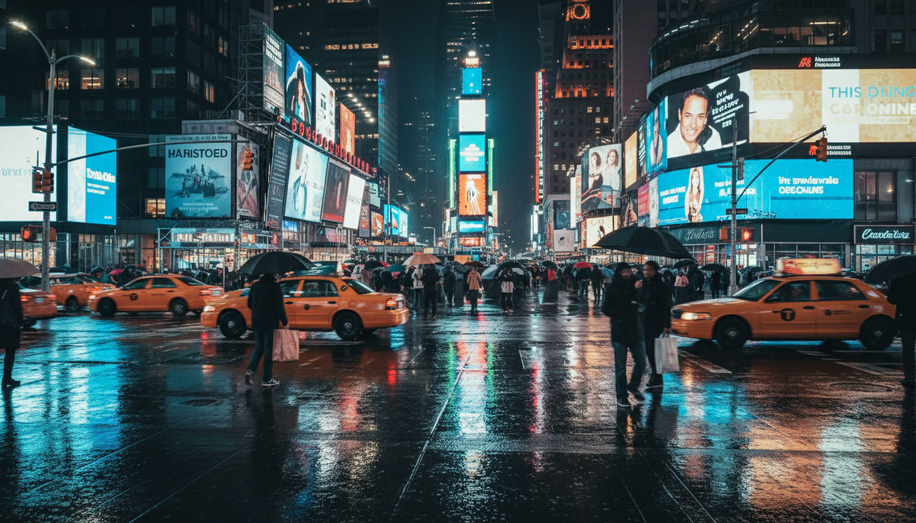
Then came the digital revolution. The 1990s introduced nascent digital tech, but the early 2000s ignited transformation with digital out-of-home (DOOH). In 2005, the first digital networks lit up, replacing static boards with screens capable of rotating multiple ads, dayparting content by time, and real-time updates. Times Square’s dazzling arrays exemplified this shift, blending vivid visuals with data-driven precision. By the 2010s, DOOH encompassed transit screens in buses and stations, retail networks, airport displays, and immersive 3D LED installations that respond to weather, location, or audience metrics.
From Pompeii’s frescoed walls to algorithm-fueled spectacles, OOH has mirrored societal pulse: ancient proclamations yielded to printed spectacles, standardized billboards, vinyl durability, and now hyper-connected digital realms. What began as chiseled stone endures as a dynamic force, proving advertising’s oldest medium remains its most adaptable.