
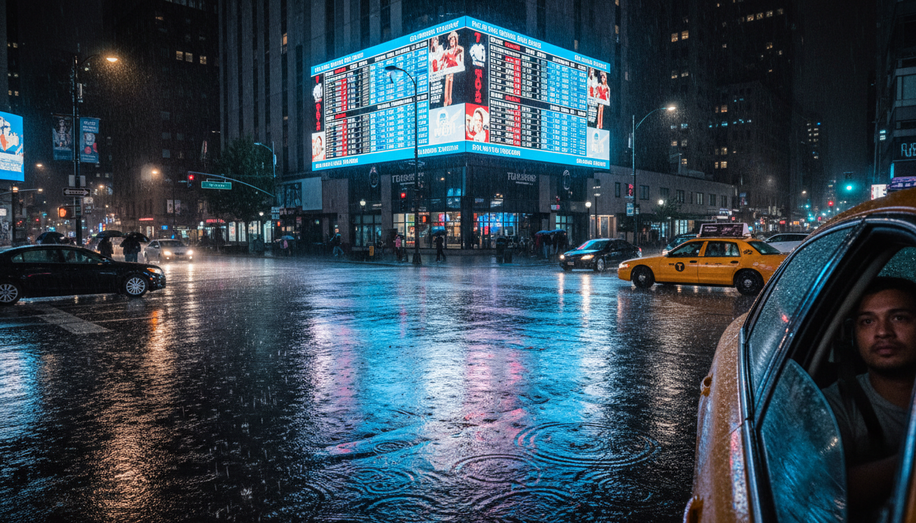

In the bustling arteries of urban life, digital billboards once confined to looping static images are evolving into living, breathing storytellers, pulsing with real-time data that captures fleeting attention spans. Advertisers are harnessing integrations with news feeds, social media streams, and live visualizations to transform these screens from passive displays into interactive spectacles that resonate in the moment. This shift marks a seismic departure from traditional out-of-home (OOH) advertising, where content was king but timeliness was a luxury few could afford.
Consider the power of context-aware dynamism. Modern digital billboards pull in environmental data like weather patterns or traffic flows, swapping messages on the fly to mirror the viewer’s reality. In rainy downpours, screens might flash promotions for cozy coffee shops or taxi services, while midday lulls trigger ads for quick lunch deliveries—boosting relevance and response rates by making the medium feel prescient. Nike’s 2024 Olympics campaign exemplified this during the Paris Games, integrating live event updates to showcase real-time medal counts and athlete highlights, driving foot traffic to stores as audiences felt personally invested in the triumph. Such tactics leverage application programming interfaces (APIs) to tap into external feeds, ensuring billboards don’t just advertise but converse with the world around them.
Social media integrations take this interactivity further, turning passive passersby into active participants. Netflix’s promotion for a high-stakes action flick invited tweets with branded hashtags, pitting characters against each other in virtual battles displayed live on the billboard. Each mention tallied votes, manifesting as on-screen bruises and bullet holes, compelling users to engage repeatedly and amplifying buzz through organic shares. This fusion of OOH with Twitter—now X—created a feedback loop where social chatter directly shaped the visual narrative, proving that billboards can serve as communal canvases for crowd-sourced drama.
Live data visualizations add another layer, injecting urgency and credibility into messages that might otherwise fade into the urban haze. Burger King’s “Hangover Whopper” stunt employed facial recognition AI to scan passersby, offering discounts based on detected signs of fatigue, while counters ticked up in real time: “10,000+ users today” or “Only 2 days left.” Skoda took a navigational approach, displaying precise drive times to scenic escapes using live traffic data—”Just 45 minutes to the coast”—tied to its “Do Something Different” ethos, though some critics noted the risk of misinterpretation if data accuracy wasn’t crystal clear. These elements build trust through transparency, as dynamic stats evolve visibly, fostering a sense of immediacy that static ads can’t replicate.
Beyond data, brands are experimenting with sensory and motion-driven responses to deepen engagement. Reebok’s Stockholm speed test challenged pedestrians to sprint past a billboard equipped with motion-tracking cameras, clocking their pace against a 10.5 mph benchmark for a chance to win trainers—turning a simple commute into a competitive thrill. KitKat’s vibrating screens in Colombia invited weary commuters to lean in for a “massage,” embodying its “Have a break” slogan with tactile feedback that blurred the line between ad and respite. Even subtler animations, like The Economist’s 2005 lightbulb that illuminated via motion sensors as people walked by, demonstrate how minimal movement—text fades, image transitions—can amplify neuro-response by 3.2 times over static creatives, provided core elements like logos remain anchored for brand recall.
High-profile installations push these boundaries into spectacle. Coca-Cola’s robotic 3D sign in Times Square, comprising 1,760 independently moving LED screens, choreographed depth and motion to mesmerizing effect, drawing crowds and social media virality. Gymshark’s “shoplifting” ploy pinned real garments to billboards, revealing discount codes as viewers plucked them free—a clever pun on “lifting essentials” that sparked participation and sales spikes. These campaigns underscore a key insight: interactivity isn’t mere gimmickry; it’s a multiplier for impressions, with studies showing dynamic DOOH yields higher participation and lasting recall.
Yet, execution demands precision. Overloading screens with motion risks overwhelming viewers, diluting the message amid the city’s visual cacophony. Technological hurdles, like reliable API connections or privacy concerns with facial recognition, require robust infrastructure—platforms from JCDecaux at Heathrow airports dynamically target transatlantic flights using passenger data, but only where ethics and accuracy align. Looking ahead into 2026, trends point toward hybrid experiences blending AR overlays with social polls, where smartphones unlock hidden animations or polls influence content in real time.
Advertisers who master this evolution are redefining OOH as a proactive medium, one that anticipates needs, invites input, and adapts instantaneously. Static billboards may linger in rural outposts, but in high-traffic hubs, the future is kinetic: a canvas that lives, reacts, and captivates, ensuring brands don’t just interrupt the commute—they become part of it. As digital infrastructure expands, expect more fusions of news tickers flashing breaking stories alongside tailored promotions, or live stock visuals syncing with market feeds to lure investors mid-stride. The result? Billboards that don’t just sell; they connect, converting fleeting glances into enduring conversations.
Mastering this kinetic future demands more than creativity; it requires sophisticated platforms capable of orchestrating complex data streams and validating impact. Blindspot’s programmatic DOOH campaign management and real-time campaign performance tracking empower advertisers to execute these dynamic campaigns with unparalleled precision, ensuring every message resonates and adapts effectively. This allows brands to strategically optimize their interactive OOH investments, leveraging robust audience measurement and ROI attribution to convert fleeting glances into enduring, measurable conversations. Learn more at https://seeblindspot.com/