
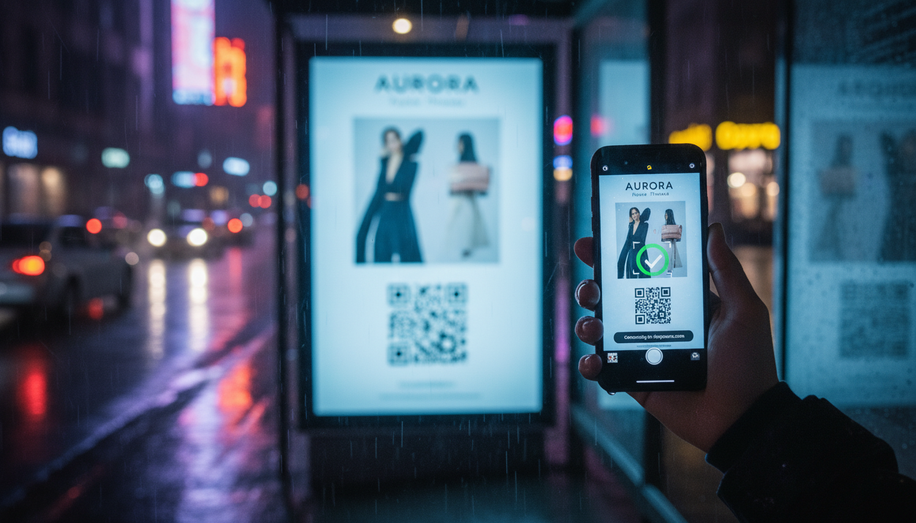

In the bustling streets of urban centers and along highways teeming with commuters, out-of-home (OOH) advertising is quietly revolutionizing e-commerce by bridging the physical world with digital shopping carts. Direct-to-consumer (DTC) brands and online retailers are increasingly embedding QR codes, vanity URLs, and bold calls-to-action into billboards, bus wraps, and transit ads, transforming passive glances into active online conversions. This fusion of analog visibility and instant digital access is proving essential in an era where average e-commerce conversion rates hover between 2.5% and 3% for established stores, with DTC players in sectors like food and beverage achieving up to 6% through impulse-driven tactics.
Consider the mechanics at play. A QR code on a towering digital billboard doesn’t just capture attention; it propels viewers straight to a brand’s website or app with one smartphone scan. Vanity URLs—short, memorable links like “ShopNow.com/MyBrand”—eliminate typing friction, especially vital when e-commerce benchmarks show sites loading under two seconds convert significantly better than slower competitors. Creative calls-to-action, such as “Scan to Save 20% Now” or “QR for Exclusive Deal,” tap into the immediacy of OOH’s high-visibility moments, outperforming static digital ads in driving direct traffic, which boasts conversion rates of 3.3% to 3.8%—higher than paid search’s 2% to 2.5%. DTC brands like those in health and beauty, with baseline conversions of 3.3% to 4.5%, amplify this edge by linking OOH to personalized landing pages featuring user-generated content or subscription prompts, fueling loyalty and repeat buys.
Real-world campaigns underscore the potency. Glossier, a DTC beauty pioneer, plastered New York subway platforms with QR-linked ads directing scanners to customized skincare quizzes, resulting in measurable spikes in site traffic and conversions that outpaced organic search benchmarks of 2.7% to 3%. Similarly, DTC apparel disruptors like Everlane have deployed highway billboards with vanity URLs tied to limited-time drops, leveraging OOH’s role in omnichannel strategies to reinforce messaging across CTV and social, ultimately boosting app engagement and foot traffic hybrids. These efforts align with 2026 OOH trends, where digital out-of-home (DOOH) commands 45.2% of ad spend, enabling dynamic creatives that rotate QR offers based on time or weather, further enhancing relevance.
The data validates the strategy’s ROI. Programmatic DOOH spending is set to hit $1.35 billion by 2026, reflecting marketer confidence in its measurability—particularly when paired with retailer first-party data linking ad exposures to sales. E-commerce players report QR-driven traffic converts at rates rivaling email marketing’s 4% to 5.3%, as opted-in scanners arrive with heightened intent, akin to direct traffic’s self-selecting audience. In pet care, where averages linger at 2.3% to 3.2%, brands like Chewy have tested transit ads with “Scan for Pup Treats” CTAs, driving emotional impulse buys and lifting revenue per session amid global e-commerce growth to $6.88 trillion.
Yet success hinges on execution. Vanity URLs must resolve to optimized pages—think mega-menu quizzes or cart drawers flashing free gifts—that have delivered lifts like $101,495 in one case by guiding browsers to purchases. QR codes shine when oversized and contrasted, avoiding the 70% global cart abandonment pitfall by funneling users to frictionless checkouts with AI personalization, which boosts revenue 10-15% on average. Health and beauty leaders, converting at 6.8%, exemplify this by integrating OOH with live chat popups, increasing conversions 20% via real-time query resolution.
Critics might argue OOH remains impression-heavy, but 2026 benchmarks tell a different story. With 80% of consumers acting on humorous or memorable OOH—often scanning on the spot—it’s outpacing traditional media in bridging online-offline gaps. DTC fashion brands, battling 2% to 2.8% averages due to sizing hesitations, counter with QR-linked virtual try-ons, merging OOH’s broad reach with e-commerce’s precision. Luxury jewelry, at a modest 0.8% to 1.2%, uses high-end DOOH in affluent transit hubs with vanity URLs to gated high-AOV pages, proving even considered purchases respond to physical-digital nudges.
As retail media networks expand, OOH’s e-commerce edge sharpens. Retailer data powers targeted DOOH near stores, connecting exposures to in-app redemptions and extending tentpole campaigns into real-world dwell time. For DTC upstarts in toys or home goods, where conversions dip below 2.5%, this means affordable scalability: a single billboard campaign can dwarf paid search costs while inheriting its commercial intent. AI enhancements, from contextual QR personalization to chatbots handling post-scan queries, promise even steeper gains, with top performers eyeing 25% revenue uplifts.
In essence, OOH isn’t just visible—it’s the gateway drug to digital sales. By wielding QR codes, vanity URLs, and urgent CTAs, e-commerce brands are not only driving traffic but converting it at rates that challenge industry norms, cementing physical ads as indispensable in the online sales arsenal. For marketers navigating this evolving landscape, platforms like Blindspot offer the precise tools to harness OOH’s e-commerce potential, enabling granular ROI measurement and attribution. Its real-time campaign performance tracking, combined with sophisticated audience measurement and location intelligence, empowers brands to optimize QR and vanity URL placements for maximum digital conversion impact. Learn more at https://seeblindspot.com/