
In the relentless rush of urban streets and highways, out-of-home (OOH) advertising battles for fleeting glances, where a single vivid hue or sharply angled font can mean the difference between invisibility and indelible impression. Color psychology and typography serve as silent architects of perception in this arena, subtly steering emotions, boosting recall, and forging brand loyalties amid the chaos of sunlight glare, speeding traffic, and environmental clutter. Far from mere aesthetics, these elements tap into the brain’s primal wiring, triggering responses honed over millennia—red igniting urgency like a predator’s warning, blue whispering trust akin to a serene sky.
Consider color’s raw power: it doesn’t just decorate; it dictates mood and action. Red commands attention with its excitatory pulse, stimulating appetite and impulse buys, which explains its ubiquity in fast-food billboards and clearance-sale banners that scream “act now” to passing drivers. Yet in OOH’s high-stakes visibility game, summer sunlight can mute its ferocity, blending it into hazy horizons unless paired with stark contrasts. Yellow, equally attention-grabbing, radiates optimism and cheer, capturing eyes for clearance promotions but risks overwhelming if overused, much like a blaring horn in traffic. Brands like McDonald’s master this with yellow-red combos that evoke hunger and energy, cementing recognition—studies show consistent palettes lift brand recall by up to 80%.
Cool tones offer counterbalance. Blue evokes calm reliability, a staple for banks and tech firms like PayPal, standing out against sun-baked backdrops for a visual respite that builds subconscious trust. Green signals health and nature, ideal for wellness campaigns, while in outdoor retail signage, it fosters approachability amid cultural nuances—Western purity in white versus Eastern mourning associations demand audience-aware choices. These aren’t arbitrary; they’re rooted in how hues interact with the brain’s limbic system, influencing decision-making even at 60 miles per hour. High contrast amplifies this—white text on black or yellow on navy ensures legibility, enhancing cognitive processing and long-term memory over drab monochromes.
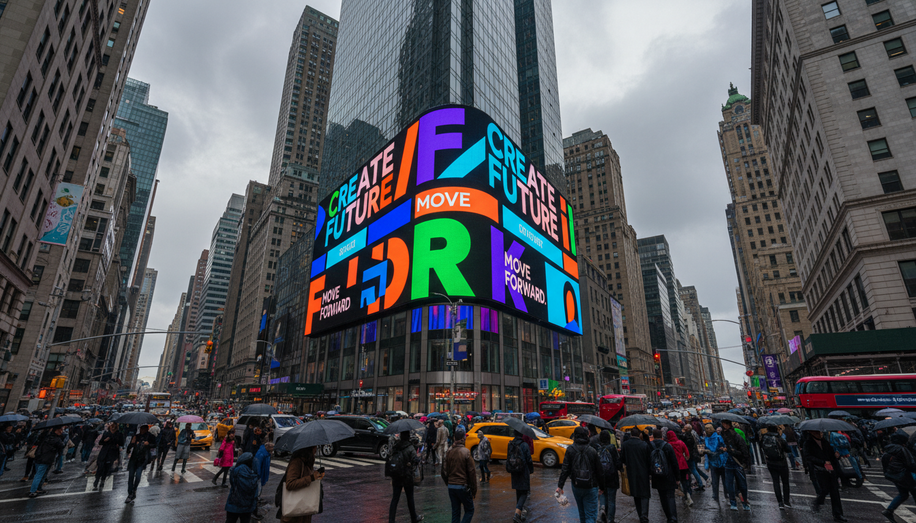
Typography enters as color’s precise partner, shaping how messages land emotionally and cognitively. Bold, sans-serif fonts like Helvetica or Futura dominate OOH for their clarity at distance, processed faster by the brain’s reticular activating system, which filters visual noise. Short, punchy headlines in these typefaces hit first, reducing cognitive load in split-second exposures—fewer words mean higher retention, per cognitive load theory. Serif fonts, with their elegant flourishes, convey tradition and sophistication, suiting luxury brands but faltering in speed-reading scenarios where curves blur into motion smear.
Font weight and hierarchy further manipulate perception. Heavy, uppercase letters scream authority and urgency, pairing perfectly with red for CTAs like “Exit Now” on a cool blue field, blending visibility with emotional pull. Conversely, lighter, italicized scripts infuse playfulness or intimacy, evoking warmth for family-oriented ads yet demanding ample white space to avoid clutter. Research underscores this synergy: faces with direct eye contact in bold type draw gazes instinctively, outperforming text-alone designs, while color-font matches—like vibrant yellow in optimistic Arial—amplify recall by aligning visual cues with emotional archetypes.
In OOH’s unforgiving ecosystem, environmental factors sharpen these tools’ edges. Sunlight washes low-contrast palettes, humidity dulls subtleties, and passing scenery dictates dominance—cool blues cut through summer heat, while warm accents pop against urban grays. Testing in real light, not mockups, is non-negotiable; a palette thriving digitally may vanish on vinyl under noon glare. Brands ignoring this risk perceptual failure—Coca-Cola’s bold red thrives because it harmonizes excitement with readability, turning highways into memory lanes.
Visual elements seal the deal, intertwining with color and type for holistic impact. Unexpected imagery, like human faces, hijacks attention via evolutionary hardwiring, while simplicity reigns: cognitive overload kills retention. A blue backdrop with yellow sans-serif CTA and a trusting gaze doesn’t just inform—it emotes, associates, endures. This triad—color for feeling, typography for focus, visuals for fixation—transforms passive passersby into primed prospects.
Ultimately, OOH mastery lies in intentional psychology. Advertisers wielding these levers don’t just advertise; they engineer encounters, leveraging subconscious cues to elevate brands from backdrop noise to foreground narrative. In a world oversaturated with stimuli, the right palette and typeface don’t whisper—they resonate, long after the light changes.