
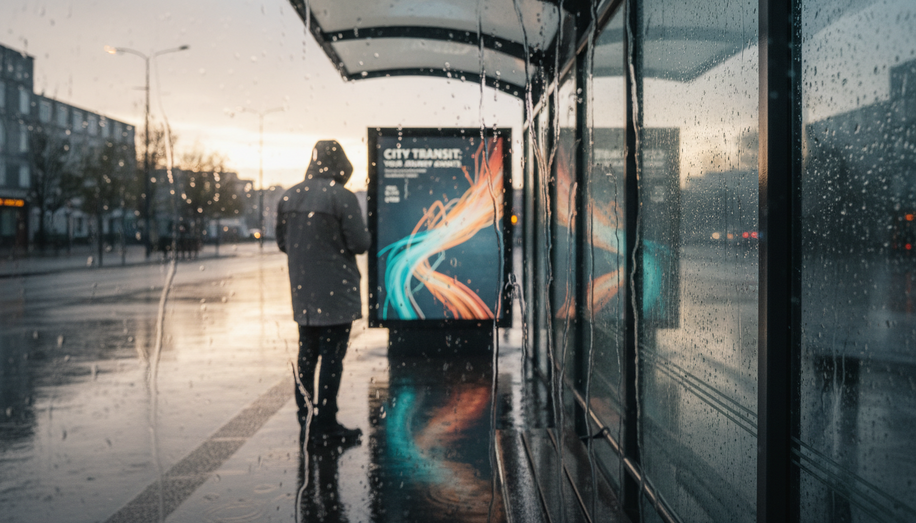

In the rhythm of urban life, the daily commute transforms into a vast, moving canvas for advertisers, where buses, subways, trains, and shelters capture the undivided attention of millions. Transit advertising, a powerhouse segment of the out-of-home (OOH) market, generated USD 3,962.9 million in revenue globally in 2025, with projections soaring to USD 6,523.4 million by 2033 at a 6.5% compound annual growth rate. This surge reflects not just economic momentum—particularly in Asia Pacific and high-growth markets like Germany—but a strategic pivot by brands seeking to pierce digital ad fatigue with unskippable, real-world impact.
Commuters represent a uniquely captive audience, strapped in or standing shoulder-to-shoulder during peak hours, their eyes naturally drawn to the surroundings. Over 1.2 million public transit trips occur daily in medium-to-large U.S. cities alone, and 71% of riders report glancing at transit ads frequently or almost always. Billboard ads in urban areas boast a 90% reach among this demographic, while 90% of Americans overall have noticed OOH advertising in the past month. Unlike television spots that viewers can mute or fast-forward amid the rise of ad-free streaming, transit ads command attention in high-traffic corridors, delivering mass exposure at a fraction of digital costs—CPMs as low as $2-5 compared to Facebook’s $12-25.
Buses offer perhaps the most dynamic opportunities, wrapping vehicles in full-color displays that traverse neighborhoods and highways, generating millions of impressions. A full bus wrap in a major city like New York can exceed $12,000, but side panels start at just a few hundred dollars monthly in smaller markets, making it accessible for local businesses. Digital bus wraps amplify this threefold, holding attention longer than static versions and boosting engagement when paired with QR codes for instant discounts. Real-world results underscore the payoff: a local coffee chain saw 15% foot traffic growth from bus and station ads near offices, while a tech launch spiked online searches and social mentions by 20%.
Subways and trains present intimate, prolonged encounters, where interior posters or digital screens exploit dwell times—often over 10 minutes for sectors like healthcare ads. Costs here vary wildly: a single interior poster runs $50-150, but a full station takeover in a bustling hub can top $100,000. Video OOH on transit achieves five times the engagement of static posters, and 3D digital out-of-home campaigns lift brand recall by 15% over 2D. Trains extend this reach along commuter rails, hitting suburban-to-urban flows with precision. Transit shelters, meanwhile, target waiting crowds at $4 average CPM in New York City, blending static and digital formats for quick-hit messaging that 60% of viewers tie to local shops.
Yet these opportunities come with hurdles. Weather can degrade static wraps on buses, while subway vandalism or overcrowding obscures views. High upfront costs for premium placements demand meticulous planning—audience research, route mapping, and timing for rush hours are non-negotiable. Measuring direct ROI remains tricky, as transit excels at top-of-funnel awareness rather than one-to-one attribution; still, 46% of consumers search a brand post-OOH exposure, and 26% visit websites immediately after. Automotive brands dominate spending here, but successes span categories, from Netflix’s buzz-building station takeovers to Mentos’ 62% unaided awareness lift via bus wraps.
Innovation is key to overcoming these challenges and maximizing engagement. Brands are layering interactivity: QR codes drive 2.5 times higher click-throughs via mobile retargeting, while augmented reality overlays on digital shelters turn passive glances into immersive experiences. Hybrid campaigns blend transit with digital, as 18% recall truck-side ads monthly and taxi-tops yield 4 million NYC impressions. Programmatic buying streamlines access to inventory, and data analytics pinpoint high-dwell routes.
For advertisers, the commute canvas demands bold creativity—short, punchy copy; high-contrast visuals; and culturally resonant themes that resonate amid the daily grind. A fintech app might target business-hub trains with seamless payment hooks, while a restaurant wraps buses along dining corridors. The result? Credibility from physical presence, geo-targeted precision, and ROI that outpaces declining TV amid OOH’s record $9.1 billion U.S. haul in 2024.
As urban mobility evolves—with projections for a $9.89 billion OOH boom in 2026—transit advertising stands resilient, turning routine journeys into revenue engines. By navigating its logistical quirks with data-driven flair, brands not only reach commuters but embed themselves in the pulse of city life, proving that in an ad-saturated world, the most effective messages are the ones you can’t scroll away from.