
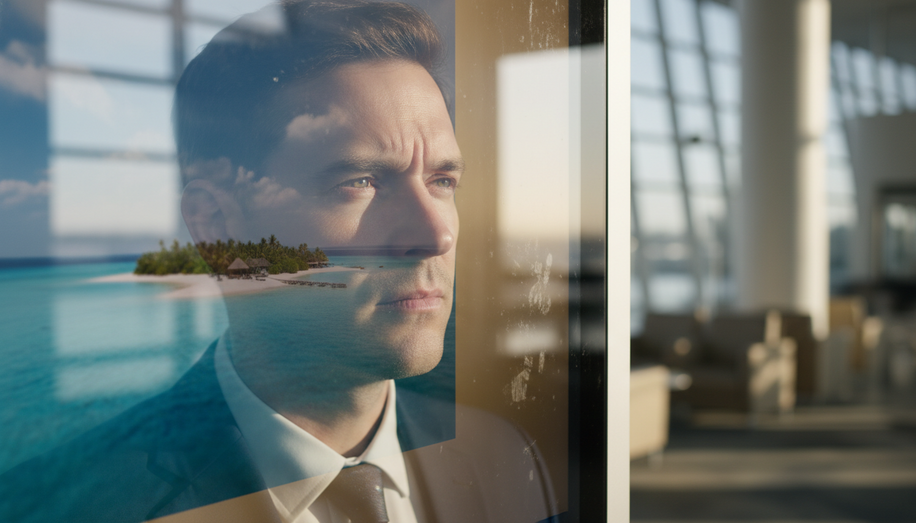

In the bustling limbo of airport terminals, travelers shed their everyday selves, entering a psychological no-man’s-land where normal rules dissolve. This liminal space—characterized by disorientation, heightened anxiety, and temporal displacement—transforms passengers into a uniquely receptive audience for out-of-home (OOH) advertising. With 81 percent of air travelers now reporting at least some stress from flying, up dramatically from pre-9/11 levels, brands have a prime opportunity to connect through targeted campaigns that address these vulnerabilities while capitalizing on moments of boredom and impulse. Airports draw affluent, diverse crowds—business executives, vacationers, and global nomads—who linger for hours, their guards down and wallets open.
Psychologically, airports trigger a cocktail of stressors that alter behavior in predictable ways. Environmental psychology highlights how crowds, noise, and recycled air overload sensory processing, fostering irritability and a mild state of dissociation. Travelers fixate on the future—their destination’s promise or a delayed flight’s frustration—creating a “zone of absence” where the present feels hazy and inhibitions loosen. National identities blur in international zones, social hierarchies flatten (a CEO might nap beside a backpacker), and time warps, with breakfast eaten at dinner hour across time zones. This disorientation, amplified by anxiety over security, connections, or flying itself, makes passengers bored yet hyper-aware, prone to escapism through shopping or spontaneous chats with strangers. Alcohol at airport bars further erodes boundaries, turning tense waits into hedonistic preludes to vacation mode.
Airport designers exploit this mindset deliberately, using “wayfinding” cues like shifting colors, carpet patterns, and landmark art to guide without overt control, all while fostering an illusion of choice—multiple seat types near gates, arranged to avoid backs-to-walkways for evolutionary comfort. Travelers feel adrift yet captive, their usual routines stripped away, making them susceptible to “terminal thinking”: the notion that normal spending rules don’t apply in this transitional realm. Duty-free splurges on luxury perfumes or gadgets spike, as anxiety meets vacation anticipation, proving passengers 20-30 percent more likely to make impulse buys than in everyday retail.
Brands can harness these dynamics across diverse airport media formats, from digital screens to wrapped pillars and floor projections, tailoring messages to psychological sweet spots. High-impact digital video walls at security chokepoints or gates target stress peaks, offering aspirational escapes: a luxury watch brand might show serene destination vistas with taglines like “Reclaim your time,” syncing with travelers’ future fixation and anxiety over delays. Static posters on baggage claim carousels or lavatory doors exploit dwell time—those bored, captive minutes—deploying humor to cut through irritability, such as a coffee chain quipping, “Jet lag? We’ve got your wake-up call,” resonating with temporal confusion.
For affluent audiences, premium placements like branded lounges or VIP walkway wraps emphasize exclusivity and status recovery. A high-end skincare line could use interactive touchscreens in business-class areas, letting executives customize routines amid identity dissolution, reinforcing “You’re still you—elevated.” Diverse demographics demand cultural nuance: multicultural digital networks in international hubs rotate messaging in multiple languages, featuring inclusive narratives—a family adventure for leisure travelers, efficiency hacks for business flyers—to foster pro-social openness observed in these spaces. Floor graphics near food courts, visible during aimless pacing, drive foot traffic with scarcity cues like “Limited-time airport exclusive,” tapping impulse and the illusion of autonomy.
Messaging strategies must be concise, emotionally resonant, and visually dominant to pierce the chaos. Bold, high-contrast visuals counter harsh lighting and peripheral glances, while short loops (15-30 seconds) match fragmented attention spans. Leverage psychogeography by placing premium alcohol ads near bars, where liquid courage flows, or wellness promotions post-security to soothe post-screening tension. Data from OOH analytics shows airport campaigns yield 40 percent higher recall than urban billboards, thanks to repeated exposure during waits—up to three hours for international flights. Post-pandemic, with travel rebounding, brands like Chanel and Rolex have seen uplift in conversions by aligning with “hedonistic flourish” mindsets, blending escapism with subtle urgency.
To maximize ROI, integrate formats seamlessly: a campaign starting with pillar wraps at check-in builds awareness, escalates via gate screens for consideration, and closes with lavatory reinforcements for purchase intent. A/B testing reveals emotional appeals outperform rational ones; fear-of-missing-out on deals exploits frustration, while empowerment narratives counter anxiety. Sustainability messaging, like eco-friendly travel gear on baggage screens, appeals to the guilt-free indulgence of liminal spending.
Ultimately, the airport’s weird psychology—stress, boredom, and blurred boundaries—positions it as the ultimate OOH gateway. Brands that decode this transit trance craft campaigns not just seen, but felt, turning delayed frustrations into loyal connections. In a world of fleeting attention, these captive moments offer unparalleled precision for reaching the global elite on the move.
Effectively decoding the airport’s complex psychology demands precise data and dynamic campaign optimization. Blindspot’s advanced **location intelligence** and **audience measurement** capabilities empower brands to strategically place and tailor OOH messages to specific psychological sweet spots and demographics within airport terminals, ensuring peak emotional resonance and engagement. Furthermore, **real-time campaign performance tracking** and **ROI measurement** provide the critical insights needed to continuously refine strategies and maximize conversions in this unique, captive environment. Learn more: https://seeblindspot.com/