
In the split-second world of out-of-home (OOH) advertising, where drivers glance at billboards from 300 meters away or pedestrians dart past digital screens amid urban bustle, typography serves as the silent architect of comprehension and recall. Far from mere decoration, choices in font, size, kerning, and color contrast determine whether a message lands with clarity or dissolves into the blur of motion, shaping not just readability but brand identity and lingering memory.
Consider font selection first, the foundational decision that can make or break an ad’s impact. Sans-serif typefaces dominate recommendations for OOH because their clean, stroke-free lines cut through distance and speed with minimal cognitive strain. Helvetica, Arial, Verdana, and Open Sans top the list, with Arial claiming 28 percent usage in digital signage headlines for its unyielding legibility. These fonts eschew the flourishes of serifs or the whimsy of scripts, which demand extra processing time—fatal in environments where viewers have mere seconds. Script or heavily stylized fonts, while artistically tempting, turn illegible at high speeds, forcing eyes to labor and minds to abandon the message. Yet typography’s power extends beyond utility: fonts evoke emotion and brand essence. A bold sans-serif signals confidence and modernity, while avoiding Comic Sans steers clear of childish connotations that undermine seriousness. Designers who pair such choices with brand aesthetics, as in campaigns reviving 1980s nostalgia through vintage styles, forge emotional bonds that boost retention and perception.
Font size amplifies this foundation, with industry consensus unanimous: bigger is unequivocally better. Large type not only extends readability range but compels longer engagement as viewers approach, turning passive passersby into active absorbers. For static billboards, experts advocate limiting messages to 10 words or fewer in oversized fonts, a constraint that paradoxically heightens impact by prioritizing brevity over verbosity. Digital out-of-home (DOOH) follows suit, where screens demand fonts scaled to dominate the frame, minimizing text to under 250 characters for snappy delivery. This scalability ensures messages pierce the veil of motion, whether from a highway or sidewalk, while accommodating diverse formats from prints to LEDs.
Kerning—the precise spacing between letters—emerges as typography’s unsung fine-tuner, often overlooked yet pivotal in fast-paced OOH. Poorly kerned bold fonts create optical illusions of crowding, rendering words as indecipherable blobs amid vehicular velocity. Even spacing maintains rhythm, guiding the eye fluidly across lines without the distraction of stretched “F A R O U T” gaps or suffocating clusters. Alignment compounds this: centered or justified text with consistent kerning ensures even flow, preventing visual chaos that erodes trust in the brand. When executed well, these subtleties elevate ordinary ads into memorable spectacles, as seen in innovative designs that bend conventions without sacrificing scanability.
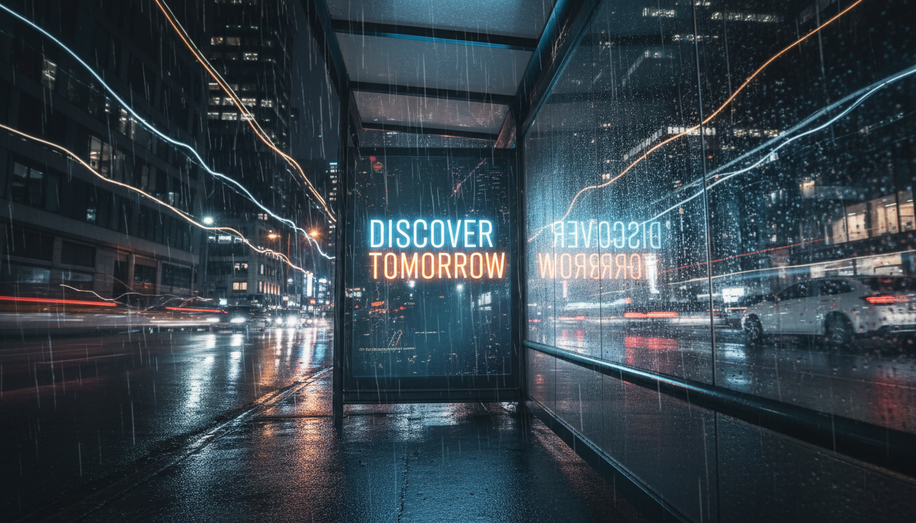
Color contrast seals the triad, transforming legible type into unforgettable beacons. High-contrast pairings—light text on dark grounds or vice versa—make letters pop against backgrounds, countering glare, distance, and peripheral vision limits. Black on red or green on blue fails spectacularly, blending into obscurity, while bold contrasts like white on navy demand attention instinctively. This principle intersects with font weight: thick, even-thickness letters in high-contrast hues withstand environmental noise, from sunlight to nightfall. Limiting to three fonts per DOOH slide, with headlines bolder and larger than body text, further enforces hierarchy, directing gaze from punchy call-to-action to subtle details.
These elements collectively craft not just readable ads but perceptual powerhouses. Typography influences brand recall by embedding emotional cues—sleek modern fonts for innovation, robust ones for reliability—while poor choices breed dismissal or negative associations, especially for accessibility needs like dyslexia. In 2025 trends, bold, thick fonts paired with minimalist messaging under seven words continue to rule, proving simplicity trumps complexity in OOH’s unforgiving arena. Campaigns ignoring this, cramming thin scripts or low-contrast palettes, squander budgets on unseen efforts.
Ultimately, masterful typography in OOH transcends aesthetics, wielding psychological precision to halt scrolling eyes and imprint messages. As highways hum and streets surge, the right font, scaled massively with impeccable kerning and stark contrast, ensures brands don’t just advertise—they imprint.