
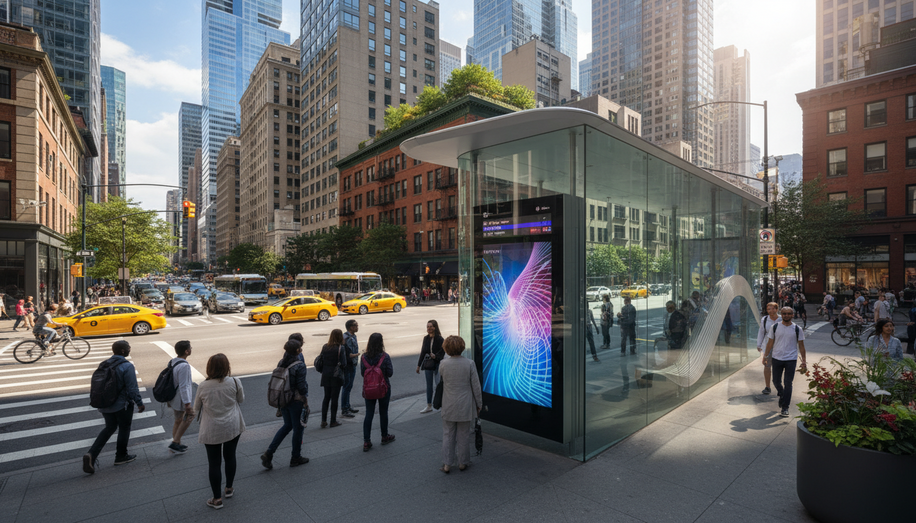

In the evolving landscape of out-of-home advertising, traditional billboards are giving way to more intimate, contextually rich formats that weave brands into the fabric of daily urban life. Street furniture like bus shelters and kiosks, alongside murals and pop-up activations, offers advertisers unprecedented opportunities to engage pedestrians and commuters not just with visibility, but with memorable interactions. These elements transform passive glances into active encounters, capitalizing on high-traffic zones where people linger, fostering deeper brand connections amid the bustle of city streets.
Bus shelters stand out as prime canvases for this shift, leveraging what experts call “guaranteed dwell time”—the minutes commuters spend waiting, ripe for immersion. No longer mere panels for static posters, these structures now host interactive installations that blend technology with creativity. Touchscreens invite users to browse products or play games, while motion sensors trigger dynamic responses, such as lights or animations that react to passersby. Augmented reality overlays transport waiters into branded worlds, simulating virtual fitting rooms or immersive stories, turning a routine pause into entertainment. In 2024, this trend accelerated globally, with brands elevating shelters from transit media to premium experiential hubs, complete with gamification that rewards participation via coupons or social shares.
JCDecaux, a leader in street furniture, exemplifies this through custom activations that complement traditional displays with can’t-miss installations, driving engagement in high-footfall areas. OUTFRONT Media emphasizes their curbside positioning along main roadways, capturing attention from both pedestrians and drivers in desirable neighborhoods, often paired with billboards for amplified awareness. Vector Media’s partnership in Los Angeles reimagines over 3,600 shelters, including 1,400 digital displays rolling out in dynamic spots, proving the format’s scalability. These evolutions yield measurable wins: higher engagement than static ads, stronger recall through involvement, and social amplification from user-generated content.
Kiosks extend this intimacy further, functioning as multifunctional nodes in urban flow—information hubs, charging stations, or digital signage that deliver real-time utility laced with subtle messaging. BoldVu’s rugged outdoor LCDs power these, enabling high-impact digital out-of-home displays tailored for media owners targeting specific audiences. Unlike towering billboards, kiosks invite touch and linger, shifting consumers from observers to participants, much like utility-based shelter interactions offering weather updates or news alongside brand narratives.
Murals take OOH into the realm of urban art, merging advertising with cultural expression to create seamless environmental blends. These large-scale wall paintings or street-level graphics don’t scream for attention; they become part of the city’s aesthetic, sparking organic conversations and photo shares. Brands commissioning murals from local artists foster authenticity, turning advertising into public art that resonates with communities. This format thrives in high-visibility alleys or building facades, where pedestrians encounter them repeatedly, building familiarity without intrusion. The key lies in synergy: murals often pair with street furniture for multi-layered campaigns, enhancing narrative depth.
Pop-up activations push boundaries most boldly, converting street furniture into temporary wonderlands. Lego’s Boston campaign turned bus shelters into AR-enabled playgrounds for International World Play Day, letting kids summon toys via augmented screens while stacking blocks—a perfect fusion of play and promotion reaching urban families. NPARALLEL’s motion-triggered lighting and simulated real-world displays at shelters create surprise, while food brands tease products roadside before digital follow-ups, spiking conversions through integrated channels. Alluvit Media highlights benches alongside shelters as versatile street furniture, ideal for pop-ups that offer seating with branded twists, like interactive games or photo booths, driving growth in pedestrian-heavy zones.
What unites these formats is their chameleon-like adaptation to urban rhythms, prioritizing relevance over reach. Bus shelters and kiosks exploit dwell time in transit corridors; murals and pop-ups inject spontaneity into pedestrian paths. Data underscores the payoff: interactive elements boost message absorption and metrics tracking, from dwell analytics to social shares, making OOH more accountable. In cluttered cities, where attention fragments, these integrations prove advertising’s future lies in enhancement, not disruption—blending utility, art, and experience to make brands feel like natural extensions of the streetscape.
As urban populations swell and tech advances, expect more hybrid innovations: digital kiosks with AR murals, or shelter pop-ups synced to live events. MyHoardings notes how 2024’s momentum positions interactive shelters as staples in experiential strategies, far beyond basic media. For advertisers, the lesson is clear: in the battle for eyes and minds, street furniture, urban art, and activations win by meeting people where they pause, play, and ponder—redefining OOH as a living, breathing dialogue with the city.