
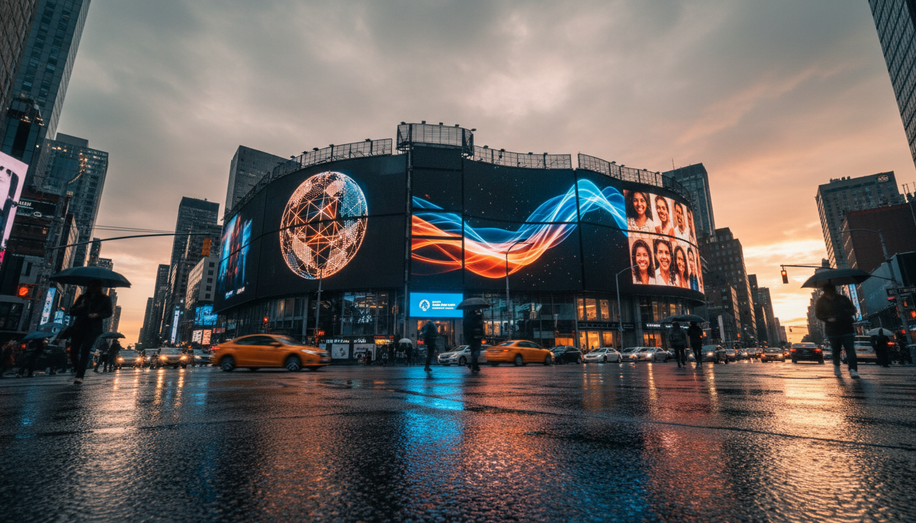

In the crowded arena of modern marketing, where digital channels dominate discussions of performance, out-of-home (OOH) advertising has quietly reclaimed its place as a full-funnel powerhouse, propelling consumers from initial awareness to loyal advocacy. Once dismissed as a top-of-funnel relic suited only for broad visibility, OOH—encompassing billboards, digital screens, transit ads, and street furniture—now delivers measurable impact at every stage, blending massive reach with precise, action-oriented tactics. A recent study comparing media formats found OOH outperforming rivals in awareness while matching social media in consideration and conversion, with lower CPMs amplifying its efficiency.
At the awareness stage, OOH excels by cutting through digital noise with unskippable, real-world presence. A 2022 OAAA and Morning Consult survey revealed that 88% of adults noticed digital OOH (DOOH) ads in the prior 60 days, with 78% taking action like website visits or purchases. This scale builds trust rapidly: 48% of brands using OOH for awareness reported 24% higher brand trust and over 100% improved consumer confidence. Unlike online ads prone to fatigue, OOH benefits from frequency; Kochava research shows it boosts conversion rates with repeated exposures, especially in high-traffic DOOH spots. A five-year Clear Channel Outdoor and Kantar study further confirmed OOH’s edge, driving higher ad awareness and brand favorability than other media, while filling gaps left by CTV and digital.
Transitioning to consideration, OOH sustains momentum by embedding brands in the consumer’s mental shortlist. Its superior recall—highest among TV, podcasts, radio, print, and online per a 2023 OAAA and Solomon Partners study—ensures familiarity translates to preference. Persuasive messaging highlights unique selling points, while strategic placements near points of interest (POIs) add contextual relevance. Brands leverage DOOH for dynamic content, such as QR codes linking to product details in high-traffic areas, keeping OOH relevant amid evaluation. Analytic Partners analysis underscores this: combining street, rail, office, and retail OOH formats yields over 30% greater returns for brand campaigns, proving multi-format strategies deepen consideration without redundancy.
The decision phase reveals OOH’s conversion prowess, often serving as the final nudge. Proximity to retail drives immediacy—59% of shoppers are likely to buy after seeing OOH within 30 minutes of store entry, per Global’s Work.Shop.Play study, with 54% of in-store visits attributed to prior exposure. Near-store ads capture 71% of shoppers’ attention, spurring 33% higher purchase likelihood among main shoppers. OUTFRONT case studies illustrate this bridge: OOH links offline impressions to online actions, turning visibility into transactions. When paired with retail media, OOH blur lines for seamless shopper strategies, priming awareness that converts at the point of sale. Frequency here pays off uniquely; unlike digital’s diminishing returns, OOH’s repeated views enhance performance.
Beyond purchase, OOH fosters retention and loyalty, extending its influence into long-term advocacy. In-store DOOH with discount QR codes encourages repeat visits, while broad campaigns acquire new customers when integrated with video. OOH’s omnichannel synergy shines: added to digital spend, it lifts returns by 39%; with TV, 18%; and all three together, 27%. Campaigns blending in-store and external OOH double ROI compared to in-store alone, delivering up to 29% sales uplift across the journey. This full-funnel versatility positions OOH as indispensable, especially as DOOH evolves into immersive storytelling with trackable outcomes.
Marketers once fixated on performance metrics overlooked OOH’s role in fueling them, but data now demands reintegration. In an era of ad-free streaming and digital saturation, OOH’s physicality commands attention, nurtures paths to purchase, and measures success through lifts in visits, sales, and loyalty. Its cost-effectiveness—matching TV impact at lower expense—makes it a strategic anchor. As consumer journeys blur online and offline, OOH doesn’t just participate; it orchestrates the progression from awareness to action, proving that in modern marketing, the most effective paths often lead outdoors.